



 Chat with AI
Exam 12: The Mucosal Immune System

Exam 1: Basic Concepts in Immunology44 Questions
Exam 2: Innate Immunity: the First Lines of Defense32 Questions
Exam 3: The Induced Responses of Innate Immunity39 Questions
Exam 4: Antigen Recognition by B-Cell and T-Cell Receptors28 Questions
Exam 5: The Generation of Lymphocyte Antigen Receptors33 Questions
Exam 6: Antigen Presentation to T Lymphocytes30 Questions
Exam 7: Lymphocyte Receptor Signaling42 Questions
Exam 8: Development and Survival of Lymphocytes37 Questions
Exam 9: T-Cell-Mediated Immunity37 Questions
Exam 10: The Humoral Immune Response30 Questions
Exam 11: Integrated Dynamics of Innate and Adaptive Immunity28 Questions
Exam 12: The Mucosal Immune System27 Questions
Exam 13: Failures of Host Defense Mechanisms43 Questions
Exam 14: Allergy and Allergic Diseases26 Questions
Exam 15: Autoimmunity and Transplantation31 Questions
Exam 16: Manipulation of the Immune Response34 Questions
Select questions type


Like wild-type (WT) mice, Rag-deficient mice have large numbers of commensal microbes in their gastrointestinal (GI) tract that remain contained in restricted to anatomical locations associated with the GI tract. However, when Rag-deficient mice are treated with a depleting antibody that eliminates all lymphocytes from the animals, these mice suffer from dissemination of commensal bacteria to peripheral organs, such as spleen and liver, and show evidence of systemic inflammation as shown by cytokine levels in the serum. ND, not detected; D3, day 3 post-antibody injection; D14, day 14 post-antibody injection. 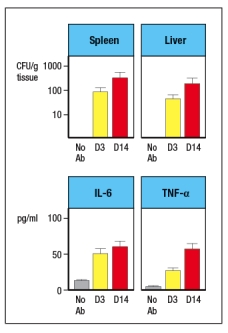 a) What are the cells in Rag-deficient mice, that, when depleted by the antibody injection, cause bacterial dissemination and systemic inflammation?
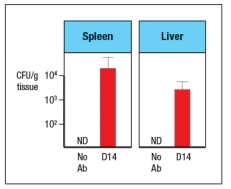
In a follow-up study, the Rag-deficient mice were treated with a blocking antibody to neutralize a cytokine (cytokine Z) known to be produced by lymphocytes. On day 14 post-antibody injection, the spleen and liver of the mice were analyzed for numbers of bacteria, and the results are shown in Figure :
 b) What is the likely identity of cytokine Z?
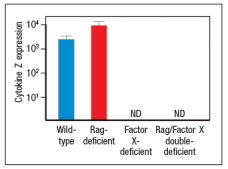
In a second follow-up study, Rag-deficient mice were crossed to a knockout for a transcription factor (Factor X) also known to be expressed in some lymphocytes. Lamina propria lymphocytes were isolated from wild-type mice, Rag-deficient mice, Factor-X-deficient mice, and double Rag/Factor-X deficient mice, and mRNA was prepared from the cells. RT-PCR was then used to determine the mRNA transcript levels for cytokine Z in all four lymphocyte populations, and the results are shown in Figure.
 c) What is the likely identity of Factor X?
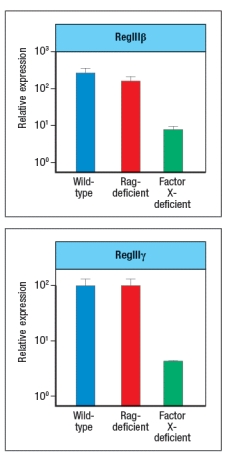
In a final experiment, the entire small intestine of wild-type mice, Rag-deficient mice, or Factor X-deficient mice is isolated and processed for mRNA, which is then used in RT-PCR experiments. Expression levels of mRNA encoding RegIII and RegIII are assessed in these samples; the results are shown in Figure.
 d) What do these data indicate about the regulation of RegIII and RegIII expression? Which cells are expressing RegIII and RegIII ?
a) What are the cells in Rag-deficient mice, that, when depleted by the antibody injection, cause bacterial dissemination and systemic inflammation?
In a follow-up study, the Rag-deficient mice were treated with a blocking antibody to neutralize a cytokine (cytokine Z) known to be produced by lymphocytes. On day 14 post-antibody injection, the spleen and liver of the mice were analyzed for numbers of bacteria, and the results are shown in Figure :
b) What is the likely identity of cytokine Z?
In a second follow-up study, Rag-deficient mice were crossed to a knockout for a transcription factor (Factor X) also known to be expressed in some lymphocytes. Lamina propria lymphocytes were isolated from wild-type mice, Rag-deficient mice, Factor-X-deficient mice, and double Rag/Factor-X deficient mice, and mRNA was prepared from the cells. RT-PCR was then used to determine the mRNA transcript levels for cytokine Z in all four lymphocyte populations, and the results are shown in Figure.
c) What is the likely identity of Factor X?
In a final experiment, the entire small intestine of wild-type mice, Rag-deficient mice, or Factor X-deficient mice is isolated and processed for mRNA, which is then used in RT-PCR experiments. Expression levels of mRNA encoding RegIII and RegIII are assessed in these samples; the results are shown in Figure.
d) What do these data indicate about the regulation of RegIII and RegIII expression? Which cells are expressing RegIII and RegIII ? (Essay)
4.8/5  (92)
(92) The Fc receptor FcRn, expressed in intestinal epithelial cells, binds to the Fc portion of IgG antibodies. Moreover, FcRn binds to IgG with high affinity at an acidic pH (<6.5) but not at physiological pH (pH 7.4). How is this biochemical feature of FcRn critical for its role in antigen presentations for gut immunity?
(Essay)
4.9/5 (97)
(97) The mucosal immune system provides protection for a vast area of the body and contains three-quarters of all the lymphocytes in the body. A key feature of the mucosal immune system is its:
(Multiple Choice)
4.8/5 (61)
(61) Recurrent infections with the enteric pathogen Clostridium difficile is a major cause of chronic antibiotic-associated diarrhea, and causes >10,000 deaths per year in the US. An increasing number of individuals with this disorder are choosing to be treated with a fecal transplant from a healthy individual. Why is this treatment effective?
(Essay)
4.8/5 (88)
(88) When mice are born, their intestinal lamina propria lacks TH17 effector cells. These cells develop after birth due to:
(Multiple Choice)
4.8/5 (63)
(63) In addition to Peyer's patches that resemble systemic lymph nodes, the intestinal epithelium also contains several thousand isolated lymphoid follicles. Unlike the organized secondary lymphoid tissues in the mucosal immune system, these lymphoid follicles:
(Multiple Choice)
4.7/5 (84)
(84) Salmonella typhimurium is the causative agent of typhoid fever, and infects the host by translocating across the intestinal epithelium. Recent studies have shown that S. typhimurium produces an effector protein called SopB that induces intestinal enterocytes to differentiate into M cells. This is beneficial to the bacteria because:
(Multiple Choice)
4.7/5 (85)
(85) 
Filters
- Essay(0)
- Multiple Choice(0)
- Short Answer(0)
- True False(0)
- Matching(0)