Exam 13: Vector Calculus

arrow
  • Select Tags
search iconSearch Question
  • Select Tags

Find the value of the gradient vector field of the function f(x,y,z)=x2y3zf ( x , y , z ) = x ^ { 2 } y ^ { 3 } z at the point (1,1,−1)( 1,1 , - 1 ) .

(Multiple Choice)
4.8/5
(82)

Evaluate ∫CFdr\int _ { C } \mathbf { F } d \mathbf { r } where F(x,y)=(ex2−y3,cos⁡y2+x3)\mathbf { F } ( x , y ) = \left( e ^ { x ^ { 2 } } - y ^ { 3 } , \cos y ^ { 2 } + x ^ { 3 } \right) and the curve C is given by C : x=2sin⁡t,y=2cos⁡t,0≤t≤2πx = 2 \sin t , y = 2 \cos t , 0 \leq t \leq 2 \pi .

(Multiple Choice)
4.8/5
(81)

Use Green's Theorem to find the area of the region bounded by one arch of the cycloid x=t−sin⁡t,y=1−cos⁡tx = t - \sin t , y = 1 - \cos t , and the x-axis.

(Essay)
4.9/5
(88)

According to Green's Theorem, the line integral ∫Cx2dx+y2dy\int _ { C } x ^ { 2 } d x + y ^ { 2 } d y over a positively oriented, piecewise-smooth, simple closed curve C is equal to the double integral ∬Df(x,y)dA\iint _ { D } f ( x , y ) d A over the region D bounded by C. Find the function f(x,y)f ( x , y ) .

(Multiple Choice)
4.9/5
(86)

Find a formula for the vector field graphed below. (There are many possible answers.) Find a formula for the vector field graphed below. (There are many possible answers.)
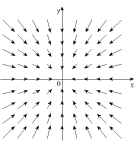
(Essay)
4.8/5
(93)

Find the gradient vector field of the function f(x;y)=x+y2f ( x ; y ) = x + y ^ { 2 }

(Multiple Choice)
5.0/5
(69)

Let f(x,y,z)=x2+y2+z2f ( x , y , z ) = x ^ { 2 } + y ^ { 2 } + z ^ { 2 } , find ∇⋅(∇f)\nabla \cdot ( \nabla f ) at the point (1,0,1)( 1,0,1 ) .

(Multiple Choice)
4.7/5
(97)

Let F(x,y,z)=3xyi+y2j−x2y4k\mathbf { F } ( x , y , z ) = 3 x y \mathbf { i } + y ^ { 2 } \mathbf { j } - x ^ { 2 } y ^ { 4 } \mathbf { k } and let S be the surface of the tetrahedron with vertices (0,0,0),(1,0,0),(0,1,0)( 0,0,0 ) , ( 1,0,0 ) , ( 0,1,0 ) , and (0,0,1)( 0,0,1 ) . Evaluate the surface integral ∬SF⋅dS\iint _ { S } \mathbf { F } \cdot d \mathbf { S } .

(Short Answer)
5.0/5
(67)

Evaluate ∫CFdr\int _ { C } \mathbf { F } d \mathbf { r } where F(x,y,z)=⟨zx−y,zy−x,ln⁡(x−y)⟩\mathbf { F } ( x , y , z ) = \left\langle \frac { z } { x - y } , \frac { z } { y - x } , \ln ( x - y ) \right\rangle and C is the circle (x+2)2+(y+3)2=1( x + 2 ) ^ { 2 } + ( y + 3 ) ^ { 2 } = 1 in the clockwise direction.

(Multiple Choice)
4.9/5
(68)

Find the flux of F(x,y,z)=(x3)i+(y3+1x+3)j+(z2+x(y+3)2)k\mathbf { F } ( x , y , z ) = \left( x ^ { 3 } \right) \mathbf { i } + \left( y ^ { 3 } + \frac { 1 } { x + 3 } \right) \mathbf { j } + \left( z ^ { 2 } + \frac { x } { ( y + 3 ) ^ { 2 } } \right) \mathbf { k } across the surface of the solid bounded by x2+z2=9x ^ { 2 } + z ^ { 2 } = 9 , and the planes y=0,y=2y = 0 , y = 2 .

(Short Answer)
4.8/5
(77)

Let F(x,y,z)=sin⁡(y2+z2)i+cos⁡(x2+z2)j+ez2+y2k\mathbf { F } ( x , y , z ) = \sin \left( y ^ { 2 } + z ^ { 2 } \right) \mathbf { i } + \cos \left( x ^ { 2 } + z ^ { 2 } \right) \mathbf { j } + e ^ { z ^ { 2 } + y ^ { 2 } } \mathbf { k } and let S be the boundary surface of the solid E={(x,y,z)∣x2+y2+z2≤1}E = \left\{ ( x , y , z ) \mid x ^ { 2 } + y ^ { 2 } + z ^ { 2 } \leq 1 \right\} . Evaluate the surface integral ∬SF⋅dS\iint _ { S } \mathbf { F } \cdot d \mathbf { S } .

(Multiple Choice)
4.8/5
(64)

Evaluate ∫CFdr\int _ { C } \mathbf { F } d \mathbf { r } where F(x,y,z)=⟨zx−z,zy−z,ln⁡(x−y)⟩\mathbf { F } ( x , y , z ) = \left\langle \frac { z } { x - z } , \frac { z } { y - z } , \ln ( x - y ) \right\rangle and C is any curve from (2,1,−5)( 2,1 , - 5 ) to (e2,0,2)\left( e ^ { 2 } , 0,2 \right) .

(Multiple Choice)
4.8/5
(93)

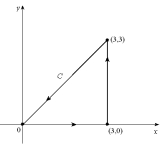
Evaluate the line integral ∫cxdy\int _ { c } x d y , where the curve CC is given in the figure below.  Evaluate the line integral  \int _ { c } x d y  , where the curve  C  is given in the figure below.

(Short Answer)
4.9/5
(82)

Find (a) the curl and (b) the divergence of the vector field F(x,y,z)=sin⁡xi+cos⁡xj+z2k\mathbf { F } ( x , y , z ) = \sin x \mathbf { i } + \cos x \mathbf { j } + z ^ { 2 } \mathbf { k } .

(Essay)
4.8/5
(87)

Evaluate the surface integral ∬SxdS\iint _ { S } x d S , where S is that part of the plane z=xz = x that lies above the square with vertices (0,0),(1,0),(0,1)( 0,0 ) , ( 1,0 ) , ( 0,1 ) , and (1,1)( 1,1 ) .

(Multiple Choice)
4.9/5
(87)

Find the flux of F(x,y,z)=x3i+2xz2j+3y2zk\mathbf { F } ( x , y , z ) = x ^ { 3 } \mathbf { i } + 2 x z ^ { 2 } \mathbf { j } + 3 y ^ { 2 } z \mathbf { k } across the surface of the solid bounded by the paraboloid z=4−x2−y2z = 4 - x ^ { 2 } - y ^ { 2 } and the xy−x y - plane.

(Short Answer)
4.8/5
(86)

Find the flux of the vector field F(x,y,z)=xi+yj+k\mathbf { F } ( x , y , z ) = x \mathbf { i } + y \mathbf { j } + \mathbf { k } across the paraboloid given by x=ucos⁡v,y=usin⁡v,z=1−u2x = u \cos v , y = u \sin v , z = 1 - u ^ { 2 } with 1≤u≤2,0≤v≤2π1 \leq u \leq 2,0 \leq v \leq 2 \pi and upward orientation:

(Short Answer)
4.8/5
(67)

Use Green's Theorem to evaluate the line integral along the given positively oriented curve: ∫C2xydx+x2dy\int _ { C } 2 x y d x + x ^ { 2 } d y , where C is the cardioid r=1+cos⁡r = 1 + \cos .

(Short Answer)
4.8/5
(78)

Evaluate the line integral ∫Cxy1+xdx−ln⁡(1+x)dy\int _ { C } \frac { x y } { 1 + x } d x - \ln ( 1 + x ) d y , where C is the triangular path consisting of the line segment from (0,0)( 0,0 ) to (4,0)( 4,0 ) , followed by the line segment from (4,0)( 4,0 ) to (0,2)( 0,2 ) , followed by the line segment from (0,2)( 0,2 ) to (0,0)( 0,0 ) .

(Short Answer)
4.9/5
(75)

Evaluate the surface integral ∬S(x+y+z)dS\iint _ { S } ( x + y + z ) d S , where S is that part of the plane z=xz = x that lies above the square with vertices (0,0),(1,0),(0,1)( 0,0 ) , ( 1,0 ) , ( 0,1 ) , and (1,1)( 1,1 ) .

(Multiple Choice)
4.9/5
(82)
Showing 221 - 240 of 240
close modal

Filters

  • Essay(0)
  • Multiple Choice(0)
  • Short Answer(0)
  • True False(0)
  • Matching(0)