



 Chat with AI
Exam 4: Applications of the Derivative

Exam 1: Preliminaries101 Questions
Exam 2: Limits and Continuity105 Questions
Exam 3: Differentiation116 Questions
Exam 4: Applications of the Derivative118 Questions
Exam 5: Integration129 Questions
Exam 6: Applications of the Definite Integral85 Questions
Exam 7: Exponentials, Logarithms and Other Transcendental Functions66 Questions
Exam 8: Integration Techniques123 Questions
Exam 9: First-Order Differential Equations72 Questions
Exam 10: Infinite Series111 Questions
Exam 11: Parametric Equations and Polar Coordinates129 Questions
Exam 12: Vectors and the Geometry of Space107 Questions
Exam 13: Vector-Valued Functions103 Questions
Exam 14: Functions of Several Variables and Partial Differentiation112 Questions
Exam 15: Multiple Integrals92 Questions
Exam 16: Vector Calculus67 Questions
Exam 17: Second Order Differential Equations38 Questions
Select questions type


Find all critical numbers. Then use a graph to determine whether the critical numbers represent a local maximum, local minimum, or neither. 
(Multiple Choice)
4.8/5  (80)
(80) A point  moves on the graph of the equation
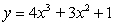 so that the x-coordinate changes at a rate of 2 units per second. How fast is the y-coordinate changing at the point

moves on the graph of the equation so that the x-coordinate changes at a rate of 2 units per second. How fast is the y-coordinate changing at the point (Multiple Choice)
4.9/5 (76)
(76) 
Use linear approximation of  at
 to estimate the quantity of
 to the nearest ten thousandth.
at to estimate the quantity of to the nearest ten thousandth. (Multiple Choice)
4.8/5 (79)
(79) A company's revenue for selling x (thousand) items is given by 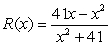 in millions of dollars. Find the value of x (rounded to the nearest item) that maximizes the revenue and find the maximum revenue (rounded to the nearest dollar).
 (Multiple Choice)
4.9/5 (72)
(72) Find the intervals where the function is increasing and decreasing. Use this information to determine all local extrema. 
(Multiple Choice)
4.7/5 (88)
(88) Sketch the graph of  while answering the following questions.
a. What is the domain and range of
 ?
b. What are the intercepts of
 ?
c. What, if any, are the equation(s) of vertical asymototes of
 ?
d. What, if any, are the local min(s) and local max(s) of
 ?
e. What, if any, are the inflection point(s) of
 ?
f. What, if it exists, is the equation of the horizontal asymotote of
 ?

while answering the following questions.
a. What is the domain and range of ?
b. What are the intercepts of ?
c. What, if any, are the equation(s) of vertical asymototes of ?
d. What, if any, are the local min(s) and local max(s) of ?
e. What, if any, are the inflection point(s) of ?
f. What, if it exists, is the equation of the horizontal asymotote of ? (Essay)
4.8/5 (88)
(88) Find the slant asymptote and graph the function and its asymptote on the same axes. 
(Essay)
4.8/5 (82)
(82) Given the graph of  , locate the absolute extrema (if they exist) on the interval
 .

, locate the absolute extrema (if they exist) on the interval . (Multiple Choice)
4.8/5 (92)
(92) Find the x-coordinates of all extrema and sketch the graph of  showing global and local behavior.

showing global and local behavior. (Essay)
4.9/5 (71)
(71) Sand is pouring from a pipe at the rate of 12 cubic feet per second. If the falling sand forms a conical pile so that its height is always  the diameter of the base, how fast is the height of the pile increasing when the height of the pile is 6 feet tall? Round answer to nearest hundredth.
 (Multiple Choice)
4.8/5 (96)
(96) Given  determine if the critical number
 represents a local maximum, local minimum or neither.
determine if the critical number represents a local maximum, local minimum or neither. (Multiple Choice)
4.8/5 (68)
(68) Suppose that at the price  dollars the demand for a product is elastic. If the price is decreased, what will happen to revenue?
 (Multiple Choice)
4.8/5 (89)
(89) Determine the following significant features of 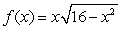 , approximating if necessary, and sketch the graph.
a). intercepts
b). asymptotes
c). extrema
d). inflection points
, approximating if necessary, and sketch the graph.
a). intercepts
b). asymptotes
c). extrema
d). inflection points (Essay)
4.9/5 (74)
(74) A plane is located at  miles (horizontally) away from an airport at an altitude of 3 miles and maintains a constant altitude. Radar at the airport detects that the distance
 between the plane and airport is changing at a rate of
 mph. What is the speed
 of the airplane?
miles (horizontally) away from an airport at an altitude of 3 miles and maintains a constant altitude. Radar at the airport detects that the distance between the plane and airport is changing at a rate of mph. What is the speed of the airplane? (Essay)
4.9/5 (85)
(85) Use Newton's method to find an approximate root of the equation  (accurate to six decimal places).
 (Multiple Choice)
4.8/5 (78)
(78) 
Determine the intervals where  is concave up and concave down.
 (Multiple Choice)
4.9/5 (87)
(87) The power required for a particular bird to fly at a speed  is proportional to
 Find
 to minimize the power.
is proportional to Find to minimize the power. (Multiple Choice)
4.8/5 (79)
(79) 

Filters
- Essay(0)
- Multiple Choice(0)
- Short Answer(0)
- True False(0)
- Matching(0)