



 Chat with AI
Exam 2: Data

Exam 2: Data30 Questions
Exam 3: Surveys and Sampling28 Questions
Exam 4: Displaying and Describing Categorical Data32 Questions
Exam 5: Displaying and Describing Quantitative Data32 Questions
Exam 6: Scatterplots, Association, and Correlation32 Questions
Exam 7: Introduction to Linear Regression32 Questions
Exam 8: Randomness and Probability32 Questions
Exam 9: Random Variables and Probability Distributions28 Questions
Exam 10: Sampling Distributions28 Questions
Exam 11: Confidence Intervals for Proportions32 Questions
Exam 12: Testing Hypotheses About Proportions36 Questions
Exam 13: Confidence Intervals and Hypothesis Tests for Means36 Questions
Exam 14: Comparing Two Means32 Questions
Exam 15: Design of Experiments and Analysis of Variance Anova24 Questions
Exam 16: Inference for Counts: Chi-Square Tests26 Questions
Exam 17: Nonparametric Methods26 Questions
Exam 18: Inference for Regression32 Questions
Exam 19: Understanding Regression Residuals28 Questions
Exam 20: Multiple Regression22 Questions
Exam 21: Building Multiple Regression Models22 Questions
Exam 22: Time Series Analysis28 Questions
Exam 23: Decision Making and Risk32 Questions
Exam 24: Quality Control28 Questions
Exam 25: Exploring and Collecting Data32 Questions
Exam 26: Understanding Probability Distributions and Statistical Inference73 Questions
Exam 27: Exploring Relationships Among Variables40 Questions
Exam 28: Using Statistics for Decision Making26 Questions
Select questions type


The Internet & Life Project study also asked respondents to indicate their education level on the following scale: Less than High School, High School, Some College, College, University. Which of the following statements is true?
(Multiple Choice)
4.9/5  (78)
(78) Tim Hortons conducts a random survey of 1000 customers in their Ottawa outlets on a particular day. For each customer they collect data on the time taken to fill the order, how frequently the customer comes to Tim Hortons in a week, whether the customer purchased only coffee or additional item(s), and the level of overall satisfaction using a scale from 1 to 5. What is the "Who" of this study?
(Multiple Choice)
4.9/5 (63)
(63) What is the "Who" in the Consumer Reports Health study on the effectiveness and safety of drugs used to treat arthritis?
(Multiple Choice)
4.9/5 (84)
(84) A few of the variables for which data were collected in the Internet & Life Project study include age, gender, income, monthly Internet bill, and number of hours spent shopping online per month. Which of the variables is categorical?
(Multiple Choice)
4.8/5 (89)
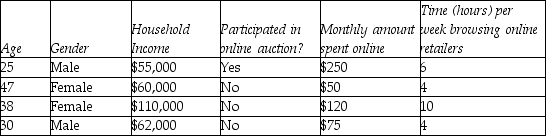
(89) The following table displays some of the data collected by the above research firm in their study of online shopping. List the variables in the data set. Indicate whether each variable is categorical or quantitative. If the variable is quantitative, give the units.
(Essay)
4.9/5 (70)
(70) Consumer Reports Health routinely compares drugs in terms of effectiveness and safety. In summer 2014 they reviewed drugs used to treat arthritis. Among the information reported was convenience of use (how many pills required each day) and possible side effects (e.g., dizziness, stomach upset). Convenience of use and possible side effects constitute the ________ of the study.
(Multiple Choice)
4.9/5 (90)
(90) The human resources department at Bell Canada recently conducted an employee satisfaction survey of 100 of its employees. Data were collected on such variables as age, gender, marital status, current salary, level of overall satisfaction on a scale from 1 to 5, number of years with the company, and job title. Which of the variables would be considered to be quantitative data?
(Multiple Choice)
4.9/5 (81)
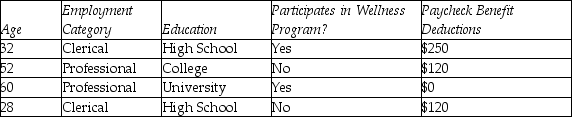
(81) The Human Resources Department of a large corporation maintains records on its employees. The table displays some of these data. List the variables in the data set. Indicate whether each variable is categorical or quantitative. If the variable is quantitative, give the units. If the variable is categorical, indicate whether it is nominal or ordinal.
(Essay)
4.9/5 (87)
(87) Vitamin D insufficiency is associated with many diseases including multiple sclerosis, breast and other cancers, bone diseases, tuberculosis. A variable which represents the vitamin D level (ng/ml) of a hospital patient is
(Multiple Choice)
4.8/5 (79)
(79) 
Filters
- Essay(0)
- Multiple Choice(0)
- Short Answer(0)
- True False(0)
- Matching(0)