



 Chat with AI
Exam 16: Amino Acids, proteins, and Enzymes

Exam 1: Chemistry in Our Lives52 Questions
Exam 2: Chemistry and Measurement85 Questions
Exam 3: Matter and Energy110 Questions
Exam 4: Atoms and Elements106 Questions
Exam 5: Nuclear Chemistry90 Questions
Exam 6: Ionic and Molecular Compounds106 Questions
Exam 7: Chemical Quantities and Reactions114 Questions
Exam 8: Gases76 Questions
Exam 9: Solutions73 Questions
Exam 10: Acids and Bases and Equilibrium67 Questions
Exam 11: Introduction to Organic Chemistry: Hydrocarbons123 Questions
Exam 12: Alcohols, thiols, ethers, aldehydes, and Ketones78 Questions
Exam 13: Carbohydrates81 Questions
Exam 14: Carboxylic Acids, esters, amines, and Amides103 Questions
Exam 15: Lipids65 Questions
Exam 16: Amino Acids, proteins, and Enzymes90 Questions
Exam 17: Nucleic Acids and Protein Synthesis64 Questions
Exam 18: Metabolic Pathways and Energy Production131 Questions
Select questions type


The one letter abbreviation for the amino acid tryptophan is ________.
(Multiple Choice)
4.8/5  (84)
(84) Immunoglobulin,a protein that stimulates immune responses,would be classified as a ________ protein.
(Multiple Choice)
4.9/5 (84)
(84) Hydrophobic interactions help to stabilize the ________ structure(s)of a protein.
(Multiple Choice)
4.9/5 (88)
(88) Amino acids that are not synthesized in the body and must be obtained from the diet are called ________.
(Multiple Choice)
5.0/5 (72)
(72) Urea is converted to ammonia and carbon dioxide by the action of urease.What will be the effect on the rate if the temperature of the reaction is lowered from 37 °C (the optimum temperature)to 27 °C? O 
 -C-
 +
 O
 2N
 +

-C- + O 2N + (Multiple Choice)
4.7/5 (91)
(91) The optimum temperature for most biological enzymes is ________.
(Short Answer)
4.9/5 (73)
(73) The R group for serine is -  -OH.In the ionized form,serine has the structural formula ________.
 (Multiple Choice)
4.8/5 (81)
(81) "Physiological conditions" for reactions within the body are approximately ________.
(Multiple Choice)
5.0/5 (71)
(71) In insulin,two peptide chains are held together in a single unit by ________.
(Multiple Choice)
5.0/5 (82)
(82) "Physiological pH," the pH for optimum activity for most enzymes,is a pH equal to about ________.
(Multiple Choice)
4.8/5 (88)
(88) What type of interaction would you expect between the following R groups in the tertiary structure of a protein? 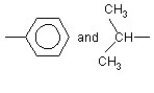
(Multiple Choice)
4.8/5 (79)
(79) What type of interaction would you expect between the following R groups in the tertiary structure of a protein? O
- 

 and -


 -

and - - (Multiple Choice)
4.8/5 (88)
(88) What kinds of interactions are not part of tertiary protein structure?
(Multiple Choice)
4.8/5 (73)
(73) The structural formulas of amino acids are the same except for the ________.
(Multiple Choice)
4.9/5 (99)
(99) A chain made of more than 50 amino acids that has biological activity is referred to as a(n)________.
(Multiple Choice)
4.9/5 (69)
(69) An enzyme that removes H atoms to form a double is a (an)________.
(Multiple Choice)
4.8/5 (100)
(100) In the β-pleated sheet secondary structure of a protein,two or more amino acid sequences in separate parts of the protein are held together ________.
(Multiple Choice)
4.8/5 (80)
(80) 
Filters
- Essay(0)
- Multiple Choice(0)
- Short Answer(0)
- True False(0)
- Matching(0)