



 Chat with AI
Exam 4: Section 2: Applications of Differentiation

Exam 1: Section 1: Preparation for Calculus16 Questions
Exam 1: Section 2: Preparation for Calculus26 Questions
Exam 1: Section 3: Preparation for Calculus23 Questions
Exam 1: Section 4: Preparation for Calculus16 Questions
Exam 1: Section 5: Preparation for Calculus25 Questions
Exam 1: Section 6: Preparation for Calculus8 Questions
Exam 2: Section 1: Limits and Their Properties10 Questions
Exam 2: Section 2: Limits and Their Properties14 Questions
Exam 2: Section 3: Limits and Their Properties25 Questions
Exam 2: Section 4: Limits and Their Properties20 Questions
Exam 2: Section 5 : Limits and Their Properties18 Questions
Exam 3: Section 1 : Differentiation20 Questions
Exam 3: Section 2: Differentiation25 Questions
Exam 3: Section 3: Differentiation26 Questions
Exam 3: Section 4 : Differentiation44 Questions
Exam 3: Section 5: Differentiation30 Questions
Exam 3: Section 6: Differentiation16 Questions
Exam 3: Section 7: Differentiation16 Questions
Exam 3: Section 8: Differentiation12 Questions
Exam 4: Section 1 : Applications of Differentiation19 Questions
Exam 4: Section 2: Applications of Differentiation17 Questions
Exam 4: Section 3: Applications of Differentiation17 Questions
Exam 4: Section 4: Applications of Differentiation26 Questions
Exam 4: Section 5: Applications of Differentiation23 Questions
Exam 4: Section 6: Applications of Differentiation22 Questions
Exam 4: Section 7: Applications of Differentiation15 Questions
Exam 4: Section 8: Applications of Differentiation16 Questions
Exam 4: Section 1: Integration19 Questions
Exam 4: Section 2: Integration17 Questions
Exam 4: Section 3: Integration19 Questions
Exam 4: Section 4: Integration18 Questions
Exam 4: Section 5: Integration31 Questions
Exam 4: Section 6: Integration18 Questions
Exam 4: Section 7: Integration27 Questions
Exam 4: Section 8: Integration16 Questions
Exam 4: Section 9: Integration20 Questions
Exam 6: Section 1: Differential Equations19 Questions
Exam 6: Section 2: Differential Equations25 Questions
Exam 6: Section 3: Differential Equations12 Questions
Exam 6: Section 4: Differential Equations14 Questions
Exam 6: Section 5: Differential Equations17 Questions
Exam 7: Section 1: Applications of Integration18 Questions
Exam 7: Section 2: Applications of Integration18 Questions
Exam 7: Section 3: Applications of Integration17 Questions
Exam 7: Section 4: Applications of Integration18 Questions
Exam 7: Section 5: Applications of Integration16 Questions
Exam 7: Section 6: Applications of Integration19 Questions
Exam 7: Section 7: Applications of Integration15 Questions
Exam 8: Section 1: Integration Techniques, Lhôpitals Rule, and Improper Integrals15 Questions
Exam 8: Section 2: Integration Techniques, Lhôpitals Rule, and Improper Integrals18 Questions
Exam 8: Section 3: Integration Techniques, Lhôpitals Rule, and Improper Integrals20 Questions
Exam 8: Section 4: Integration Techniques, Lhôpitals Rule, and Improper Integrals19 Questions
Exam 8: Section 5: Integration Techniques, Lhôpitals Rule, and Improper Integrals14 Questions
Exam 8: Section 6: Integration Techniques, Lhôpitals Rule, and Improper Integrals15 Questions
Exam 8: Section 7: Integration Techniques, Lhôpitals Rule, and Improper Integrals18 Questions
Exam 8: Section 8: Integration Techniques, Lhôpitals Rule, and Improper Integrals15 Questions
Exam 9: Section 1: Infinite Series17 Questions
Exam 9: Section 2: Infinite Series23 Questions
Exam 9: Section 3: Infinite Series18 Questions
Exam 9: Section 4: Infinite Series21 Questions
Exam 9: Section 5: Infinite Series15 Questions
Exam 9: Section 6: Infinite Series21 Questions
Exam 9: Section 7: Infinite Series18 Questions
Exam 9: Section 8: Infinite Series18 Questions
Exam 9: Section 9: Infinite Series19 Questions
Exam 9: Section 10: Infinite Series16 Questions
Exam 10: Section 1: Conics, Parametric Equations, and Polar Coordinates26 Questions
Exam 10: Section 2: Conics, Parametric Equations, and Polar Coordinates17 Questions
Exam 10: Section 3: Conics, Parametric Equations, and Polar Coordinates22 Questions
Exam 10: Section 4: Conics, Parametric Equations, and Polar Coordinates15 Questions
Exam 10: Section 5: Conics, Parametric Equations, and Polar Coordinates18 Questions
Exam 10: Section 6: Conics, Parametric Equations, and Polar Coordinates19 Questions
Exam 11: Section 1: Vectors and the Geometry of Space20 Questions
Exam 11: Section 2: Vectors and the Geometry of Space21 Questions
Exam 11: Section 3: Vectors and the Geometry of Space18 Questions
Exam 11: Section 4: Vectors and the Geometry of Space18 Questions
Exam 11: Section 5: Vectors and the Geometry of Space21 Questions
Exam 11: Section 6: Vectors and the Geometry of Space20 Questions
Exam 11: Section 7: Vectors and the Geometry of Space19 Questions
Exam 12: Section 1: Vector-Valued Functions21 Questions
Exam 12: Section 2: Vector-Valued Functions24 Questions
Exam 12: Section 3: Vector-Valued Functions18 Questions
Exam 12: Section 4: Vector-Valued Functions20 Questions
Exam 12: Section 5: Vector-Valued Functions19 Questions
Exam 13: Section 1: Functions of Several Variables19 Questions
Exam 13: Section 2: Functions of Several Variables22 Questions
Exam 13: Section 3: Functions of Several Variables23 Questions
Exam 13: Section 4: Functions of Several Variables17 Questions
Exam 13: Section 6: Functions of Several Variables20 Questions
Exam 13: Section 7: Functions of Several Variables20 Questions
Exam 13: Section 8: Functions of Several Variables20 Questions
Exam 13: Section 9: Functions of Several Variables17 Questions
Exam 13: Section 10: Functions of Several Variables18 Questions
Exam 14: Section 1: Multiple Integration20 Questions
Exam 14: Section 2: Multiple Integration19 Questions
Exam 14: Section 3: Multiple Integration20 Questions
Exam 14: Section 4: Multiple Integration18 Questions
Exam 14: Section 5: Multiple Integration18 Questions
Exam 14: Section 6: Multiple Integration19 Questions
Exam 14: Section 7: Multiple Integration19 Questions
Exam 14: Section 8: Multiple Integration19 Questions
Exam 15: Section 1: Vector Analysis21 Questions
Exam 15: Section 2: Vector Analysis18 Questions
Exam 15: Section 3: Vector Analysis18 Questions
Exam 15: Section 4: Vector Analysis18 Questions
Exam 15: Section 5: Vector Analysis21 Questions
Exam 15: Section 6: Vector Analysis18 Questions
Exam 15: Section 7: Vector Analysis18 Questions
Exam 15: Section 8: Vector Analysis17 Questions
Select questions type


A plane begins its takeoff at 2:00 P.M. on a 2200-mile flight. After 12.5 hours, the plane arrives at its destination. Explain why there are at least two times during the flight when the speed of the plane is 100 miles per hour.

Free
(Multiple Choice)
4.8/5  (81)
(81) Correct Answer: Verified
C
Determine whether the Mean Value Theorem can be applied to the function  on the closed interval [3,9]. If the Mean Value Theorem can be applied, find all numbers c in the open interval (3,9) such that
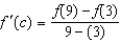 .
on the closed interval [3,9]. If the Mean Value Theorem can be applied, find all numbers c in the open interval (3,9) such that .Free
(Multiple Choice)
4.9/5 (82)
(82) Correct Answer:Verified
VerifiedA
The height of an object t seconds after it is dropped from a height of 550 meters is  Find the average velocity of the object during the first 7 seconds.
Free
(Multiple Choice)
4.9/5 (96)
(96) Correct Answer:Verified
VerifiedB
Which of the following functions passes through the point  and satisfies
 ?
and satisfies ? (Multiple Choice)
4.7/5 (64)
(64) Determine whether Rolle's Theorem can be applied to  on the closed interval
 If Rolle's Theorem can be applied, find all values of c in the open interval
 such that

on the closed interval If Rolle's Theorem can be applied, find all values of c in the open interval such that (Multiple Choice)
4.9/5 (80)
(80) Determine whether Rolle's Theorem can be applied to the function  on the closed interval
 . If Rolle's Theorem can be applied, find all numbers c in the open interval
 such that
 .
on the closed interval . If Rolle's Theorem can be applied, find all numbers c in the open interval such that . (Multiple Choice)
4.7/5 (72)
(72) A company introduces a new product for which the number of units sold S is 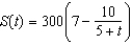 where t is the time in months since the product was introduced. Find the average value of
 during the first year.
where t is the time in months since the product was introduced. Find the average value of during the first year. (Multiple Choice)
4.9/5 (86)
(86) The ordering and transportation cost C for components used in a manufacturing process is approximated by 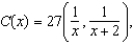 where C is measured in thousands of dollars and x is the order size in hundreds. According to Rolle's Theorem, the rate of change of the cost must be 0 for some order size in the interval
 Find this order size. Round your answer to three decimal places.
where C is measured in thousands of dollars and x is the order size in hundreds. According to Rolle's Theorem, the rate of change of the cost must be 0 for some order size in the interval Find this order size. Round your answer to three decimal places. (Multiple Choice)
4.9/5 (97)
(97) Find a function f that has derivative  and with graph passing through the point (5,6).
 (Multiple Choice)
4.9/5 (78)
(78) Determine whether Rolle's Theorem can be applied to the function  on the closed interval
 . If Rolle's Theorem can be applied, find all numbers c in the open interval
 such that

on the closed interval . If Rolle's Theorem can be applied, find all numbers c in the open interval such that (Multiple Choice)
4.9/5 (71)
(71) Determine whether Rolle's Theorem can be applied to the function  on the closed interval
 If Rolle's Theorem can be applied, find all numbers c in the open interval
 such that

on the closed interval If Rolle's Theorem can be applied, find all numbers c in the open interval such that (Multiple Choice)
4.8/5 (71)
(71) Determine whether Rolle's Theorem can be applied to 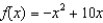 on the closed interval
 If Rolle's Theorem can be applied, find all values of c in the open interval
 such that

on the closed interval If Rolle's Theorem can be applied, find all values of c in the open interval such that (Multiple Choice)
4.8/5 (72)
(72) The height of an object t seconds after it is dropped from a height of 250 meters is  Find the time during the first 8 seconds of fall at which the instantaneous velocity equals the average velocity.
 (Multiple Choice)
4.8/5 (82)
(82) Determine whether the Mean Value Theorem can be applied to the function  on the closed interval
 If the Mean Value Theorem can be applied, find all numbers c in the open interval
 such that
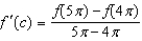 .
on the closed interval If the Mean Value Theorem can be applied, find all numbers c in the open interval such that . (Multiple Choice)
4.9/5 (84)
(84) A company introduces a new product for which the number of units sold S is 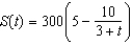 where t is the time in months since the product was introduced. During what month does
 equal the average value of
 during the first year?
where t is the time in months since the product was introduced. During what month does equal the average value of during the first year? (Multiple Choice)
4.8/5 (84)
(84) Determine whether Rolle's Theorem can be applied to the function 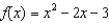 on the closed interval [-1,3]. If Rolle's Theorem can be applied, find all values of c in the open interval (-1,3) such that

on the closed interval [-1,3]. If Rolle's Theorem can be applied, find all values of c in the open interval (-1,3) such that (Multiple Choice)
4.8/5 (80)
(80) Determine whether the Mean Value Theorem can be applied to the function  on the closed interval [0,16]. If the Mean Value Theorem can be applied, find all numbers c in the open interval (0,16) such that
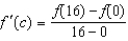 .
on the closed interval [0,16]. If the Mean Value Theorem can be applied, find all numbers c in the open interval (0,16) such that . (Multiple Choice)
4.8/5 (83)
(83) 
Filters
- Essay(0)
- Multiple Choice(0)
- Short Answer(0)
- True False(0)
- Matching(0)