



 Chat with AI
Exam 7: Audit Evidence

Exam 1: The Demand for Audit and Other Assurance Services47 Questions
Exam 2: The CPA Profession67 Questions
Exam 3: Audit Reports139 Questions
Exam 4: Professional Ethics114 Questions
Exam 5: Legal Liability113 Questions
Exam 6: The CPA Profession114 Questions
Exam 7: Audit Evidence94 Questions
Exam 8: Audit Planning and Analytical Procedures95 Questions
Exam 9: Materiality and Risk102 Questions
Exam 10: Section 404 Audits of Internal Control and Control Risk116 Questions
Exam 11: Fraud Auditing83 Questions
Exam 12: The Impact of Information Technology on the Audit Process106 Questions
Exam 13: Overall Audit Plan and Audit Program94 Questions
Exam 14: Audit of the Sales and Collection Cycle: Tests of Controls and Substantive Tests of Transactions108 Questions
Exam 15: Audit Sampling for Tests of Controls and Substantive Tests of Transactions117 Questions
Exam 16: Completing the Tests in the Sales and Collection Cycle: Accounts Receivable96 Questions
Exam 17: Audit Sampling for Tests of Details and Balances114 Questions
Exam 18: Audit of the Acquisition and Payment Cycle: Tests of Controls and Substantive Tests of Transactions, and Accounts Payable114 Questions
Exam 19: Completing the Tests in the Acquisition and Payment Cycle: Verification of Selected Accounts101 Questions
Exam 20: Audit of the Payroll and Personnel Cycle113 Questions
Exam 21: Audit of the Inventory and Warehousing Cycle115 Questions
Exam 22: Audit of the Capital Acquisition and Repayment Cycle91 Questions
Exam 23: Audit of Cash Balances92 Questions
Exam 24: Completing the Audit116 Questions
Exam 25: Other Assurance Services100 Questions
Exam 26: Internal and Governmental Financial Auditing and Operational Auditing73 Questions
Select questions type


Which of the following statements is correct regarding the costs involved in obtaining evidence?
(Multiple Choice)
4.8/5  (79)
(79) Below are 10 documents typically examined during an audit. Classify each document as either internal or external.
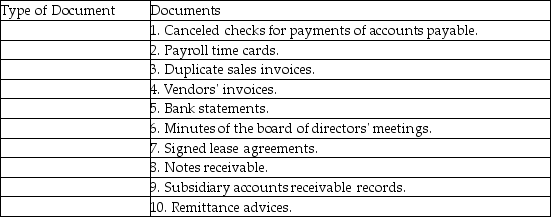
(Essay)
4.9/5 (56)
(56) Audit evidence has two primary qualities for the auditor; relevance and reliability. Given the choices below which provides the auditor with the most reliable audit evidence?
(Multiple Choice)
4.9/5 (67)
(67) Auditors may decide to replace tests of details with analytical procedures when possible because the:
(Multiple Choice)
4.8/5 (81)
(81) Auditor judgment is the primary determinant in determining the amount of evidence gathered.
(True/False)
4.8/5 (87)
(87) One purpose of performing analytical procedures in the planning phase of an audit is to assess the client's financial condition. Explain how the assessment of a client's financial condition can affect the auditor's decisions concerning evidence accumulation in later phases of the audit.
(Essay)
4.9/5 (70)
(70) Distinguish between internal documentation and external documentation as types of audit evidence. Give two examples of each. Which type is considered more reliable?
(Essay)
4.8/5 (90)
(90) When making decisions about evidence for a given audit, the auditor's goal is to obtain a sufficient amount of timely, reliable evidence that is relevant to the information being verified. In addition, the goal of audit efficiency is to gather and evaluate the information:
(Multiple Choice)
5.0/5 (80)
(80) Analytical procedures can be used to provide reliable substantive evidence for all balance-related audit objectives.
(True/False)
4.8/5 (66)
(66) Indicate whether confirmation of accounts receivable and accounts payable, provided they each are significant accounts, is required or optional:
(Multiple Choice)
4.7/5 (82)
(82) Cost is never an adequate justification for omitting a necessary procedure or not gathering an adequate sample size.
(True/False)
4.8/5 (74)
(74) When analytical procedures reveal unusual fluctuations in an account balance, the auditor will probably perform fewer tests of details for that account and increase the tests of controls related to the account.
(True/False)
4.7/5 (85)
(85) Calculating the gross margin for the current year under audit as a percent of sales and comparing it with previous years is what type of evidence?
(Multiple Choice)
5.0/5 (85)
(85) Which of the following discoveries through the use of analytical procedures would most likely indicate a relatively high risk of financial failure?
(Multiple Choice)
4.7/5 (76)
(76) Often, auditor procedures result in significant differences being discovered by the auditor. The auditor should investigate further if:
(Multiple Choice)
4.7/5 (80)
(80) The relevance of audit evidence depends on the audit objective being tested.
(True/False)
4.8/5 (79)
(79) Which of the following is the most objective type of evidence?
(Multiple Choice)
4.9/5 (71)
(71) Analytical procedures must be used in the planning and completion phases of the audit.
(True/False)
4.9/5 (81)
(81) 
Filters
- Essay(0)
- Multiple Choice(0)
- Short Answer(0)
- True False(0)
- Matching(0)