



 Chat with AI
Exam 15: Aggregate Demand and Aggregate Supply

Exam 1: Ten Principles of Economics439 Questions
Exam 2: Thinking Like an Economist615 Questions
Exam 3: Interdependence and the Gains From Trade527 Questions
Exam 4: The Market Forces of Supply and Demand697 Questions
Exam 5: Measuring a Nations Income518 Questions
Exam 6: Measuring the Cost of Living543 Questions
Exam 7: Production and Growth507 Questions
Exam 8: Saving, Investment, and the Financial System565 Questions
Exam 9: The Basic Tools of Finance510 Questions
Exam 10: Unemployment and Its Natural Rate698 Questions
Exam 11: The Monetary System517 Questions
Exam 12: Money Growth and Inflation484 Questions
Exam 13: Open-Economy Macroeconomics: Basic Concepts520 Questions
Exam 14: A Macroeconomic Theory of the Open Economy478 Questions
Exam 15: Aggregate Demand and Aggregate Supply563 Questions
Exam 16: The Influence of Monetary and Fiscal Policy on Aggregate Demand510 Questions
Exam 17: The Short-Run Tradeoff Between Inflation and Unemployment516 Questions
Exam 18: Six Debates Over Macroeconomic Policy372 Questions
Select questions type


Which of the following affected aggregate demand during the recession of 2008-2009?
(Multiple Choice)
4.9/5  (90)
(90) Explain how an increase in the price level changes interest rates. How does this change in interest rates lead to changes in investment and net exports?
(Essay)
5.0/5 (83)
(83) Changes in what four variables will shift the long run aggregate supply curve?
(Essay)
4.9/5 (73)
(73) Figure 33-10. 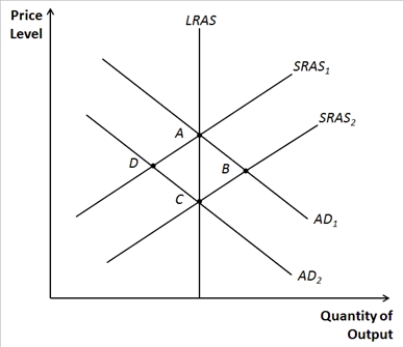 -Refer to Figure 33-10. If the economy starts at point A, a short-run fall in output would be consistent with a movement to point
 (Multiple Choice)
4.8/5 (72)
(72) Optimism
Imagine that the economy is in long-run equilibrium. Then, perhaps because of improved international relations and increased confidence in policy makers, people become more optimistic about the future and stay this way for some time.
-Refer to Optimism. What happens to the expected price level and what's the result for wage bargaining?
(Multiple Choice)
4.7/5 (88)
(88) Explain how a change in the expected price level would shift the short-run and long-run aggregate-supply curves.
(Essay)
4.8/5 (77)
(77) Stagflation results from continued decreases in aggregate demand.
(True/False)
4.7/5 (82)
(82) Which of the following explains why production rises in most years?
(Multiple Choice)
4.9/5 (75)
(75) According to the aggregate demand and aggregate supply model, in the long run a decrease in the money supply leads to
(Multiple Choice)
4.8/5 (77)
(77) If speculators bid up the value of the dollar in the market for foreign-currency exchange, U.S. aggregate demand would shift to the left.
(True/False)
4.8/5 (78)
(78) The aggregate-demand curve shows that a decrease in the price level
(Multiple Choice)
4.9/5 (93)
(93) Keynes believed that economies experiencing high unemployment should adopt policies to
(Multiple Choice)
5.0/5 (74)
(74) An increase in the actual price level does not shift the short-run aggregate supply curve, but an expected increase in the price level shifts the short-run aggregate supply curve to the left.
(True/False)
4.8/5 (78)
(78) If businesses in general decide that they have overbuilt and so now have too much capital, their response to this would initially shift
(Multiple Choice)
4.8/5 (90)
(90) Pessimism
Suppose the economy is in long-run equilibrium. Then because of corporate scandal, international tensions, and loss of confidence in policymakers, people become pessimistic regarding the future and retain that level of pessimism for some time.
-Refer to Pessimism. How is the new long-run equilibrium different from the original one?
(Multiple Choice)
4.8/5 (73)
(73) 
Filters
- Essay(0)
- Multiple Choice(0)
- Short Answer(0)
- True False(0)
- Matching(0)