



 Chat with AI
Exam 10: Unemployment and Its Natural Rate

Exam 1: Ten Principles of Economics439 Questions
Exam 2: Thinking Like an Economist615 Questions
Exam 3: Interdependence and the Gains From Trade527 Questions
Exam 4: The Market Forces of Supply and Demand697 Questions
Exam 5: Measuring a Nations Income518 Questions
Exam 6: Measuring the Cost of Living543 Questions
Exam 7: Production and Growth507 Questions
Exam 8: Saving, Investment, and the Financial System565 Questions
Exam 9: The Basic Tools of Finance510 Questions
Exam 10: Unemployment and Its Natural Rate698 Questions
Exam 11: The Monetary System517 Questions
Exam 12: Money Growth and Inflation484 Questions
Exam 13: Open-Economy Macroeconomics: Basic Concepts520 Questions
Exam 14: A Macroeconomic Theory of the Open Economy478 Questions
Exam 15: Aggregate Demand and Aggregate Supply563 Questions
Exam 16: The Influence of Monetary and Fiscal Policy on Aggregate Demand510 Questions
Exam 17: The Short-Run Tradeoff Between Inflation and Unemployment516 Questions
Exam 18: Six Debates Over Macroeconomic Policy372 Questions
Select questions type


Minimum-wage laws are one reason there is always some unemployment in the U.S. economy.
(True/False)
4.8/5  (89)
(89) What is the theory of efficiency wages? Provide four reasons that employers might pay efficiency wages.
(Essay)
4.9/5 (67)
(67) A firm might offer efficiency wages so its workers will eat a more nutritious diet and therefore be healthier and more productive.
(True/False)
4.9/5 (80)
(80) Consider two labor markets in which jobs are equally attractive in all respects other than the wage rate. All workers are equally able to do either job. Initially, both labor markets are perfectly competitive. If a union organizes workers in one of the markets, then the wage rates will tend to
(Multiple Choice)
4.8/5 (81)
(81) Unions are often thought to cause conflict between different groups of workers -- between the insiders who benefit from high union wages and the outsiders who do not get the union jobs.
(True/False)
4.7/5 (71)
(71) Minimum-wage laws and unions are similar to each other but different from efficiency wages in that minimum-wage law and unions
(Multiple Choice)
4.8/5 (85)
(85) The invention of the telegraph led to the loss of jobs for those who had delivered mail by horse but created jobs for telegraph operators and delivery persons. This is an example of
(Multiple Choice)
4.8/5 (71)
(71) Structural unemployment is often thought to explain relatively short spells of unemployment.
(True/False)
4.8/5 (83)
(83) Table 28-11
2010 Labor Data for Tajnia
 -Refer to Table 28-11. The total adult population of Tajnia in 2010 is 30,000.
 (True/False)
4.8/5 (76)
(76) The labor force equals the sum of the employed and the unemployed.
(True/False)
4.8/5 (96)
(96) Advocates of government-run employment agencies and public training programs believe they make job search more efficient.
(True/False)
4.7/5 (75)
(75) In 2012, the U.S. natural rate of unemployment was estimated to be about 5.5 percent, which at the time was below the actual rate of unemployment of about 8.1 percent.
(True/False)
4.7/5 (86)
(86) If the wage is kept above the equilibrium wage for any reason, the result is structural unemployment.
(True/False)
4.7/5 (72)
(72) More than 3 percent of U.S. workers leave their jobs in a typical month.
(True/False)
4.7/5 (77)
(77) When a minimum-wage law forces the wage to remain above the level that balances supply and demand, the result is a surplus of labor.
(True/False)
4.7/5 (80)
(80) A person who is not employed and claims to be trying hard to find a job but really is not trying hard to find a job is
(Multiple Choice)
4.9/5 (69)
(69) Figure 28-7  -Refer to Figure 28-7. Without a minimum wage, what is the equilibrium level of employment? Explain what happens to the level of employment if the minimum wage is equal to $125.
 (Essay)
4.9/5 (68)
(68) Figure 28-6 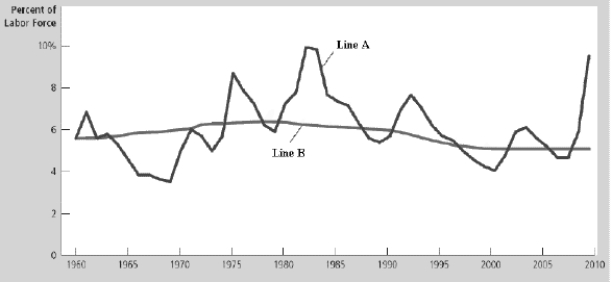 Refer to Figure 28-6. What type of unemployment is measured by the differences between lines A and B?
 (Short Answer)
4.9/5 (90)
(90) 
Filters
- Essay(0)
- Multiple Choice(0)
- Short Answer(0)
- True False(0)
- Matching(0)