



 Chat with AI
Exam 12: Capital Budgeting Decisions

Exam 1: Managerial Accounting and Cost Concepts166 Questions
Exam 2: Job-Order Costing154 Questions
Exam 3: Process Costing109 Questions
Exam 4: Cost-Volume-Profit Relationships241 Questions
Exam 5: Variable Costing and Segment Reporting: Tools for Management200 Questions
Exam 6: Activity-Based Costing: a Tool to Aid Decision Making138 Questions
Exam 7: Profit Planning106 Questions
Exam 8: Flexible Budgets and Performance Analysis295 Questions
Exam 9: Standard Costs and Variances178 Questions
Exam 10: Performance Measurement in Decentralized Organizations93 Questions
Exam 11: Differential Analysis: The Key to Decision Making153 Questions
Exam 12: Capital Budgeting Decisions144 Questions
Exam 13: Statement of Cash Flows108 Questions
Exam 14: Financial Statement Analysis211 Questions
Exam 15: Least-Squares Regression Computations22 Questions
Exam 16: Appendix B: Cost of Quality42 Questions
Exam 17: The Predetermined Overhead Rate and Capacity27 Questions
Exam 18: Further Classification of Labor Costs20 Questions
Exam 19: Fifo Method79 Questions
Exam 20: Service Department Allocations46 Questions
Exam 21: Abc Action Analysis15 Questions
Exam 22: Using a Modified Form of Activity-Based Costing to Determine Product Costs for External Reports16 Questions
Exam 23: Predetermined Overhead Rates and Overhead Analysis in a Standard Costing System105 Questions
Exam 24: Journal Entries to Record Variances52 Questions
Exam 25: Transfer Pricing21 Questions
Exam 26: Service Department Charges41 Questions
Exam 27: The Concept of Present Value12 Questions
Exam 28: Income Taxes in Capital Budgeting Decisions36 Questions
Exam 29: The Direct Method of Determining the Net Cash Provided by Operating Activities48 Questions
Exam 30: Pricing Products and Services67 Questions
Exam 31: Profitability Analysis71 Questions
Select questions type


(Ignore income taxes in this problem. )The Jason Company is considering the purchase of a machine that will increase revenues by $32,000 each year.Cash outflows for operating this machine will be $6,000 each year.The cost of the machine is $65,000.It is expected to have a useful life of five years with no salvage value.For this machine,the simple rate of return is:
(Multiple Choice)
4.9/5  (94)
(94) In preference decisions,the profitability index and internal rate of return methods may produce conflicting rankings of projects.
(True/False)
4.9/5 (86)
(86) If new equipment is replacing old equipment,any salvage received from sale of the old equipment should not be considered in computing the payback period of the new equipment.
(True/False)
4.8/5 (75)
(75) (Ignore income taxes in this problem.) Gull Inc. is considering the acquisition of equipment that costs $480,000 and has a useful life of 6 years with no salvage value. The incremental net cash flows that would be generated by the equipment are: 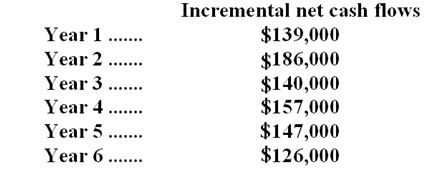 -The payback period of this investment is closest to:
 (Multiple Choice)
4.9/5 (80)
(80) (Ignore income taxes in this problem. )An investment of P dollars now will yield cash inflows of $3,000 at the end of the first year and $2,000 at the end of the fourth year.If the internal rate of return for this investment is 20%,then the value of P is:
(Multiple Choice)
4.8/5 (76)
(76) (Ignore income taxes in this problem. )Gocke Company is considering purchasing a machine that would cost $478,800 and have a useful life of 5 years.The machine would reduce cash operating costs by $114,000 per year.The machine would have no salvage value.
Required:
a.Compute the payback period for the machine.
b.Compute the simple rate of return for the machine.
(Essay)
4.9/5 (93)
(93) (Ignore income taxes in this problem.) The Crawford Company is pondering an investment in a machine that costs $350,000, that will have a useful life of eight years, and that will have a salvage value of $25,000. If this machine is purchased, a similar, old machine will be sold at a salvage value of $40,000. The anticipated yearly revenues and expenses associated with the new machine are: 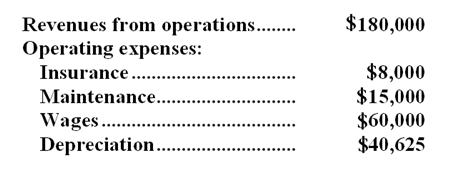 All of the revenues and expenses except depreciation are for cash. The company's required rate of return is 12%. The annual cash flows occur uniformly throughout the year.
-The payback period,to the nearest tenth of a year,of this investment is:
All of the revenues and expenses except depreciation are for cash. The company's required rate of return is 12%. The annual cash flows occur uniformly throughout the year.
-The payback period,to the nearest tenth of a year,of this investment is: (Multiple Choice)
4.8/5 (76)
(76) (Ignore income taxes in this problem. )A newly developed device is being considered by Fairway Foods for use in processing and canning peaches.The device,which is available only on a royalty basis,is reported to be a great labor saver.Fairway's production manager has gathered the following data:  The new device must be obtained through a licensing arrangement with the developer.The license period lasts for only 8 years.Fairway Foods' required rate of return is 10%.
Required:
By use of the incremental cost approach,compute the net present value of the proposed licensing of the new device.Show all computations in good form.Should the company enter into a licensing arrangement to use the new device?
The new device must be obtained through a licensing arrangement with the developer.The license period lasts for only 8 years.Fairway Foods' required rate of return is 10%.
Required:
By use of the incremental cost approach,compute the net present value of the proposed licensing of the new device.Show all computations in good form.Should the company enter into a licensing arrangement to use the new device? (Essay)
4.8/5 (82)
(82) (Ignore income taxes in this problem. )The management of Burney Corporation is investigating purchasing equipment that would increase sales revenues by $74,000 per year and cash operating expenses by $32,000 per year.The equipment would cost $115,000 and have a 5 year life with no salvage value.The simple rate of return on the investment is closest to:
(Multiple Choice)
4.8/5 (80)
(80) (Ignore income taxes in this problem. )A piece of new equipment will cost $70,000.The equipment will provide a cost savings of $15,000 per year for ten years,after which it will have a $3,000 salvage value.If the required rate of return is 14%,the equipment's net present value is:
(Multiple Choice)
5.0/5 (84)
(84) (Ignore income taxes in this problem. )The Valentine Company has decided to buy a machine costing $14,750.Estimated cash savings from using the new machine amount to $4,500 per year.The machine will have no salvage value at the end of its useful life of five years.If Valentine's required rate of return is 10%,the machine's internal rate of return is closest to:
(Multiple Choice)
4.9/5 (79)
(79) (Ignore income taxes in this problem)The management of Londo Corporation is investigating buying a small used aircraft to use in making airborne inspections of its above-ground pipelines.The aircraft would have a useful life of 6 years.The company uses a discount rate of 15% in its capital budgeting.The net present value of the investment,excluding the intangible benefits,is -$474,060.To the nearest whole dollar how large would the annual intangible benefit have to be to make the investment in the aircraft financially attractive?
(Multiple Choice)
4.8/5 (87)
(87) (Ignore income taxes in this problem. )Sam Weller is thinking of investing $70,000 to start a bookstore.Sam plans to withdraw $15,000 from the business at the end of each year for the next five years.At the end of the fifth year,Sam plans to sell the business for $110,000 cash.At a 12% discount rate,what is the net present value of the investment?
(Multiple Choice)
4.8/5 (62)
(62) (Ignore income taxes in this problem.) Friden Company has just purchased a new piece of equipment with the following characteristics:  -The simple rate of return would be approximately:
 (Multiple Choice)
4.8/5 (82)
(82) (Ignore income taxes in this problem. )The following data pertain to an investment in equipment: 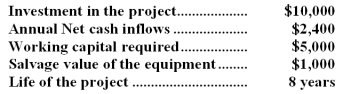 At the completion of the project,the working capital will be released for use elsewhere.Compute the net present value of the project,using a discount rate of 10%:
 (Multiple Choice)
4.7/5 (77)
(77) (Ignore income taxes in this problem. )Cottrell,Inc. ,is investigating an investment in equipment that would have a useful life of 9 years.The company uses a discount rate of 15% in its capital budgeting.The net present value of the investment,excluding the salvage value,is -$230,392.To the nearest whole dollar how large would the salvage value of the equipment have to be to make the investment in the equipment financially attractive?
(Multiple Choice)
4.9/5 (71)
(71) (Ignore income taxes in this problem.) Shields Company has gathered the following data on a proposed investment project: 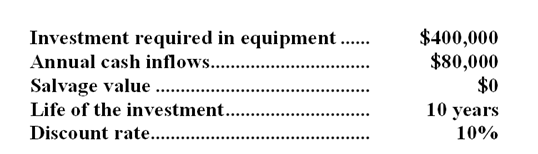 -The payback period for the investment is closest to:
 (Multiple Choice)
5.0/5 (83)
(83) (Ignore income taxes in this problem. )The Jackson Company has invested in a machine that cost $70,000,that has a useful life of seven years,and that has no salvage value at the end of its useful life.The machine is being depreciated by the straight-line method,based on its useful life.It will have a payback period of four years.Given these data,the simple rate of return on the machine is closest to:
(Multiple Choice)
4.9/5 (80)
(80) (Ignore income taxes in this problem. )Rosenholm Corporation uses a discount rate of 18% in its capital budgeting.Partial analysis of an investment in automated equipment with a useful life of 5 years has thus far yielded a net present value of -$327,960.This analysis did not include any estimates of the intangible benefits of automating this process nor did it include any estimate of the salvage value of the equipment.
Required:
a.Ignoring any salvage value,how large would the additional cash flow per year from the intangible benefits have to be to make the investment in the automated equipment financially attractive?
b.Ignoring any cash flows from intangible benefits,how large would the salvage value of the automated equipment have to be to make the investment in the automated equipment financially attractive?
(Essay)
4.8/5 (79)
(79) (Ignore income taxes in this problem. )Blaine Corporation is considering replacing a technologically obsolete machine with a new state-of-the-art numerically controlled machine.The new machine would cost $180,000 and would have a ten-year useful life.Unfortunately,the new machine would have no salvage value.The new machine would cost $12,000 per year to operate and maintain,but would save $48,000 per year in labor and other costs.The old machine can be sold now for scrap for $20,000.What is the simple rate of return on the new machine (round off your answer to the nearest one-hundredth of a percent)?
(Multiple Choice)
4.8/5 (70)
(70) 
Filters
- Essay(0)
- Multiple Choice(0)
- Short Answer(0)
- True False(0)
- Matching(0)