



 Chat with AI
Exam 28: Income Taxes in Capital Budgeting Decisions

Exam 1: Managerial Accounting and Cost Concepts166 Questions
Exam 2: Job-Order Costing154 Questions
Exam 3: Process Costing109 Questions
Exam 4: Cost-Volume-Profit Relationships241 Questions
Exam 5: Variable Costing and Segment Reporting: Tools for Management200 Questions
Exam 6: Activity-Based Costing: a Tool to Aid Decision Making138 Questions
Exam 7: Profit Planning106 Questions
Exam 8: Flexible Budgets and Performance Analysis295 Questions
Exam 9: Standard Costs and Variances178 Questions
Exam 10: Performance Measurement in Decentralized Organizations93 Questions
Exam 11: Differential Analysis: The Key to Decision Making153 Questions
Exam 12: Capital Budgeting Decisions144 Questions
Exam 13: Statement of Cash Flows108 Questions
Exam 14: Financial Statement Analysis211 Questions
Exam 15: Least-Squares Regression Computations22 Questions
Exam 16: Appendix B: Cost of Quality42 Questions
Exam 17: The Predetermined Overhead Rate and Capacity27 Questions
Exam 18: Further Classification of Labor Costs20 Questions
Exam 19: Fifo Method79 Questions
Exam 20: Service Department Allocations46 Questions
Exam 21: Abc Action Analysis15 Questions
Exam 22: Using a Modified Form of Activity-Based Costing to Determine Product Costs for External Reports16 Questions
Exam 23: Predetermined Overhead Rates and Overhead Analysis in a Standard Costing System105 Questions
Exam 24: Journal Entries to Record Variances52 Questions
Exam 25: Transfer Pricing21 Questions
Exam 26: Service Department Charges41 Questions
Exam 27: The Concept of Present Value12 Questions
Exam 28: Income Taxes in Capital Budgeting Decisions36 Questions
Exam 29: The Direct Method of Determining the Net Cash Provided by Operating Activities48 Questions
Exam 30: Pricing Products and Services67 Questions
Exam 31: Profitability Analysis71 Questions
Select questions type


Jenny Inc. has provided the following data concerning an investment project that has been proposed: 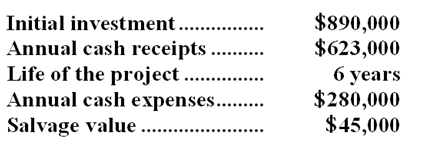 The company's tax rate is 30%. For tax purposes, the entire initial investment will be depreciated over 5 years without any reduction for salvage value. The company uses a discount rate of 14%.
-When computing the net present value of the project,what is the after-tax cash flow from the salvage value in the final year?
The company's tax rate is 30%. For tax purposes, the entire initial investment will be depreciated over 5 years without any reduction for salvage value. The company uses a discount rate of 14%.
-When computing the net present value of the project,what is the after-tax cash flow from the salvage value in the final year? (Multiple Choice)
4.9/5  (83)
(83) Morgado Inc. has provided the following data to be used in evaluating a proposed investment project: 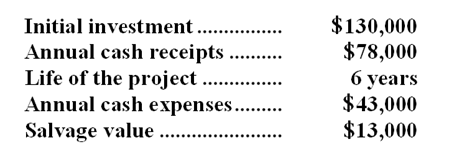 The company's tax rate is 30%. For tax purposes, the entire initial investment will be depreciated over 5 years without any reduction for salvage value. The company uses a discount rate of 19%.
-When computing the net present value of the project,what are the annual after-tax cash receipts?
The company's tax rate is 30%. For tax purposes, the entire initial investment will be depreciated over 5 years without any reduction for salvage value. The company uses a discount rate of 19%.
-When computing the net present value of the project,what are the annual after-tax cash receipts? (Multiple Choice)
4.8/5 (91)
(91) Morgado Inc. has provided the following data to be used in evaluating a proposed investment project: The company's tax rate is 30%. For tax purposes, the entire initial investment will be depreciated over 5 years without any reduction for salvage value. The company uses a discount rate of 19%.
-By how much does the depreciation deduction reduce taxes each year in which the depreciation deduction is taken?
The company's tax rate is 30%. For tax purposes, the entire initial investment will be depreciated over 5 years without any reduction for salvage value. The company uses a discount rate of 19%.
-By how much does the depreciation deduction reduce taxes each year in which the depreciation deduction is taken? (Multiple Choice)
4.9/5 (85)
(85) A company is considering purchasing an asset for $50,000 that would have a useful life of 8 years and would have a salvage value of $5,000.For tax purposes,the entire original cost of the asset would be depreciated over 8 years using the straight-line method and the salvage value would be ignored.The asset would generate annual net cash inflows of $26,000 throughout its useful life.The project would require additional working capital of $8,000,which would be released at the end of the project.The company's tax rate is 40% and its discount rate is 13%.
Required:
What is the net present value of the asset?
(Essay)
4.7/5 (80)
(80) Jenny Inc. has provided the following data concerning an investment project that has been proposed: The company's tax rate is 30%. For tax purposes, the entire initial investment will be depreciated over 5 years without any reduction for salvage value. The company uses a discount rate of 14%.
-The net present value of the project is closest to:
The company's tax rate is 30%. For tax purposes, the entire initial investment will be depreciated over 5 years without any reduction for salvage value. The company uses a discount rate of 14%.
-The net present value of the project is closest to: (Multiple Choice)
4.8/5 (74)
(74) Last year the sales at Summit Company were $400,000 and were all cash sales.The expenses at Summit were $250,000 and were all cash expenses.The tax rate was 40%.The after-tax net cash inflow at Summit last year was:
(Multiple Choice)
4.8/5 (86)
(86) The reduction in taxes made possible by the annual depreciation deductions equals the depreciation deduction multiplied by the tax rate.
(True/False)
4.8/5 (86)
(86) In an equipment selection capital budgeting decision,which of the following will increase the present value of the tax savings from the annual depreciation deductions?
(Multiple Choice)
4.9/5 (86)
(86) A company anticipates a depreciation deduction of $20,000 in year 3 of a project.The company's tax rate is 30% and its discount rate is 14%.The present value of the annual depreciation deductions resulting from this deduction is closest to:
(Multiple Choice)
4.9/5 (81)
(81) Consider a machine which costs $115,000 now and which has a useful life of seven years.This machine will require a major overhaul at the end of the fourth year which will cost "X" dollars.If the tax rate is 40%,and if the after-tax cash outflow for this overhaul is $3,600,then the amount of "X" in dollars is:
(Multiple Choice)
5.0/5 (69)
(69) Management is considering purchasing an asset for $30,000 that would have a useful life of 5 years and no salvage value.For tax purposes,the entire original cost of the asset would be depreciated over 5 years using the straight-line method.The asset would generate annual net cash inflows of $21,000 throughout its useful life.The project would require additional working capital of $4,000,which would be released at the end of the project.The company's tax rate is 40% and its discount rate is 8%.
Required:
What is the net present value of the asset?
(Essay)
4.8/5 (68)
(68) The Dill and Gherkin Law Firm is contemplating the decision to open up a branch office across town.The firm would sign a 5-year lease for a fully furnished office for $24,000 per year.The lease also requires a $30,000 security deposit upon signing.This deposit will be given back at the end of the 5-year lease term.No other amounts will need to be invested.However,additional operating costs are expected to be $65,000 per year for the 5 years.The firm expects to generate an additional $100,000 of revenue per year for the 5 years from the branch office.The firm's after-tax cost of capital is 16% and its tax rate is 30%.The net present value of this investment project is closest to:
(Multiple Choice)
4.8/5 (85)
(85) Sarafin Inc.is considering a project that would require an initial investment of $693,000 and would have a useful life of 7 years.The annual cash receipts would be $416,000 and the annual cash expenses would be $208,000.The salvage value of the assets used in the project would be $35,000.The company's tax rate is 30%.For tax purposes,the entire initial investment without any reduction for salvage value will be depreciated over 5 years.The company uses a discount rate of 15%.
Required:
Compute the net present value of the project.
(Essay)
4.9/5 (86)
(86) Eisenbeis Inc.has provided the following data concerning a proposed investment project: 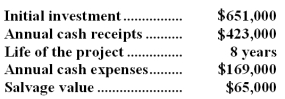 The company's tax rate is 30%.For tax purposes,the entire initial investment without any reduction for salvage value will be depreciated over 7 years.The company uses a discount rate of 13%.
Required:
Compute the net present value of the project.
The company's tax rate is 30%.For tax purposes,the entire initial investment without any reduction for salvage value will be depreciated over 7 years.The company uses a discount rate of 13%.
Required:
Compute the net present value of the project. (Essay)
4.7/5 (82)
(82) 
Filters
- Essay(0)
- Multiple Choice(0)
- Short Answer(0)
- True False(0)
- Matching(0)