



 Chat with AI
Exam 9: Worlds of Gas and Liquidthe Giant Planets

Exam 1: Why Learn Astronomy65 Questions
Exam 2: Patterns in the Skymotions of Earth70 Questions
Exam 3: Gravity and Orbitsa Celestial Ballet68 Questions
Exam 4: Light70 Questions
Exam 5: The Tools of the Astronomer68 Questions
Exam 6: The Birth and Evolution of Planetary Systems67 Questions
Exam 7: The Terrestrial Planets and Earths Moon71 Questions
Exam 8: Atmospheres of the Terrestrial Planets71 Questions
Exam 9: Worlds of Gas and Liquidthe Giant Planets68 Questions
Exam 10: Gravity Is More Than Keplers Laws69 Questions
Exam 11: Planetary Adornmentsmoons and Rings68 Questions
Exam 12: Dwarf Planets and Small Solar System Bodies69 Questions
Exam 13: Taking the Measure of Stars70 Questions
Exam 14: A Run-Of-The-Mill G-Type Starour Sun68 Questions
Exam 15: Star Formation and the Interstellar Medium67 Questions
Exam 16: Stars in the Slow Lanelow-Mass Stellar Evolution69 Questions
Exam 17: Live Fast,die Younghigh-Mass Stellar Evolution70 Questions
Exam 18: Our Expanding Universe70 Questions
Exam 19: Galaxies69 Questions
Exam 20: The Milky Waya Normal Spiral Galaxy70 Questions
Exam 21: Modern Cosmology70 Questions
Exam 22: The Origin of Structure45 Questions
Exam 23: Life40 Questions
Select questions type


You observe Neptune as it occults a background star when the relative velocity between Neptune and the Earth is 30 km/s,and the star crosses through the middle of the planet and disappears for 27.6 minutes.What is Neptune's diameter?
(Multiple Choice)
4.8/5  (83)
(83) The giant planets are made primarily of carbon dioxide and methane.
(True/False)
4.8/5 (79)
(79) When charged particles oscillate around magnetic field lines of a planet they emit radiation in the microwave region of the spectrum.
(True/False)
4.8/5 (92)
(92) The Great Red Spot,Jupiter's most prominent storm system,has a diameter that is __________ times the Earth's diameter.
(Multiple Choice)
5.0/5 (90)
(90) Calculate Jupiter's mass (in Earth masses)based on its gravitational pull on its moon,Io,using Newton's version of Kepler's third law:  .In order to do so,you will need the following information: Io's
 ;Io's semimajor
 ;the mass of the
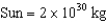 ;the
 (also,
 ).
.In order to do so,you will need the following information: Io's ;Io's semimajor ;the mass of the ;the (also, ). (Essay)
4.8/5 (84)
(84) Uranus and Neptune are called ice giants because they have deep salty oceans that give rise to their strong magnetic fields.
(True/False)
4.8/5 (83)
(83) The composition of the giant planets is consistent with solar abundance,but not with the composition of the universe as a whole.
(True/False)
4.9/5 (75)
(75) If you could find a large enough ocean,which one of these planets would float in it?
(Multiple Choice)
4.9/5 (74)
(74) __________ has the most extreme seasons of any planet in the Solar System.
(Multiple Choice)
4.8/5 (75)
(75) How does the discovery of Neptune relate to the discovery of extrasolar planets?
(Essay)
4.8/5 (68)
(68) The fact that Jupiter's radius is contracting at a rate of 1 mm/year results in
(Multiple Choice)
4.9/5 (85)
(85) The inner core of each of the giant planets is made up of rocky material that is __________ times the mass of the Earth.
(Multiple Choice)
4.7/5 (77)
(77) The strongest magnetic fields in the Solar System are found on which planet?
(Multiple Choice)
4.9/5 (88)
(88) Suppose you attach a weight to one end of a spring and then hold the other end of the spring and spin it above your head.The faster you spin the spring,the farther away the weight will move from your hand.This example illustrates
(Multiple Choice)
4.9/5 (87)
(87) We refer to some of the inner regions of Jupiter and Saturn as metallic hydrogen because they
(Multiple Choice)
4.9/5 (93)
(93) Despite the high temperatures deep in the interior of giant planets,their cores remain liquid because
(Multiple Choice)
5.0/5 (65)
(65) The colors of the cloud bands on Jupiter and Saturn are due primarily to differences in their
(Multiple Choice)
4.9/5 (77)
(77) 
Filters
- Essay(0)
- Multiple Choice(0)
- Short Answer(0)
- True False(0)
- Matching(0)