



 Chat with AI
Exam 2: Patterns in the Skymotions of Earth

Exam 1: Why Learn Astronomy92 Questions
Exam 2: Patterns in the Skymotions of Earth96 Questions
Exam 3: Motion of Astronomical Bodies91 Questions
Exam 4: Gravity and Orbits88 Questions
Exam 5: Light87 Questions
Exam 6: The Tools of the Astronomer94 Questions
Exam 7: The Birth and Evolution of Planetary Systems87 Questions
Exam 8: The Terrestrial Planets and Earths Moon99 Questions
Exam 9: Atmospheres of the Terrestrial Planets92 Questions
Exam 10: Worlds of Gas and Liquid the Giant Planets92 Questions
Exam 11: Planetary Adornmentsmoons and Rings93 Questions
Exam 12: Dwarf Planets and Small Solar System Bodies89 Questions
Exam 13: Taking the Measure of Stars88 Questions
Exam 14: Our Starthe Sun88 Questions
Exam 15: Star Formation and the Interstellar Medium89 Questions
Exam 16: Evolution of Low-Mass Stars90 Questions
Exam 17: Evolution of High-Mass Stars90 Questions
Exam 18: Relativity and Black Holes90 Questions
Exam 19: The Expanding Universe90 Questions
Exam 20: Galaxies95 Questions
Exam 21: The Milky Waya Normal Spiral Galaxy96 Questions
Exam 22: Modern Cosmology92 Questions
Exam 23: Large-Scale Structure in the Universe65 Questions
Exam 24: Life61 Questions
Select questions type


If you see a full moon tonight, how long would you have to wait to see the next full moon?
(Multiple Choice)
5.0/5  (83)
(83) Explain why the eclipse seasons occur roughly twice every 11 months, rather than twice per year.
(Essay)
4.9/5 (95)
(95) For a person living in Vancouver, Canada, at latitude of +49°, the Sun will reach a maximum height above the Southern horizon on winter solstice of
(Multiple Choice)
4.8/5 (70)
(70) On which day of the year does the Sun reach its northernmost point in the sky?
(Multiple Choice)
4.9/5 (76)
(76) When the Northern Hemisphere experiences fall, the Southern Hemisphere experiences:
(Multiple Choice)
4.9/5 (67)
(67) The Earth's rotational axis precesses in space and completes one revolution every:
(Multiple Choice)
4.9/5 (91)
(91) Which of the following stars will be the North Star in 12,000 years?
(Multiple Choice)
4.9/5 (72)
(72) The Moon undergoes synchronous rotation, and as a consequence the:
(Multiple Choice)
4.9/5 (64)
(64) Based on the location of the moon in the diagram below, draw a picture of how the moon would appear to an observer located on Earth. 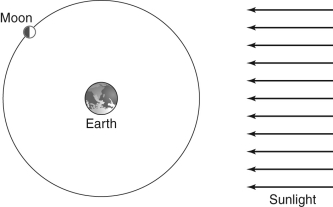
(Essay)
4.7/5 (82)
(82) 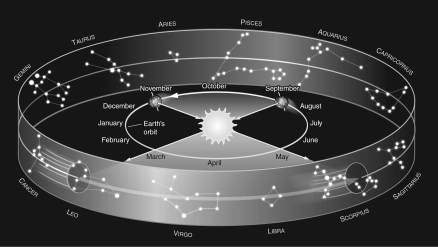 Figure 1
-Assume you are observing the night sky from a typical city in the United States with a latitude of +40°. Using Figure 1, which constellation of the zodiac would be nearest to the meridian at 10 P.M. in mid-May?
Figure 1
-Assume you are observing the night sky from a typical city in the United States with a latitude of +40°. Using Figure 1, which constellation of the zodiac would be nearest to the meridian at 10 P.M. in mid-May? (Multiple Choice)
4.7/5 (89)
(89) The day with the smallest number of daylight hours over the course of the year for a person living in the Northern Hemisphere is the:
(Multiple Choice)
4.7/5 (72)
(72) If the star Polaris has an altitude of 35°, then we know that:
(Multiple Choice)
4.9/5 (83)
(83) If you are standing on the equator and shoot a cannonball directly north, where would you expect it to land?
(Essay)
4.8/5 (71)
(71) How often would we have leap years if Earth's orbital period were 365.1 days?
(Multiple Choice)
4.8/5 (69)
(69) Figure 1
-Assume you are observing the night sky from a typical city in the United States with a latitude of +40°. Using Figure 1, which constellation of the zodiac would be nearest to the meridian at 6 P.M. in mid-September?
Figure 1
-Assume you are observing the night sky from a typical city in the United States with a latitude of +40°. Using Figure 1, which constellation of the zodiac would be nearest to the meridian at 6 P.M. in mid-September? (Multiple Choice)
4.9/5 (76)
(76) 
Filters
- Essay(0)
- Multiple Choice(0)
- Short Answer(0)
- True False(0)
- Matching(0)