



 Chat with AI
Exam 6: The Tools of the Astronomer

Exam 1: Why Learn Astronomy92 Questions
Exam 2: Patterns in the Skymotions of Earth96 Questions
Exam 3: Motion of Astronomical Bodies91 Questions
Exam 4: Gravity and Orbits88 Questions
Exam 5: Light87 Questions
Exam 6: The Tools of the Astronomer94 Questions
Exam 7: The Birth and Evolution of Planetary Systems87 Questions
Exam 8: The Terrestrial Planets and Earths Moon99 Questions
Exam 9: Atmospheres of the Terrestrial Planets92 Questions
Exam 10: Worlds of Gas and Liquid the Giant Planets92 Questions
Exam 11: Planetary Adornmentsmoons and Rings93 Questions
Exam 12: Dwarf Planets and Small Solar System Bodies89 Questions
Exam 13: Taking the Measure of Stars88 Questions
Exam 14: Our Starthe Sun88 Questions
Exam 15: Star Formation and the Interstellar Medium89 Questions
Exam 16: Evolution of Low-Mass Stars90 Questions
Exam 17: Evolution of High-Mass Stars90 Questions
Exam 18: Relativity and Black Holes90 Questions
Exam 19: The Expanding Universe90 Questions
Exam 20: Galaxies95 Questions
Exam 21: The Milky Waya Normal Spiral Galaxy96 Questions
Exam 22: Modern Cosmology92 Questions
Exam 23: Large-Scale Structure in the Universe65 Questions
Exam 24: Life61 Questions
Select questions type


Discuss two advantages of flyby missions over orbiters in exploring planets and moons in the Solar System.
(Essay)
4.8/5  (80)
(80) The 305-meter Arecibo radio telescope in Puerto Rico has a resolution that is closest to that of:
(Multiple Choice)
5.0/5 (89)
(89) Which of the following phenomena is shown in the figure below? 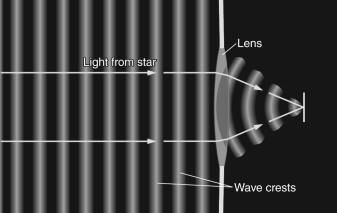
(Multiple Choice)
4.9/5 (87)
(87) Which telescope would collect 100 times more light than a 1-meter telescope?
(Multiple Choice)
5.0/5 (92)
(92) Explain three major advantages of CCDs over other imaging techniques.
(Essay)
4.7/5 (79)
(79) One reason to prefer a reflecting over a refracting telescope is:
(Multiple Choice)
4.8/5 (89)
(89) Large reflecting telescopes have mirrors that are _________ in shape.
(Multiple Choice)
4.7/5 (75)
(75) A prism is able to spread white light out into a spectrum of colors based on the property of:
(Multiple Choice)
4.8/5 (87)
(87) Calculate the resolution of an interferometric array consisting of five 10-m radio telescopes, each located 1,000 meters apart from each other and observing a distant object at a wavelength of 21 cm.
(Essay)
4.9/5 (68)
(68) Grote Reber conducted the first radio survey of the sky in the 1930s and 1940s with his 9-meter diameter radio telescope. Why did his telescope need to be so large?
(Multiple Choice)
4.9/5 (85)
(85) What type of waves have NOT yet been directly detected by astronomers?
(Multiple Choice)
4.9/5 (85)
(85) 
Filters
- Essay(0)
- Multiple Choice(0)
- Short Answer(0)
- True False(0)
- Matching(0)