



 Chat with AI
Exam 8: The Terrestrial Planets and Earths Moon

Exam 1: Why Learn Astronomy92 Questions
Exam 2: Patterns in the Skymotions of Earth96 Questions
Exam 3: Motion of Astronomical Bodies91 Questions
Exam 4: Gravity and Orbits88 Questions
Exam 5: Light87 Questions
Exam 6: The Tools of the Astronomer94 Questions
Exam 7: The Birth and Evolution of Planetary Systems87 Questions
Exam 8: The Terrestrial Planets and Earths Moon99 Questions
Exam 9: Atmospheres of the Terrestrial Planets92 Questions
Exam 10: Worlds of Gas and Liquid the Giant Planets92 Questions
Exam 11: Planetary Adornmentsmoons and Rings93 Questions
Exam 12: Dwarf Planets and Small Solar System Bodies89 Questions
Exam 13: Taking the Measure of Stars88 Questions
Exam 14: Our Starthe Sun88 Questions
Exam 15: Star Formation and the Interstellar Medium89 Questions
Exam 16: Evolution of Low-Mass Stars90 Questions
Exam 17: Evolution of High-Mass Stars90 Questions
Exam 18: Relativity and Black Holes90 Questions
Exam 19: The Expanding Universe90 Questions
Exam 20: Galaxies95 Questions
Exam 21: The Milky Waya Normal Spiral Galaxy96 Questions
Exam 22: Modern Cosmology92 Questions
Exam 23: Large-Scale Structure in the Universe65 Questions
Exam 24: Life61 Questions
Select questions type


The American and African/European continents are now separated by the Atlantic Ocean, which is approximately 4,000 km wide. Assuming a continental drift rate of 2 cm/year, how long has it been since they were one land mass?
(Essay)
4.8/5  (94)
(94) What would you study in order to determine the timescale on which the Earth's magnetic field reverses direction?
(Multiple Choice)
4.7/5 (79)
(79) 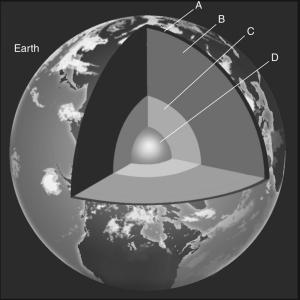 Figure 3
-Which layer in Figure 3 represents the Earth's liquid core?
Figure 3
-Which layer in Figure 3 represents the Earth's liquid core? (Multiple Choice)
4.7/5 (95)
(95) The Mars rovers named Spirit and Opportunity found evidence in the chemical makeup of the rocks that proves Mars had liquid water on its surface in the past.
(True/False)
4.7/5 (73)
(73) The Moon has a diameter that is approximately one-fourth that of Earth. If these objects' interiors are heated by radioactive decays, and the total amount of energy in decays is proportional to the object's volume, then how does the amount of heat the Moon has compare to that of Earth?
(Multiple Choice)
4.7/5 (70)
(70) Which of the following are NOT sites of frequent volcanic and earthquake activity on Earth?
(Multiple Choice)
4.8/5 (89)
(89) The fact that Earth's interior is differentiated suggests that:
(Multiple Choice)
4.8/5 (87)
(87)  Figure 1
-Which picture in Figure 1 illustrates an example of volcanism occurring on Earth?
Figure 1
-Which picture in Figure 1 illustrates an example of volcanism occurring on Earth? (Multiple Choice)
4.8/5 (80)
(80) If the Himalaya mountain range is presently 8,000 meters in height and is rising at a rate of 0.5 meters per century because of the convergence of two continental plates, how long did it take to create this mountain range?
(Multiple Choice)
5.0/5 (71)
(71) Mars, Venus, and Earth are much less heavily cratered than Mercury and the Moon. This is explained by the fact that:
(Multiple Choice)
4.9/5 (78)
(78) Which of the following is NOT a factor that helps explain Earth's lack of craters compared to the Moon?
(Multiple Choice)
4.8/5 (80)
(80) To survive passage through the Earth's atmosphere without burning or breaking up before it hits the ground, an asteroid must be:
(Multiple Choice)
4.9/5 (80)
(80) The feature on Mars shown in the figure below is _________ named _________. 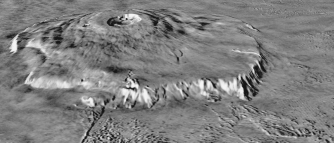
(Multiple Choice)
4.9/5 (80)
(80) Figure 1
-Which picture in Figure 1 is an example of impacts occurring on Earth?
Figure 1
-Which picture in Figure 1 is an example of impacts occurring on Earth? (Multiple Choice)
4.8/5 (79)
(79)  Figure 4
-The large feature spanning the surface of Mars in Figure 4 is _________ and probably was created by _________.
Figure 4
-The large feature spanning the surface of Mars in Figure 4 is _________ and probably was created by _________. (Multiple Choice)
4.9/5 (85)
(85) 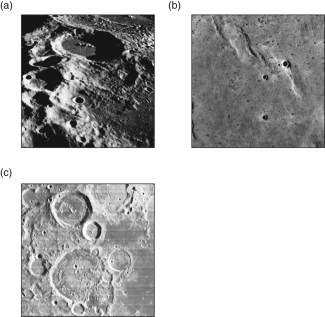 Figure 2
-Which of these three lunar surfaces shown in Figure 2 is the oldest?
Figure 2
-Which of these three lunar surfaces shown in Figure 2 is the oldest? (Multiple Choice)
4.8/5 (82)
(82) Which is NOT a reason that we suspect that the extinction of the dinosaurs was caused by a large impact by a large object?
(Multiple Choice)
4.8/5 (67)
(67) Examine the figure below that shows the continental plates of the Earth and the locations of volcanoes and earthquakes. Which statement is FALSE? 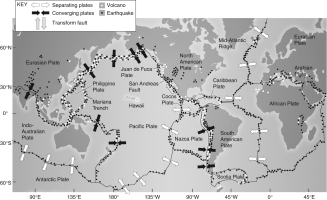
(Multiple Choice)
4.8/5 (71)
(71) If there is water on Mars today, where is it likely to be? Name two separate pieces of evidence we have that Mars once had flowing water on its surface and how this evidence was obtained.
(Essay)
4.8/5 (75)
(75) 
Filters
- Essay(0)
- Multiple Choice(0)
- Short Answer(0)
- True False(0)
- Matching(0)