



 Chat with AI
Exam 14: Our Starthe Sun

Exam 1: Why Learn Astronomy92 Questions
Exam 2: Patterns in the Skymotions of Earth96 Questions
Exam 3: Motion of Astronomical Bodies91 Questions
Exam 4: Gravity and Orbits88 Questions
Exam 5: Light87 Questions
Exam 6: The Tools of the Astronomer94 Questions
Exam 7: The Birth and Evolution of Planetary Systems87 Questions
Exam 8: The Terrestrial Planets and Earths Moon99 Questions
Exam 9: Atmospheres of the Terrestrial Planets92 Questions
Exam 10: Worlds of Gas and Liquid the Giant Planets92 Questions
Exam 11: Planetary Adornmentsmoons and Rings93 Questions
Exam 12: Dwarf Planets and Small Solar System Bodies89 Questions
Exam 13: Taking the Measure of Stars88 Questions
Exam 14: Our Starthe Sun88 Questions
Exam 15: Star Formation and the Interstellar Medium89 Questions
Exam 16: Evolution of Low-Mass Stars90 Questions
Exam 17: Evolution of High-Mass Stars90 Questions
Exam 18: Relativity and Black Holes90 Questions
Exam 19: The Expanding Universe90 Questions
Exam 20: Galaxies95 Questions
Exam 21: The Milky Waya Normal Spiral Galaxy96 Questions
Exam 22: Modern Cosmology92 Questions
Exam 23: Large-Scale Structure in the Universe65 Questions
Exam 24: Life61 Questions
Select questions type


If a coronal mass ejection occurs on the Sun that expels material at a speed of 800 km/s, how long will it take these charged particles to reach the Earth?
(Multiple Choice)
4.9/5  (75)
(75) Our Sun is unique compared to the other stars in our galaxy because of its:
(Multiple Choice)
4.9/5 (65)
(65) Explain why hydrostatic equilibrium results in the center of the Sun having the highest pressure and temperature.
(Essay)
4.8/5 (71)
(71) The magnetic field of the Sun is continuously produced and deformed by:
(Multiple Choice)
4.8/5 (78)
(78) Explain why the solution to the solar neutrino problem is an excellent example of how observations drive the evolution of science.
(Essay)
4.8/5 (88)
(88) The temperature of the corona is much hotter than any other layer in the solar atmosphere.
(True/False)
4.9/5 (63)
(63) Solar wind particles hit the surface of the Moon, but they don't make it to the surface of the Earth because the Earth:
(Multiple Choice)
4.9/5 (82)
(82) Approximately how long does it take the photons released in nuclear reactions in the core of the Sun to exit the photosphere?
(Multiple Choice)
4.9/5 (76)
(76) In addition to the laws of physics and chemistry, what information do we need to know about our Sun to calculate its internal structure and radius?
(Essay)
4.9/5 (78)
(78) When two atomic nuclei come together to form a new species of atom, this is called:
(Multiple Choice)
4.8/5 (81)
(81) The picture below shows a diagram of the Sun with zones labeled A, B, and C. 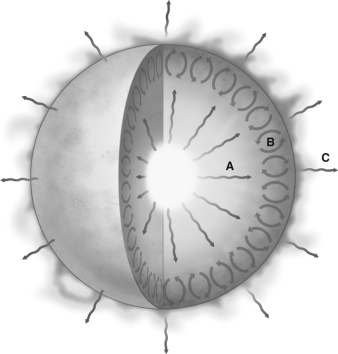 Explain how energy is being transferred in each of the three regions.
 (Essay)
4.9/5 (91)
(91) The Sun's internal magnetic field becomes tangled up over time because of:
(Multiple Choice)
4.8/5 (79)
(79) In the proton-proton chain, the net reaction is that 4 protons are converted into 1 helium nucleus. What other byproducts are released in this reaction, and why?
(Essay)
4.8/5 (64)
(64) The solar spectrum is an example of a(n) _________ spectrum.
(Multiple Choice)
4.8/5 (74)
(74) Imagine that you observed the Sun and measured the brightness of the face of the Sun at the locations marked in this image: 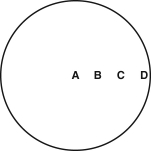 At which of these locations would you measure the lowest brightness?
 (Multiple Choice)
4.9/5 (91)
(91) 
Filters
- Essay(0)
- Multiple Choice(0)
- Short Answer(0)
- True False(0)
- Matching(0)