



 Chat with AI
Exam 15: Star Formation and the Interstellar Medium

Exam 1: Why Learn Astronomy92 Questions
Exam 2: Patterns in the Skymotions of Earth96 Questions
Exam 3: Motion of Astronomical Bodies91 Questions
Exam 4: Gravity and Orbits88 Questions
Exam 5: Light87 Questions
Exam 6: The Tools of the Astronomer94 Questions
Exam 7: The Birth and Evolution of Planetary Systems87 Questions
Exam 8: The Terrestrial Planets and Earths Moon99 Questions
Exam 9: Atmospheres of the Terrestrial Planets92 Questions
Exam 10: Worlds of Gas and Liquid the Giant Planets92 Questions
Exam 11: Planetary Adornmentsmoons and Rings93 Questions
Exam 12: Dwarf Planets and Small Solar System Bodies89 Questions
Exam 13: Taking the Measure of Stars88 Questions
Exam 14: Our Starthe Sun88 Questions
Exam 15: Star Formation and the Interstellar Medium89 Questions
Exam 16: Evolution of Low-Mass Stars90 Questions
Exam 17: Evolution of High-Mass Stars90 Questions
Exam 18: Relativity and Black Holes90 Questions
Exam 19: The Expanding Universe90 Questions
Exam 20: Galaxies95 Questions
Exam 21: The Milky Waya Normal Spiral Galaxy96 Questions
Exam 22: Modern Cosmology92 Questions
Exam 23: Large-Scale Structure in the Universe65 Questions
Exam 24: Life61 Questions
Select questions type


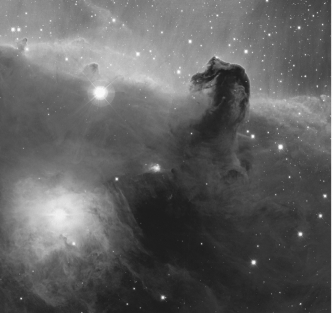
What is the most likely explanation for the dark area in the image below? 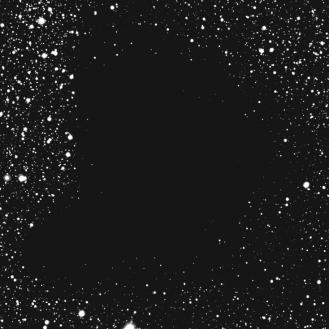
(Multiple Choice)
4.7/5  (79)
(79) 
The entire process of star formation is really just an evolving balance between:
(Multiple Choice)
5.0/5 (85)
(85) The interstellar medium is divided up into three different kinds of gas clouds: cold gas at 10 K, warm gas at 8000 K, and hot gas at about 1 million K.
(True/False)
4.8/5 (74)
(74) Molecular hydrogen atoms are found only inside dense clouds where they are shielded from stellar radiation.
(True/False)
4.9/5 (76)
(76) When a molecular cloud fragments and stars form, the least massive stars are the first to form while the most massive stars take longer to form.
(True/False)
4.7/5 (82)
(82) Star formation in a molecular cloud can be slowed by the strength of its magnetic field and turbulence caused by supernovae and stellar winds from massive stars.
(True/False)
4.8/5 (67)
(67) Stars forming in molecular clouds tend to form first in the low-density periphery.
(True/False)
4.8/5 (75)
(75) Because angular momentum must be conserved, as a gas cloud contracts due to gravity it will also:
(Multiple Choice)
4.8/5 (77)
(77) A protostar's evolutionary "track" in the H-R diagram traces out:
(Multiple Choice)
4.7/5 (85)
(85) A _________ is a failed star that shines primarily because of energy derived from its gravitational collapse rather than nuclear burning.
(Multiple Choice)
4.8/5 (78)
(78) Below are three pictures of the disk of the Milky Way, taken in three different wavelength ranges. 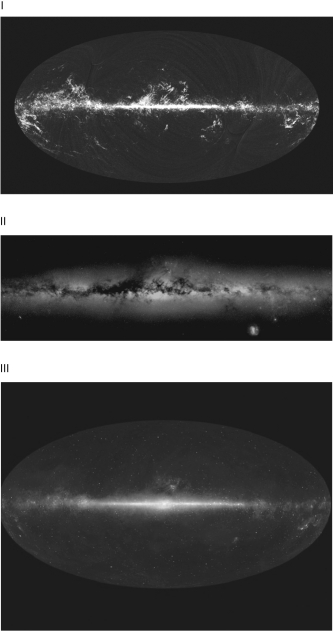 Put the three pictures in order from shortest to longest wavelength.
 (Multiple Choice)
5.0/5 (79)
(79) A protostar is usually in hydrostatic equilibrium as its collapses.
(True/False)
4.9/5 (77)
(77) Describe the general process of how the interstellar medium can create a star.
(Essay)
4.8/5 (76)
(76) Why can we see dust in the interstellar medium better at far-infrared wavelengths than we can at optical wavelengths?
(Essay)
4.9/5 (78)
(78) 
Filters
- Essay(0)
- Multiple Choice(0)
- Short Answer(0)
- True False(0)
- Matching(0)