



 Chat with AI
Exam 18: Relativity and Black Holes

Exam 1: Why Learn Astronomy92 Questions
Exam 2: Patterns in the Skymotions of Earth96 Questions
Exam 3: Motion of Astronomical Bodies91 Questions
Exam 4: Gravity and Orbits88 Questions
Exam 5: Light87 Questions
Exam 6: The Tools of the Astronomer94 Questions
Exam 7: The Birth and Evolution of Planetary Systems87 Questions
Exam 8: The Terrestrial Planets and Earths Moon99 Questions
Exam 9: Atmospheres of the Terrestrial Planets92 Questions
Exam 10: Worlds of Gas and Liquid the Giant Planets92 Questions
Exam 11: Planetary Adornmentsmoons and Rings93 Questions
Exam 12: Dwarf Planets and Small Solar System Bodies89 Questions
Exam 13: Taking the Measure of Stars88 Questions
Exam 14: Our Starthe Sun88 Questions
Exam 15: Star Formation and the Interstellar Medium89 Questions
Exam 16: Evolution of Low-Mass Stars90 Questions
Exam 17: Evolution of High-Mass Stars90 Questions
Exam 18: Relativity and Black Holes90 Questions
Exam 19: The Expanding Universe90 Questions
Exam 20: Galaxies95 Questions
Exam 21: The Milky Waya Normal Spiral Galaxy96 Questions
Exam 22: Modern Cosmology92 Questions
Exam 23: Large-Scale Structure in the Universe65 Questions
Exam 24: Life61 Questions
Select questions type


The singularity of a black hole has an infinitely small radius, but its event horizon is finite.
(True/False)
4.7/5  (84)
(84) If the Sun were to be instantly replaced by a 1M black hole, the gravitational pull of the black hole on Earth would be:
(Multiple Choice)
4.9/5 (92)
(92) You observe a distant galaxy apparently moving away at 1/3 the speed of light (v =c/3). If you could measure the speed that this galaxy's light is passing the Earth, you would get:
(Multiple Choice)
4.9/5 (86)
(86) Gravitational lensing allows us to see distant objects brightened and distorted because of massive objects in the path that the light from the object travels.
(True/False)
4.8/5 (84)
(84) Photons have no mass, and Einstein's theory of general relativity says:
(Multiple Choice)
4.8/5 (86)
(86) As shown in this figure, an observer in a windowless room notices that light from a flashlight does not follow a straight path, but instead seems to be bent downwards as it crosses the room. What does the observer conclude is happening? 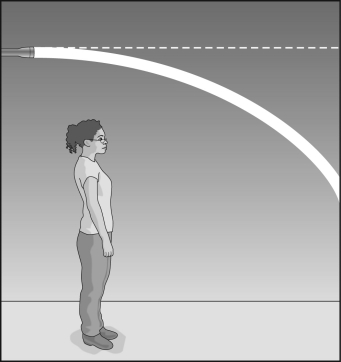
(Multiple Choice)
4.9/5 (93)
(93) Galileo supposedly experimented with gravity by dropping two objects of different masses from the leaning tower of Pisa at the same instant and observing that they hit the ground at the same time. If Albert Einstein had done the experiment, how would his conclusion have differed from Galileo's?
(Essay)
4.8/5 (72)
(72) 
Filters
- Essay(0)
- Multiple Choice(0)
- Short Answer(0)
- True False(0)
- Matching(0)