



 Chat with AI
Exam 24: Life

Exam 1: Why Learn Astronomy92 Questions
Exam 2: Patterns in the Skymotions of Earth96 Questions
Exam 3: Motion of Astronomical Bodies91 Questions
Exam 4: Gravity and Orbits88 Questions
Exam 5: Light87 Questions
Exam 6: The Tools of the Astronomer94 Questions
Exam 7: The Birth and Evolution of Planetary Systems87 Questions
Exam 8: The Terrestrial Planets and Earths Moon99 Questions
Exam 9: Atmospheres of the Terrestrial Planets92 Questions
Exam 10: Worlds of Gas and Liquid the Giant Planets92 Questions
Exam 11: Planetary Adornmentsmoons and Rings93 Questions
Exam 12: Dwarf Planets and Small Solar System Bodies89 Questions
Exam 13: Taking the Measure of Stars88 Questions
Exam 14: Our Starthe Sun88 Questions
Exam 15: Star Formation and the Interstellar Medium89 Questions
Exam 16: Evolution of Low-Mass Stars90 Questions
Exam 17: Evolution of High-Mass Stars90 Questions
Exam 18: Relativity and Black Holes90 Questions
Exam 19: The Expanding Universe90 Questions
Exam 20: Galaxies95 Questions
Exam 21: The Milky Waya Normal Spiral Galaxy96 Questions
Exam 22: Modern Cosmology92 Questions
Exam 23: Large-Scale Structure in the Universe65 Questions
Exam 24: Life61 Questions
Select questions type


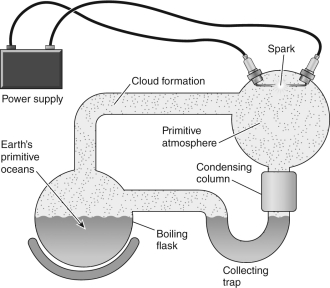
Scientists have shown that ammonia and methane, mixed together with liquid water and either hydrogen, carbon dioxide, or nitrogen, and exposed to electrical sparks, can produce some of the amino acids essential for life.
(True/False)
4.9/5  (80)
(80) If we model the history of the universe as a single day, at what time would the first Homo sapiens appear?
(Multiple Choice)
4.9/5 (77)
(77) Why would the 21-cm line be a good place to search for signals from intelligent life in the universe?
(Essay)
4.8/5 (85)
(85) Complex microorganisms that have complex DNA enclosed in a cell nucleus are called:
(Multiple Choice)
4.8/5 (85)
(85) Based on what you know of the Earth's evolution, what percent of Earth-like planets in a star cluster with an age of 2 billion years likely has intelligent life?
(Multiple Choice)
4.8/5 (75)
(75) 
The field of astrobiology uses our knowledge of ___________ to study life in the universe.
(Multiple Choice)
5.0/5 (85)
(85) Mutations always lead to improvements in an organism's ability to survive and reproduce.
(True/False)
4.8/5 (83)
(83) If the entire history of the universe were scaled to fit into one day, what time of day would microorganisms first form, oxygen start becoming a significant component of the atmosphere, and humans split off from their genetic ancestors?
(Essay)
4.9/5 (87)
(87) Which one of the following is NOT one of the three categories of terrestrial life based on their DNA characteristics?
(Multiple Choice)
4.8/5 (79)
(79) We search for intelligent life in the universe most effectively by:
(Multiple Choice)
4.9/5 (78)
(78) Using life on Earth as an example, calculate the maximum likelihood that any technologically advanced civilization that arose still exists on its home planet today.
(Essay)
4.8/5 (91)
(91) Animals are most closely related to which of the following branches?
(Multiple Choice)
4.7/5 (84)
(84) When the Pioneer and Voyager spacecraft were launched into space in the 1970s, they were outfitted with messages describing where they came from. Why is it fairly unlikely that an alien civilization will use them to find us?
(Multiple Choice)
4.7/5 (84)
(84) Which of the following Solar System objects is NOT a good candidate for future searches for life?
(Multiple Choice)
4.9/5 (85)
(85) As living organisms evolved to become more complex during the history of the Earth, did this violate the second law of thermodynamics?
(Essay)
4.7/5 (65)
(65) What determines whether or not a specific mutation is passed on to future generations?
(Essay)
4.9/5 (75)
(75) 
Filters
- Essay(0)
- Multiple Choice(0)
- Short Answer(0)
- True False(0)
- Matching(0)