



 Chat with AI
Exam 28: The Labor Market: Demand, Supply and Outsourcing

Exam 1: The Nature of Economics348 Questions
Exam 2: Scarcity and the World of Trade-Offs411 Questions
Exam 3: Demand and Supply451 Questions
Exam 4: Extensions of Demand and Supply Analysis401 Questions
Exam 5: Public Spending and Public Choice362 Questions
Exam 6: Funding the Public Sector201 Questions
Exam 7: The Macroeconomy: Unemployment, Inflation, and Deflation413 Questions
Exam 8: Measuring the Economys Performance416 Questions
Exam 9: Global Economic Growth and Development290 Questions
Exam 10: Real GDP and the Price Level in the Long Run298 Questions
Exam 11: Classical and Keynesian Macro Analyses368 Questions
Exam 12: Consumption, Real GDP, and the Multiplier452 Questions
Exam 13: Fiscal Policy274 Questions
Exam 14: Deficit Spending and the Public Debt146 Questions
Exam 15: Money, Banking, and Central Banking516 Questions
Exam 16: Domestic and International Dimensions of Monetary Policy357 Questions
Exam 17: Stabilization in an Integrated World Economy321 Questions
Exam 18: Policies and Prospects for Global Economic Growth228 Questions
Exam 19: Demand and Supply Elasticity412 Questions
Exam 20: Consumer Choice459 Questions
Exam 21: Rents, Profits, and the Financial Environment of Business445 Questions
Exam 22: The Firm: Cost and Output Determination391 Questions
Exam 23: Perfect Competition432 Questions
Exam 24: Monopoly386 Questions
Exam 25: Monopolistic Competition307 Questions
Exam 26: Oligopoly and Strategic Behavior308 Questions
Exam 27: Regulation and Antitrust Policy in a Globalized Economy310 Questions
Exam 28: The Labor Market: Demand, Supply and Outsourcing376 Questions
Exam 29: Unions and Labor Market Monopoly Power319 Questions
Exam 30: Income, Poverty, and Health Care304 Questions
Exam 31: Environmental Economics299 Questions
Exam 32: Comparative Advantage and the Open Economy282 Questions
Exam 33: Exchange Rates and the Balance of Payments285 Questions
Select questions type


If a monopolist has an output price of $10, marginal revenue equal to $4, and faces a fixed wage rate of $7, then the monopolist should hire labor until the marginal revenue product is equal to
(Multiple Choice)
5.0/5  (83)
(83) Which of the following would NOT shift an industry's supply of labor curve?
(Multiple Choice)
5.0/5 (86)
(86)  -Refer to the above table. How many workers will this firm hire if the weekly wage rate is $770?
 (Multiple Choice)
4.8/5 (75)
(75) If the price elasticity of demand is greater than 1, then consumer demand is
(Multiple Choice)
4.9/5 (67)
(67) If a firm wants to maximize profits, it should hire workers up to the point at which
(Multiple Choice)
4.9/5 (74)
(74) 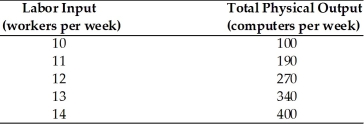 -The above table depicts output from a firm that manufactures computers. The computers sell for $1,000 each. What is the marginal revenue product (MRP) for the fourteenth worker per week?
 (Multiple Choice)
4.8/5 (68)
(68) 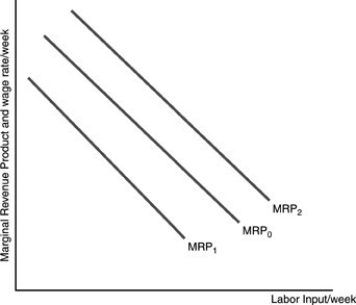 -Refer to the above figure. The firm is operating using MRP0. An increase in demand for the product has occurred. The relevant curve for the firm after the increase in price
 (Multiple Choice)
4.7/5 (65)
(65)
-The above table depicts the output of a firm that manufactures computers. The computers sell for $1,000 each. What is the marginal physical product (MPP) of the eleventh worker per week?
-The above table depicts the output of a firm that manufactures computers. The computers sell for $1,000 each. What is the marginal physical product (MPP) of the eleventh worker per week? (Multiple Choice)
4.7/5 (73)
(73)  -Refer to the above table. If the price of the product is $1.50, what is the marginal revenue product of the 11th worker?
 (Multiple Choice)
4.9/5 (79)
(79)
-Refer to the above table. If the price of the product is $1.50, and the marginal factor cost of an additional unit of an input is $135, how many units of labor should be hired?
-Refer to the above table. If the price of the product is $1.50, and the marginal factor cost of an additional unit of an input is $135, how many units of labor should be hired? (Multiple Choice)
4.9/5 (65)
(65) When the price of a product increases, the marginal revenue product curve in a perfectly competitive market
(Multiple Choice)
4.9/5 (85)
(85) The individual demand curve for an input such as labor to a firm would be the downward sloping portion of the firm's
(Multiple Choice)
5.0/5 (81)
(81) If the demand for online banking decreases, we would expect to see the
(Multiple Choice)
4.8/5 (66)
(66)  -Refer to the above table. If the price of the good produced is $5, the marginal revenue product of the 5th worker is
 (Multiple Choice)
4.9/5 (74)
(74)  -Refer to the above table. If the price of the good produced is $9, the marginal revenue product of the 13th worker is
 (Multiple Choice)
4.8/5 (94)
(94) We would expect unions to have a more difficult time negotiating higher wages for their members when
(Multiple Choice)
4.8/5 (94)
(94)
-Refer to the above table. Which of the following statements is correct?
-Refer to the above table. Which of the following statements is correct? (Multiple Choice)
4.9/5 (83)
(83) 
Filters
- Essay(0)
- Multiple Choice(0)
- Short Answer(0)
- True False(0)
- Matching(0)