



 Chat with AI
Exam 29: Unions and Labor Market Monopoly Power

Exam 1: The Nature of Economics348 Questions
Exam 2: Scarcity and the World of Trade-Offs411 Questions
Exam 3: Demand and Supply451 Questions
Exam 4: Extensions of Demand and Supply Analysis401 Questions
Exam 5: Public Spending and Public Choice362 Questions
Exam 6: Funding the Public Sector201 Questions
Exam 7: The Macroeconomy: Unemployment, Inflation, and Deflation413 Questions
Exam 8: Measuring the Economys Performance416 Questions
Exam 9: Global Economic Growth and Development290 Questions
Exam 10: Real GDP and the Price Level in the Long Run298 Questions
Exam 11: Classical and Keynesian Macro Analyses368 Questions
Exam 12: Consumption, Real GDP, and the Multiplier452 Questions
Exam 13: Fiscal Policy274 Questions
Exam 14: Deficit Spending and the Public Debt146 Questions
Exam 15: Money, Banking, and Central Banking516 Questions
Exam 16: Domestic and International Dimensions of Monetary Policy357 Questions
Exam 17: Stabilization in an Integrated World Economy321 Questions
Exam 18: Policies and Prospects for Global Economic Growth228 Questions
Exam 19: Demand and Supply Elasticity412 Questions
Exam 20: Consumer Choice459 Questions
Exam 21: Rents, Profits, and the Financial Environment of Business445 Questions
Exam 22: The Firm: Cost and Output Determination391 Questions
Exam 23: Perfect Competition432 Questions
Exam 24: Monopoly386 Questions
Exam 25: Monopolistic Competition307 Questions
Exam 26: Oligopoly and Strategic Behavior308 Questions
Exam 27: Regulation and Antitrust Policy in a Globalized Economy310 Questions
Exam 28: The Labor Market: Demand, Supply and Outsourcing376 Questions
Exam 29: Unions and Labor Market Monopoly Power319 Questions
Exam 30: Income, Poverty, and Health Care304 Questions
Exam 31: Environmental Economics299 Questions
Exam 32: Comparative Advantage and the Open Economy282 Questions
Exam 33: Exchange Rates and the Balance of Payments285 Questions
Select questions type


Which of the following is a correct statement about unions in the United States?
(Multiple Choice)
4.9/5  (86)
(86) At the profit-maximizing level of employment, the monopsonist
(Multiple Choice)
4.9/5 (85)
(85) Discuss the significant laws passed since the Great Depression that affect labor-management relations.
(Essay)
4.7/5 (83)
(83) A company can hire non-union workers, but a condition of their employment is that they must join the union within their first 90 days on the job. This is an example of a
(Multiple Choice)
4.8/5 (79)
(79) A union could raise wages without causing unemployment of union members if it can increase demand for union labor. How might this goal be achieved?
(Essay)
4.9/5 (94)
(94)  -According to the above table, the marginal factor cost of the eighth worker is
 (Multiple Choice)
4.9/5 (70)
(70) The president of the United States can obtain a court injunction that will stop a strike for an 80-day "cooling-off"period if the strike is expected to imperil national safety or health. This power is granted in the
(Multiple Choice)
4.7/5 (75)
(75) 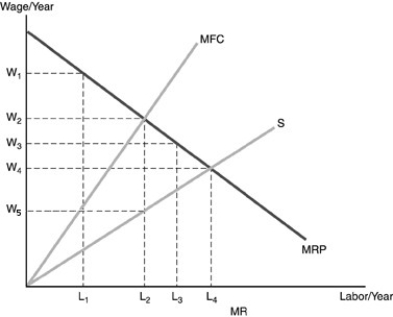 -Refer to the above figure. The wage rate under perfect competition is
 (Multiple Choice)
4.9/5 (88)
(88) Which of the following types of unions did the CIO promote?
(Multiple Choice)
4.9/5 (78)
(78) The 1935 Act granting workers the right to form unions and bargain collectively is known as
(Multiple Choice)
4.8/5 (81)
(81) A firm that is a monopsonist in the labor market and a monopolist in the product market will hire labor to the point at which
(Multiple Choice)
5.0/5 (87)
(87) To reduce labor surplus above the equilibrium union wage level, a union may do all of the following EXCEPT
(Multiple Choice)
4.9/5 (78)
(78) 
Filters
- Essay(0)
- Multiple Choice(0)
- Short Answer(0)
- True False(0)
- Matching(0)