



 Chat with AI
Exam 31: Environmental Economics

Exam 1: The Nature of Economics348 Questions
Exam 2: Scarcity and the World of Trade-Offs411 Questions
Exam 3: Demand and Supply451 Questions
Exam 4: Extensions of Demand and Supply Analysis401 Questions
Exam 5: Public Spending and Public Choice362 Questions
Exam 6: Funding the Public Sector201 Questions
Exam 7: The Macroeconomy: Unemployment, Inflation, and Deflation413 Questions
Exam 8: Measuring the Economys Performance416 Questions
Exam 9: Global Economic Growth and Development290 Questions
Exam 10: Real GDP and the Price Level in the Long Run298 Questions
Exam 11: Classical and Keynesian Macro Analyses368 Questions
Exam 12: Consumption, Real GDP, and the Multiplier452 Questions
Exam 13: Fiscal Policy274 Questions
Exam 14: Deficit Spending and the Public Debt146 Questions
Exam 15: Money, Banking, and Central Banking516 Questions
Exam 16: Domestic and International Dimensions of Monetary Policy357 Questions
Exam 17: Stabilization in an Integrated World Economy321 Questions
Exam 18: Policies and Prospects for Global Economic Growth228 Questions
Exam 19: Demand and Supply Elasticity412 Questions
Exam 20: Consumer Choice459 Questions
Exam 21: Rents, Profits, and the Financial Environment of Business445 Questions
Exam 22: The Firm: Cost and Output Determination391 Questions
Exam 23: Perfect Competition432 Questions
Exam 24: Monopoly386 Questions
Exam 25: Monopolistic Competition307 Questions
Exam 26: Oligopoly and Strategic Behavior308 Questions
Exam 27: Regulation and Antitrust Policy in a Globalized Economy310 Questions
Exam 28: The Labor Market: Demand, Supply and Outsourcing376 Questions
Exam 29: Unions and Labor Market Monopoly Power319 Questions
Exam 30: Income, Poverty, and Health Care304 Questions
Exam 31: Environmental Economics299 Questions
Exam 32: Comparative Advantage and the Open Economy282 Questions
Exam 33: Exchange Rates and the Balance of Payments285 Questions
Select questions type


If a person does NOT pay all costs associated with a particular resource-using activity, then
(Multiple Choice)
5.0/5  (70)
(70) Joe has broken the mirror of my car. I have legal recourse to sue for damages because of
(Multiple Choice)
4.8/5 (79)
(79) By 2006, the market price of European Union emissions allowances dropped because
(Multiple Choice)
5.0/5 (71)
(71) "The number of species on earth is decreasing drastically and economic development is the main factor for the problem." Do you agree or disagree? Why?
(Essay)
4.8/5 (75)
(75) If pollutants from smoke stacks in a city such as Newark causes people to paint their homes and cars more frequently, this implies
(Multiple Choice)
4.7/5 (82)
(82) 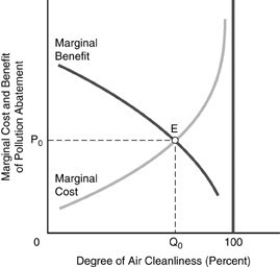 -The optimal quantity of pollution in the above figure
Participating nations in the 1997 Kyoto Protocol agreed to reduce overall greenhouse gases emission through 2020 to
(Multiple Choice)
4.8/5 (85)
(85) A good that has social costs that are equal to private costs has a price that is
(Multiple Choice)
4.9/5 (79)
(79) In order for a voluntary agreement to be reached in general, transaction costs should be
(Multiple Choice)
4.9/5 (85)
(85) To correct for the social impact of pollution, the government should levy a per-unit tax
(Multiple Choice)
4.9/5 (92)
(92) All of the costs associated with making and enforcing contracts are referred to as
(Multiple Choice)
4.8/5 (85)
(85) Suppose a large tree on Jack's property blocks Amy's view of the ocean. Jack accepts Amy's offer of $2,000 to cut down the tree. This is an example of
(Multiple Choice)
4.8/5 (81)
(81) When the private costs and the social costs are NOT the same, there is a(n)
(Multiple Choice)
4.7/5 (83)
(83) Which of the following is the main reason for externalities?
(Multiple Choice)
4.9/5 (84)
(84) It is assumed that the marginal benefit of air cleanliness falls with the degree of cleanliness since
(Multiple Choice)
4.7/5 (84)
(84) Which of the following statements concerning pollution is correct?
(Multiple Choice)
4.9/5 (86)
(86) In a market for emission permits, firms that emit over their allowed limits
(Multiple Choice)
4.8/5 (66)
(66) Suppose there are two firms on a river and the production processes of both require clean water. The upstream firm's process dirties the water, which it dumps back into the river. The downstream firm must clean the water before using it in its production process. If the two firms would merge
(Multiple Choice)
5.0/5 (82)
(82) 
Filters
- Essay(0)
- Multiple Choice(0)
- Short Answer(0)
- True False(0)
- Matching(0)