



 Chat with AI
Exam 33: Exchange Rates and the Balance of Payments

Exam 1: The Nature of Economics348 Questions
Exam 2: Scarcity and the World of Trade-Offs411 Questions
Exam 3: Demand and Supply451 Questions
Exam 4: Extensions of Demand and Supply Analysis401 Questions
Exam 5: Public Spending and Public Choice362 Questions
Exam 6: Funding the Public Sector201 Questions
Exam 7: The Macroeconomy: Unemployment, Inflation, and Deflation413 Questions
Exam 8: Measuring the Economys Performance416 Questions
Exam 9: Global Economic Growth and Development290 Questions
Exam 10: Real GDP and the Price Level in the Long Run298 Questions
Exam 11: Classical and Keynesian Macro Analyses368 Questions
Exam 12: Consumption, Real GDP, and the Multiplier452 Questions
Exam 13: Fiscal Policy274 Questions
Exam 14: Deficit Spending and the Public Debt146 Questions
Exam 15: Money, Banking, and Central Banking516 Questions
Exam 16: Domestic and International Dimensions of Monetary Policy357 Questions
Exam 17: Stabilization in an Integrated World Economy321 Questions
Exam 18: Policies and Prospects for Global Economic Growth228 Questions
Exam 19: Demand and Supply Elasticity412 Questions
Exam 20: Consumer Choice459 Questions
Exam 21: Rents, Profits, and the Financial Environment of Business445 Questions
Exam 22: The Firm: Cost and Output Determination391 Questions
Exam 23: Perfect Competition432 Questions
Exam 24: Monopoly386 Questions
Exam 25: Monopolistic Competition307 Questions
Exam 26: Oligopoly and Strategic Behavior308 Questions
Exam 27: Regulation and Antitrust Policy in a Globalized Economy310 Questions
Exam 28: The Labor Market: Demand, Supply and Outsourcing376 Questions
Exam 29: Unions and Labor Market Monopoly Power319 Questions
Exam 30: Income, Poverty, and Health Care304 Questions
Exam 31: Environmental Economics299 Questions
Exam 32: Comparative Advantage and the Open Economy282 Questions
Exam 33: Exchange Rates and the Balance of Payments285 Questions
Select questions type


An increase in the inflation rate of one country relative to another country will probably cause
(Multiple Choice)
4.9/5  (83)
(83) When a dinner in Bulgaria costs 150 Bulgarian levas, it will cost a U.S. resident ________ dollars, if the exchange rate is 1.5 Bulgarian levas to the dollar.
(Multiple Choice)
4.9/5 (95)
(95)  -Using the above figure. A rightward shift of the supply curve, ceteris paribus, would result in
 (Multiple Choice)
4.8/5 (80)
(80) Which of the following is included in both the balance of trade and the balance of payments?
(Multiple Choice)
4.7/5 (72)
(72) Under a flexible exchange rate system, one factor that does NOT directly affect rates of exchange is
(Multiple Choice)
4.8/5 (90)
(90) The U.S. government suspended the convertibility of the dollar into gold in
(Multiple Choice)
4.9/5 (85)
(85) If interest rates in Sweden go up relative to the rest of the world, the
(Multiple Choice)
4.7/5 (76)
(76) Checking exchange rates, you find $1 equals 0.75 euros. Then the price of 1 euro is
(Multiple Choice)
4.9/5 (84)
(84) Which of the following is a deficit item on the U.S. balance of payments accounts?
(Multiple Choice)
4.8/5 (64)
(64) 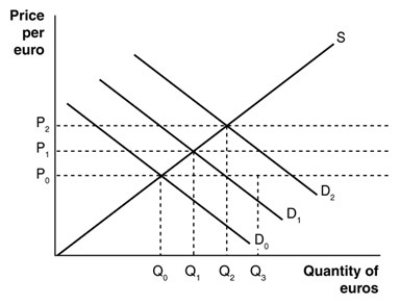 -In the above figure, which of the following is a possible explanation for the reduction in the equilibrium value of the European euro from P2 to P1?
 (Multiple Choice)
4.9/5 (67)
(67) An example of a transaction that will be a surplus item on the U.S. balance of payments is
(Multiple Choice)
4.8/5 (81)
(81) All of the following are surplus items in the balance of payments EXCEPT
(Multiple Choice)
4.8/5 (81)
(81) Suppose a central bank tries to keep exchange rates fixed. When there is an increase in the demand for foreign goods, the central bank will most likely
(Multiple Choice)
4.9/5 (78)
(78) 
Filters
- Essay(0)
- Multiple Choice(0)
- Short Answer(0)
- True False(0)
- Matching(0)