



 Chat with AI
Exam 6: Funding the Public Sector

Exam 1: The Nature of Economics348 Questions
Exam 2: Scarcity and the World of Trade-Offs411 Questions
Exam 3: Demand and Supply451 Questions
Exam 4: Extensions of Demand and Supply Analysis401 Questions
Exam 5: Public Spending and Public Choice362 Questions
Exam 6: Funding the Public Sector201 Questions
Exam 7: The Macroeconomy: Unemployment, Inflation, and Deflation413 Questions
Exam 8: Measuring the Economys Performance416 Questions
Exam 9: Global Economic Growth and Development290 Questions
Exam 10: Real GDP and the Price Level in the Long Run298 Questions
Exam 11: Classical and Keynesian Macro Analyses368 Questions
Exam 12: Consumption, Real GDP, and the Multiplier452 Questions
Exam 13: Fiscal Policy274 Questions
Exam 14: Deficit Spending and the Public Debt146 Questions
Exam 15: Money, Banking, and Central Banking516 Questions
Exam 16: Domestic and International Dimensions of Monetary Policy357 Questions
Exam 17: Stabilization in an Integrated World Economy321 Questions
Exam 18: Policies and Prospects for Global Economic Growth228 Questions
Exam 19: Demand and Supply Elasticity412 Questions
Exam 20: Consumer Choice459 Questions
Exam 21: Rents, Profits, and the Financial Environment of Business445 Questions
Exam 22: The Firm: Cost and Output Determination391 Questions
Exam 23: Perfect Competition432 Questions
Exam 24: Monopoly386 Questions
Exam 25: Monopolistic Competition307 Questions
Exam 26: Oligopoly and Strategic Behavior308 Questions
Exam 27: Regulation and Antitrust Policy in a Globalized Economy310 Questions
Exam 28: The Labor Market: Demand, Supply and Outsourcing376 Questions
Exam 29: Unions and Labor Market Monopoly Power319 Questions
Exam 30: Income, Poverty, and Health Care304 Questions
Exam 31: Environmental Economics299 Questions
Exam 32: Comparative Advantage and the Open Economy282 Questions
Exam 33: Exchange Rates and the Balance of Payments285 Questions
Select questions type


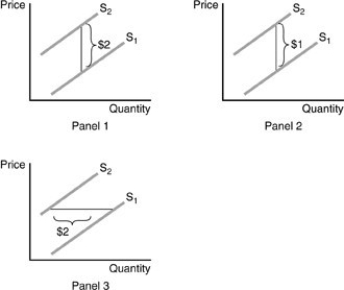 -Refer to the above figures. A unit tax of $2 has been levied on a good. Which of the panels depict the effect of the taxes?
 (Multiple Choice)
4.9/5  (78)
(78)  -Assume that the government one day decides to tax greens fees at all state golf courses. To the government's dismay, not only was the amount of tax collected small, but there was a 90 percent decline in golfing. What type of tax analysis did the government apparently rely upon when it imposed this tax?
 (Multiple Choice)
5.0/5 (75)
(75)  -If a unit excise tax is placed on a good for which the demand is very unresponsive to a price change, then
 (Multiple Choice)
4.8/5 (80)
(80) Suppose Jill has earned more income this year as compared to what she did last year. Her income tax has also increased. Does it necessarily mean that the income tax system is progressive? Explain.
(Essay)
4.9/5 (76)
(76) A government is thinking about increasing the sales tax rate. Should it use static or dynamic tax analysis? Explain why one approach is better than the other.
(Essay)
4.9/5 (76)
(76) A "flat tax" on personal income, in which the same tax rate is applied to every dollar of income earned by each taxpayer, is an example of
(Multiple Choice)
4.9/5 (80)
(80) The responsibility of paying for the Social Security benefits for currently retired individuals falls on
(Multiple Choice)
4.8/5 (95)
(95) State and local governments receive most of their revenue from
(Multiple Choice)
4.9/5 (84)
(84) If you were to face a marginal tax rate of 20 percent, how much would your tax bill increase when your income increased from $50,000 to $52,000?
(Multiple Choice)
4.8/5 (91)
(91)  -The demand and supply of a product is given in the above table. A unit tax of $2 is imposed on the product. The equilibrium quantity for this product after the tax is imposed is equal to
 (Multiple Choice)
4.9/5 (84)
(84) How can we anticipate the proportion of a newly imposed unit excise tax that consumers will pay?
(Multiple Choice)
4.8/5 (68)
(68) Which of the following is an argument that the incidence of corporate taxation falls entirely on consumers?
(Multiple Choice)
4.9/5 (79)
(79) The largest share of federal government tax receipts is derived from
(Multiple Choice)
4.9/5 (76)
(76)  -When a unit tax of $2 is levied on a product
Suppose the tax rate on the first $10,000 of income is 0 percent; 10 percent on the next $20,000; 20 percent on the next $20,000; 30 percent on the next $20,000; and 40 percent on income over $60,000. Family A has an income of $55,000. What is the tax liability of Family A?
(Multiple Choice)
4.8/5 (89)
(89) 
Filters
- Essay(0)
- Multiple Choice(0)
- Short Answer(0)
- True False(0)
- Matching(0)