



 Chat with AI
Exam 16: Notes Payable and Notes Receivable

Exam 16: Notes Payable and Notes Receivable88 Questions
Exam 17: Merchandise Inventory78 Questions
Exam 18: Property, Plant, and Equipment90 Questions
Exam 19: Accounting for Partnerships85 Questions
Exam 20: Corporations: Formation and Capital Stock Transactions81 Questions
Exam 21: Corporate Earnings and Capital Transactions85 Questions
Exam 22: Long-Term Bonds90 Questions
Exam 23: Financial Statement Analysis100 Questions
Exam 24: The Statement of Cash Flows90 Questions
Exam 25: Departmentalized Profit and Cost Centers90 Questions
Exam 26: Accounting for Manufacturing Activities89 Questions
Exam 27: Job Order Cost Accounting83 Questions
Exam 28: Process Cost Accounting83 Questions
Exam 29: Controlling Manufacturing Costs: Standard Costs89 Questions
Exam 30: Cost-Revenue Analysis for Decision Making90 Questions
Select questions type


Compute the maturity value of a 5-month, 8 percent note with a face value of $8,000. (round answer to 2 decimal places)
(Short Answer)
4.8/5  (81)
(81) When a note payable is __________________, the lender deducts interest on the loan in advance, and the borrower receives only the difference between the face amount of the note and the interest on it to maturity.
(Short Answer)
4.8/5 (82)
(82) If the proceeds of a note discounted at a bank are greater than the face value of the note, the difference is recognized as
(Multiple Choice)
4.8/5 (78)
(78) Compute the maturity value of a 180-day, 6 percent note with a face value of $1,000.
(Short Answer)
4.9/5 (63)
(63) A(n) ____________________ is a written order that requires the person or business addressed to pay a stated sum of money to another person or firm or to the bearer.
(Short Answer)
4.9/5 (89)
(89) On March 1, a firm purchased equipment for $5,000, signing a 30-day note bearing interest at 12 percent a year. The entry to record the payment of the amount due on March 31 will include a debit to Notes Payable for
(Multiple Choice)
4.9/5 (87)
(87) The total that must be paid when a note becomes due is known as the
(Multiple Choice)
4.8/5 (77)
(77) Compute the amount of interest owed on a 90-day, 10 percent note for $15,000.
(Short Answer)
4.8/5 (85)
(85) When a note receivable is discounted, the net proceeds are computed by subtracting the discount charges from the ____________________ value of the note.
(Short Answer)
4.9/5 (70)
(70) If the proceeds of a discounted note are less than the face amount, the difference is debited to Interest Expense.
(True/False)
4.7/5 (68)
(68) How much interest will accrue on a $20,000 face value, 120-day note that bears interest at 9 percent a year?
(Multiple Choice)
5.0/5 (78)
(78) The Crown Company had the following transactions involving notes receivable during 2011. Record the transactions on page 7 of a general journal. Omit descriptions. 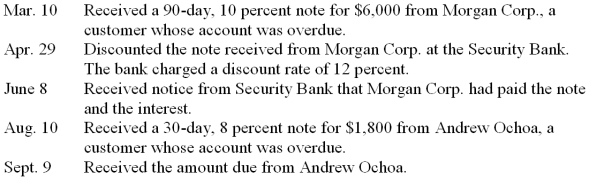
(Essay)
4.8/5 (80)
(80) Compute the maturity value of a 6-month, 9 percent note with a face value of $5,000.
(Short Answer)
4.9/5 (88)
(88) How much interest will accrue on a $40,000 face value, 60-day note that bears interest at 9 percent a year?
(Multiple Choice)
4.9/5 (67)
(67) Compute the maturity value of a 60-day, 7 percent note with a face value of $6,000.
(Short Answer)
4.9/5 (71)
(71) The Jiminez Company accepted an interest-bearing note to settle a past-due account originating from a sale of merchandise. When the note is collected, the interest earned should be credited to
(Multiple Choice)
4.9/5 (65)
(65) If the amount of a note is not collected at maturity, the accountant should debit Uncollectible Accounts Expense and credit Notes Receivable.
(True/False)
4.8/5 (80)
(80) Interest Expense is usually classified as a(n) ____________________ expense on the income statement.
(Short Answer)
4.8/5 (75)
(75) The face value of a noninterest-bearing note is its maturity value.
(True/False)
4.9/5 (79)
(79) 
Filters
- Essay(0)
- Multiple Choice(0)
- Short Answer(0)
- True False(0)
- Matching(0)