



 Chat with AI
Exam 16: Monetary Theory and Policy

Exam 1: The Art and Science of Economic Analysis162 Questions
Exam 2: Economic Tools and Economics Systems198 Questions
Exam 3: Economic Decision Makers207 Questions
Exam 4: Demand, supply, and Markets239 Questions
Exam 5: Introduction to Macroeconomics165 Questions
Exam 6: Tracking the Useconomy206 Questions
Exam 7: Unemployment and Inflation208 Questions
Exam 8: Productivity and Growth123 Questions
Exam 9: Aaggregate Expenditure and Aggregate Demand169 Questions
Exam 10: Baggregate Expenditure and Aggregate Demand144 Questions
Exam 11: Aggregate Supply211 Questions
Exam 12: Fiscal Policy169 Questions
Exam 13: Federal Budgets and Public Policy161 Questions
Exam 14: Money and the Financial System212 Questions
Exam 15: Banking and the Money Supply234 Questions
Exam 16: Monetary Theory and Policy198 Questions
Exam 17: Macro Policy Debate: Active or Passive198 Questions
Exam 18: International Trade160 Questions
Exam 19: Externalities and the Environment201 Questions
Exam 20: International Finance232 Questions
Exam 21: Economic Development97 Questions
Exam 22: understanding Graphs73 Questions
Exam 23: National Income Accounts20 Questions
Exam 24: The Algebra of Demand-Side Equilibrium72 Questions
Select questions type


Exhibit 15-5 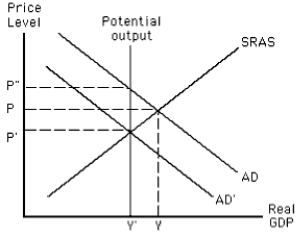 -If the economy pictured in Exhibit 15-5 is in equilibrium where AD = SRAS,then it
 (Multiple Choice)
4.9/5  (82)
(82) Which of the following best explains why the demand for money depends upon the interest rate?
(Multiple Choice)
4.9/5 (77)
(77) If there is a decrease in the supply of money,which one of the following is most likely to happen?
(Multiple Choice)
4.8/5 (67)
(67) Exhibit 15-6 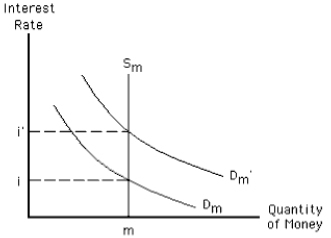 -If the Fed is targeting interest rates and money demand shifts from Dm to Dm' in Exhibit 15-6,the Fed will
 (Multiple Choice)
5.0/5 (80)
(80) In a macroeconomic model,increases in the money supply decrease the interest rate,increase investment,and thus raise employment and real GDP.
(True/False)
4.9/5 (68)
(68) Historical evidence has shown that the M1 velocity of money in the United States
(Multiple Choice)
4.9/5 (68)
(68) When an increase in the money supply reduces the interest rate,investment and nominal GDP increase.
(True/False)
4.8/5 (89)
(89) When calculating by how much changes in the money supply will change nominal GDP,we use the money multiplier instead of the spending multiplier.
(True/False)
4.9/5 (91)
(91) The money demand curve shifts to the right whenever there is a decrease in the interest rate.
(True/False)
4.7/5 (77)
(77) According to the equation of exchange,if real GDP is $2 trillion and the money supply is $0.5 trillion,the velocity of money
(Multiple Choice)
4.8/5 (68)
(68) For monetary policy to be effective in changing planned investment spending,
(Multiple Choice)
4.7/5 (76)
(76) An increase in the money supply will cause a decrease in planned investment spending.
(True/False)
4.8/5 (81)
(81) Which of the following is not considered to be a nonbank financial institution.
(Multiple Choice)
4.9/5 (89)
(89) Exhibit 15-8 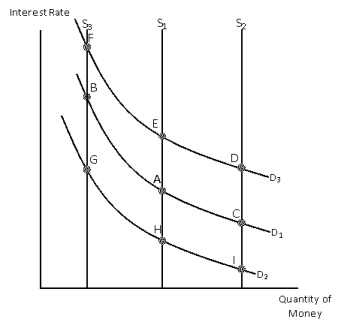 -In Exhibit 15-8,the demand for money is represented by D1 and the supply by S1.If the Fed lowers the discount rate,the equilibrium will move from
 (Multiple Choice)
4.9/5 (76)
(76) If interest rates are __________ to changes in the money supply and planned investment expenditures are __________ to interest rate changes,then monetary policy will be effective in changing aggregate demand.
(Multiple Choice)
4.9/5 (88)
(88) 
Filters
- Essay(0)
- Multiple Choice(0)
- Short Answer(0)
- True False(0)
- Matching(0)