



 Chat with AI
Exam 19: Externalities and the Environment

Exam 1: The Art and Science of Economic Analysis162 Questions
Exam 2: Economic Tools and Economics Systems198 Questions
Exam 3: Economic Decision Makers207 Questions
Exam 4: Demand, supply, and Markets239 Questions
Exam 5: Introduction to Macroeconomics165 Questions
Exam 6: Tracking the Useconomy206 Questions
Exam 7: Unemployment and Inflation208 Questions
Exam 8: Productivity and Growth123 Questions
Exam 9: Aaggregate Expenditure and Aggregate Demand169 Questions
Exam 10: Baggregate Expenditure and Aggregate Demand144 Questions
Exam 11: Aggregate Supply211 Questions
Exam 12: Fiscal Policy169 Questions
Exam 13: Federal Budgets and Public Policy161 Questions
Exam 14: Money and the Financial System212 Questions
Exam 15: Banking and the Money Supply234 Questions
Exam 16: Monetary Theory and Policy198 Questions
Exam 17: Macro Policy Debate: Active or Passive198 Questions
Exam 18: International Trade160 Questions
Exam 19: Externalities and the Environment201 Questions
Exam 20: International Finance232 Questions
Exam 21: Economic Development97 Questions
Exam 22: understanding Graphs73 Questions
Exam 23: National Income Accounts20 Questions
Exam 24: The Algebra of Demand-Side Equilibrium72 Questions
Select questions type


Exhibit 17-9 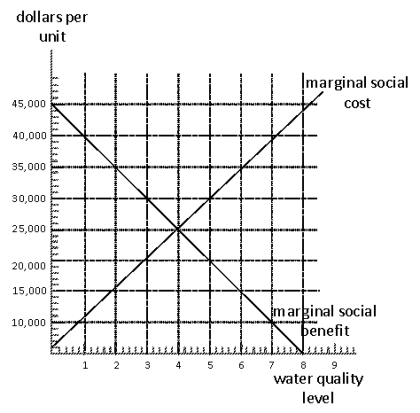 -In Exhibit 17-9,the welfare loss (from society's perspective)that results from 6 units of water quality is shown by area
 (Multiple Choice)
4.8/5  (86)
(86) Economists view pollution as an economic problem that arises because
(Multiple Choice)
4.8/5 (93)
(93) Exhibit 17-8 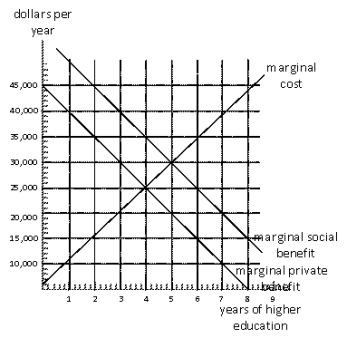 -Exhibit 17-8 represents the consumer market for higher education.If people base their education decisions on the marginal social benefit of education,what would be the social gain?
 (Multiple Choice)
4.9/5 (92)
(92) Unpriced by-products of production or consumption that provide benefits to other consumers or other firms are known as
(Multiple Choice)
4.8/5 (80)
(80) When competitive market equilibrium determines a level of output for which the marginal social cost exceeds the marginal social benefit,the private equilibrium results in
(Multiple Choice)
5.0/5 (93)
(93) The Coase solution to the externality problem only works when bargaining costs are high.
(True/False)
4.9/5 (75)
(75) A metal-stamping factory moves next to a day care center.Noise from the factory makes it impossible for the kids to nap.It would cost the factory $5 million to move; it would cost $1 million for the day care center to move.Sound insulation for the factory costs $1 million; insulation for the day care center costs $200,000.The court determines that the day care center has the property right.What would be the optimal solution to this problem?
(Multiple Choice)
4.8/5 (79)
(79) If you live in a state with a returnable deposit law and you decide to throw out your empty bottles and cans,chances are that someone down the line with a higher opportunity cost than you will find them and return them for deposits.
(True/False)
4.9/5 (88)
(88) Exhibit 17-2 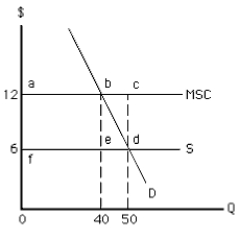 -In Exhibit 17-2,the market equilibrium price and output (determined exclusively by private decisions)are
 (Multiple Choice)
4.9/5 (80)
(80) When the free market produces less than the socially optimal quantity of a good,
(Multiple Choice)
4.9/5 (82)
(82) In the United States,what percentage of smog comes from automobiles?
(Multiple Choice)
4.9/5 (78)
(78) Exhibit 17-2
-In Exhibit 17-2,the socially efficient price and level of output are
-In Exhibit 17-2,the socially efficient price and level of output are (Multiple Choice)
4.9/5 (83)
(83) The Coase theorem argues that the assignment of property rights will generate an efficient solution to the problem of
(Multiple Choice)
4.8/5 (91)
(91) 
Filters
- Essay(0)
- Multiple Choice(0)
- Short Answer(0)
- True False(0)
- Matching(0)