



 Chat with AI
Exam 20: International Finance

Exam 1: The Art and Science of Economic Analysis162 Questions
Exam 2: Economic Tools and Economics Systems198 Questions
Exam 3: Economic Decision Makers207 Questions
Exam 4: Demand, supply, and Markets239 Questions
Exam 5: Introduction to Macroeconomics165 Questions
Exam 6: Tracking the Useconomy206 Questions
Exam 7: Unemployment and Inflation208 Questions
Exam 8: Productivity and Growth123 Questions
Exam 9: Aaggregate Expenditure and Aggregate Demand169 Questions
Exam 10: Baggregate Expenditure and Aggregate Demand144 Questions
Exam 11: Aggregate Supply211 Questions
Exam 12: Fiscal Policy169 Questions
Exam 13: Federal Budgets and Public Policy161 Questions
Exam 14: Money and the Financial System212 Questions
Exam 15: Banking and the Money Supply234 Questions
Exam 16: Monetary Theory and Policy198 Questions
Exam 17: Macro Policy Debate: Active or Passive198 Questions
Exam 18: International Trade160 Questions
Exam 19: Externalities and the Environment201 Questions
Exam 20: International Finance232 Questions
Exam 21: Economic Development97 Questions
Exam 22: understanding Graphs73 Questions
Exam 23: National Income Accounts20 Questions
Exam 24: The Algebra of Demand-Side Equilibrium72 Questions
Select questions type


One signal that the U.S.dollar was overvalued in the early 1970s was
(Multiple Choice)
4.9/5  (77)
(77) Exhibit 18-8  -Exhibit 18-8 shows the market for euros in the US.Initially the demand for euros is represented by D1 and the supply of euros is represented by S1.Equilibrium in the market for euros is at point A.In response to an increase in the income of US consumers the equilibrium will be at point _____.
 (Multiple Choice)
4.8/5 (86)
(86) Which of the following statements is not true of fixed and flexible exchange rate systems?
(Multiple Choice)
5.0/5 (96)
(96) The current account shows international transactions in goods and services,the capital account shows international transactions involving the flow of financial assets,and the official reserve transactions account shows movement of international reserves.
(True/False)
4.9/5 (79)
(79) If the exchange rate changes from 1500 lire per U.S.dollar to 1000 lire per U.S.dollar,the U.S.dollar has
(Multiple Choice)
4.8/5 (86)
(86) In the early 1970s,in an attempt to solve the problem of the overvalued U.S.dollar,world leaders
(Multiple Choice)
4.8/5 (90)
(90) Foreign investors may wish to purchase U.S.assets for all of the following reasons except one.Which is the exception?
(Multiple Choice)
4.9/5 (82)
(82) Exhibit 18-8
-Exhibit 18-8 shows the market for euros in the US.Initially the demand for euros is represented by D1 and the supply of euros is represented by S1.Equilibrium in the market for euros is at point A.In response to a decrease in the income of US consumers the equilibrium will be at point _____.
-Exhibit 18-8 shows the market for euros in the US.Initially the demand for euros is represented by D1 and the supply of euros is represented by S1.Equilibrium in the market for euros is at point A.In response to a decrease in the income of US consumers the equilibrium will be at point _____. (Multiple Choice)
4.7/5 (79)
(79) The Bretton Woods system fixed all exchange rates in terms of the U.S.dollar.
(True/False)
4.9/5 (82)
(82) Exhibit 18-7 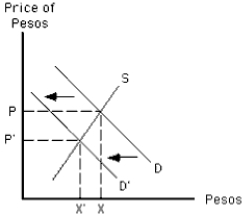 -Suppose that in response to the demand shift shown in Exhibit 18-7,Mexico's central bank takes action to protect its currency,the peso,from depreciating.Enforcing a floor such as Mexico establishes is
 (Multiple Choice)
4.9/5 (83)
(83) The current account shows international transactions in goods and services,the capital account shows international transactions involving the flow of financial assets,and the official reserve transactions account shows movement of international reserves.
(True/False)
4.9/5 (87)
(87) An exchange rate is the price of one commodity (e.g.,corn)measured in terms of another commodity (e.g.,wheat).
(True/False)
4.9/5 (84)
(84) Exhibit 18-5 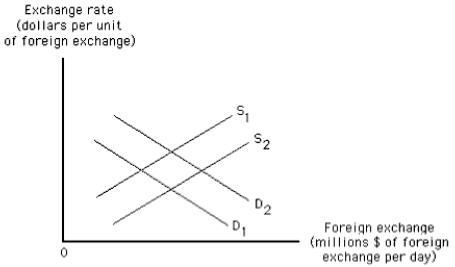 -Suppose that British incomes rise relative to incomes in the United States.Then,in Exhibit 18-5
 (Multiple Choice)
4.8/5 (81)
(81) Which of the following is not considered a unilateral transfer?
(Multiple Choice)
4.9/5 (67)
(67) U.S.investment earnings from foreign assets minus foreigners' earnings from their U.S.assets is
(Multiple Choice)
4.7/5 (96)
(96) 
Filters
- Essay(0)
- Multiple Choice(0)
- Short Answer(0)
- True False(0)
- Matching(0)