



 Chat with AI
Exam 9: Monopolistic Competition and Oligopoly

Exam 1: The Role and Method of Economics235 Questions
Exam 2: The Economic Way of Thinking152 Questions
Exam 3: Supply and Demand252 Questions
Exam 4: Using Supply and Demand248 Questions
Exam 5: Market Failure and Public Choice206 Questions
Exam 6: Production and Costs177 Questions
Exam 7: Firms in Competitive Markets200 Questions
Exam 8: Monopoly162 Questions
Exam 9: Monopolistic Competition and Oligopoly193 Questions
Exam 10: Labor Markets, Income Distribution, and Poverty230 Questions
Exam 11: Introduction to Macroeconomics: Unemployment, Inflation, and Economic Fluctuations151 Questions
Exam 12: Economic Growth177 Questions
Exam 13: Aggregate Demand and Aggregate Supply180 Questions
Exam 14: Fiscal Policy123 Questions
Exam 15: Monetary Institutions170 Questions
Exam 16: The Federal Reserve System and Monetary Policy133 Questions
Exam 17: Issues in Macroeconomic Theory and Policy105 Questions
Exam 18: International Economics261 Questions
Select questions type


Which of the following conditions distinguishes perfect competition from monopolistic competition?
(Multiple Choice)
4.8/5  (87)
(87) Under which one of the following market structures are sellers most likely to consider the reaction of rival sellers when they set the price of their product?
(Multiple Choice)
4.9/5 (74)
(74) If the eyeglass industry is monopolistically competitive, then:
(Multiple Choice)
5.0/5 (84)
(84) Figure 9-E
Two cigarette manufacturers (Firm A and Firm B) are faced with lawsuits from states to recover the health care-related expenses associated with cigarette smoking. Both cigarette firms have evidence that indicates that cigarette smoke causes lung cancer (and other related illnesses). State prosecutors do not have access to the same data used by the cigarette manufacturers, and thus will have difficulty recovering full costs without the help of at least one tobacco firm's evidence. Each firm has been presented with an opportunity to lower their liability in the suit if they cooperate with attorneys representing the states.
 -Refer to Figure 9-E.If both firms follow a dominant strategy, Firm A's profits (losses) will be:
 (Multiple Choice)
4.9/5 (63)
(63) Exhibit 9-A
The following diagram depicts monopolistically competitive firms.  -Refer to Exhibit 9-A.The firm illustrated in Graph A above maximizes profits (minimizes losses) by producing at level of output ____ and charging price ____.
 (Multiple Choice)
4.9/5 (75)
(75) Figure 9-F
Prior to the year 2000, the United States considered renewal of Most Favored Nation (MFN) trading status with China annually (Most Favored Nation trading status is now called Normal Trade Relations). Historically, legislators made threats of not renewing MFN status because of alleged human rights abuses in China. The nonrenewable of MFN trading status would likely have triggered retaliatory measures by China. The game below reflects the potential economic gains from trade in a scenario in which China chooses whether to impose trade sanctions against U. S. firms and the United States chooses whether to renew MFN status with China.
 -Refer to Figure 9-F.If both countries follow a dominant strategy, the gains from trade for the United Sates will be:
 (Multiple Choice)
4.9/5 (71)
(71) Under conditions of oligopoly markets, firms generally don't like to compete based on price.Why?
(Multiple Choice)
5.0/5 (70)
(70) Which of the following will not generally be true of a monopolistic competitor operating in the long run?
(Multiple Choice)
4.8/5 (74)
(74) A monopolistically competitive firm derives its ability to influence price from:
(Multiple Choice)
4.8/5 (80)
(80) Figure 9-I
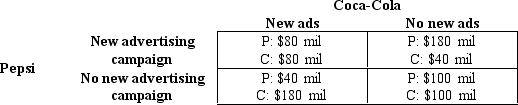 -Refer to Figure 9-I.The manufacturers of Pepsi and Coca-Cola must each decide whether to launch new ad campaigns to advertise their respective soft drinks.The payoff matrix shows the profits earned from sales of Pepsi and Coca-Cola under alternative advertising scenarios.Based on this information, one can say that:
 (Multiple Choice)
4.8/5 (75)
(75) Bert and Ernie are noncolluding oligopolists.If both choose a high price strategy, each makes $40 in profits; if both choose a low price strategy, each makes $30 in profits.If Bert chooses a high price strategy and Ernie chooses a low price strategy, Bert makes $20 in profits and Ernie makes $60 in profits, while if Bert chooses a low price strategy and Ernie chooses a high price strategy, Bert makes $60 in profits and Ernie makes $20 in profits.Which combination of pricing strategies would you expect Bert and Ernie to adopt if they act independently?
(Multiple Choice)
4.8/5 (84)
(84) Excess capacity occurs in long-run equilibrium under monopolistic competition so that:
(Multiple Choice)
4.8/5 (79)
(79) If firms meet together to decide on prices and outputs, it is called:
(Multiple Choice)
4.9/5 (87)
(87) An industry characterized by only a few firms in the market is called:
(Multiple Choice)
4.9/5 (82)
(82) Monopolistic competition is characterized by which of the following attributes: i.Many sellers
ii.Praduct differentiation
iii.Siprificant bariers to entry
(Multiple Choice)
4.8/5 (90)
(90) If the firms in an oligopoly collude, the results will represent what other type of industry?
(Multiple Choice)
4.8/5 (78)
(78) Which of the following is not a characteristic of monopolistic competition?
(Multiple Choice)
5.0/5 (89)
(89) 
Filters
- Essay(0)
- Multiple Choice(0)
- Short Answer(0)
- True False(0)
- Matching(0)