



 Chat with AI
Exam 3: Motion in Two Dimensions

Exam 1: Introduction and Vectors69 Questions
Exam 2: Motion in One Dimension55 Questions
Exam 3: Motion in Two Dimensions82 Questions
Exam 4: The Laws of Motion97 Questions
Exam 5: More Applications of Newtons Laws80 Questions
Exam 6: Energy of a System81 Questions
Exam 7: Conservation of Energy77 Questions
Exam 8: Momentum and Collisions84 Questions
Exam 9: Relativity31 Questions
Exam 10: Rotational Motion121 Questions
Exam 11: Gravity,planetary Orbits,and the Hydrogen Atom62 Questions
Exam 12: Oscillatory Motion44 Questions
Exam 13: Mechanical Waves56 Questions
Exam 14: Superposition and Standing Waves57 Questions
Exam 15: Fluid Mechanics48 Questions
Exam 16: Temperature and the Kinetic Theory of Gases54 Questions
Exam 17: Energy in Thermal Processes: the First Law of Thermodynamics69 Questions
Exam 18: Heat Engines,entropy,and the Second Law of Thermodynamics51 Questions
Exam 19: Electric Forces and Electric Fields156 Questions
Exam 20: Electric Potential and Capacitance158 Questions
Exam 21: Current and Direct Current Circuits113 Questions
Exam 22: Magnetic Forces and Magnetic Fields157 Questions
Exam 23: Faradays Law and Inductance76 Questions
Exam 24: Electromagnetic Waves41 Questions
Exam 25: Reflection and Refraction of Light34 Questions
Exam 26: Image Formation by Mirrors and Lenses41 Questions
Exam 27: Wave Optics72 Questions
Exam 28: Quantum Physics69 Questions
Exam 29: Atomic Physics35 Questions
Exam 30: Nuclear Physics62 Questions
Exam 31: Particle Physics31 Questions
Select questions type


The site from which an airplane takes off is the origin.The x axis points east;the y axis points straight up.The position and velocity vectors of the plane at a later time are given by and . The plane is most likely
(Multiple Choice)
4.8/5  (70)
(70) A student in the front of a school bus tosses a ball to another student in the back of the bus while the bus is moving forward at constant velocity.The speed of the ball as seen by a stationary observer in the street:
(Multiple Choice)
4.8/5 (77)
(77) A fast duck is flying mi/h at the same altitude as a slow airplane flying with a velocity of mi/h.How fast and in what direction is the duck moving relative to the airplane?
(Short Answer)
4.8/5 (75)
(75) A car travels in a flat circle of radius R.At a certain instant the velocity of the car is 20 m/s north,and the total acceleration of the car is 2.5 m/s2 37 south of west.Which of the following is correct?
(Multiple Choice)
4.8/5 (85)
(85) A 0.14-km wide river flows with a uniform speed of 4.0 m/s toward the east.It takes 20 s for a boat to cross the river to a point directly north of its departure point on the south bank.What is the speed of the boat relative to the water?
(Multiple Choice)
4.7/5 (74)
(74) A stunt pilot performs a circular dive of radius 800 m.At the bottom of the dive (point B in the figure)the pilot has a speed of 200 m/s which at that instant is increasing at a rate of 20 m/s2.What acceleration does the pilot have at point B? 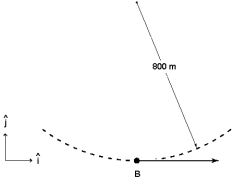
(Multiple Choice)
4.8/5 (69)
(69) A baseball is hit at ground level.The ball is observed to reach its maximum height above ground level 3.0 s after being hit.And 2.5 s after reaching this maximum height,the ball is observed to barely clear a fence that is 97.5 m from where it was hit.How high is the fence?
(Multiple Choice)
4.9/5 (72)
(72) A football is thrown upward at a 30.0 angle to the horizontal.To throw a 40.0-m pass,what must be the initial speed of the ball?
(Short Answer)
4.9/5 (66)
(66) A car travels around an oval racetrack at constant speed.The car is accelerating 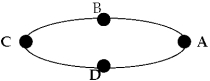
(Multiple Choice)
4.8/5 (85)
(85) A satellite is in a circular orbit 600 km above the Earth's surface.The acceleration of gravity is 8.21 m/s2 at this altitude.The radius of the Earth is 6 400 km.Determine the speed of the satellite,and the time to complete one orbit around the Earth.
(Short Answer)
4.8/5 (82)
(82) The position of an object is given by where t is in seconds.At t = 2.0 s,what is the magnitude of the particle's acceleration?
(Multiple Choice)
4.7/5 (79)
(79) An object moving at a constant speed requires 6.0 s to go once around a circle with a diameter of 4.0 m.What is the magnitude of the instantaneous acceleration of the particle during this time?
(Multiple Choice)
4.9/5 (82)
(82) A particle moves in the xy plane in a circle centered on the origin.At a certain instant the velocity and acceleration of the particle are 6.0 î m/s and (3.0 î + 4.0 ĵ1 )m/s2.What are the x and y coordinates of the particle at this moment?
(Multiple Choice)
4.9/5 (88)
(88) A boat moves at 10.0 m/s relative to the water.If the boat is in a river where the current is 2.0 m/s,how long does it take the boat to make a complete round trip of 1.00 km upstream followed by a 1.00 km trip downstream?
(Short Answer)
5.0/5 (70)
(70) Car A leaves point O at t = 0 and travels a quarter circle counterclockwise at 30.0 m/s to point P.Car B will leave point O and travel to point P at the same speed but in a straight line.The radius of the circle is 100 m.At what time should car B leave point O in order to arrive at point P at the same time as car A?
(Multiple Choice)
4.8/5 (76)
(76) A rifle is aimed horizontally toward the center of a target 0.10 km away,but the bullet strikes 10 cm below the center.Calculate the velocity of the bullet just as it emerges from the rifle.
(Short Answer)
4.8/5 (80)
(80) A particle moves in the xy plane with a constant acceleration given by .At t = 0,its position and velocity are 10 i? and ,respectively.What is the distance from the origin to the particle at t = 2.0 s?
(Multiple Choice)
4.8/5 (81)
(81) A small dense object is suspended from the rear view mirror in a car by a lightweight fiber.As the car is accelerating at 1.90 m/s2,what angle does the string make with the vertical?
(Short Answer)
4.9/5 (76)
(76) A car travels counterclockwise around a flat circle of radius 0.25 km at a constant speed of 20 m/s.When the car is at point A as shown in the figure,what is the car's acceleration? 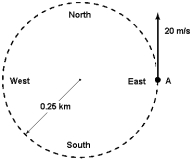
(Multiple Choice)
5.0/5 (71)
(71) At t = 0,a particle leaves the origin with a velocity of 5.0 m/s in the positive y direction.Its acceleration is given by = (3.0 i? - 2.0j?)m/s2.At the instant the particle reaches its maximum y coordinate how far is the particle from the origin?
(Multiple Choice)
4.9/5 (80)
(80) 
Filters
- Essay(0)
- Multiple Choice(0)
- Short Answer(0)
- True False(0)
- Matching(0)