



 Chat with AI
Exam 7: Conservation of Energy

Exam 1: Introduction and Vectors69 Questions
Exam 2: Motion in One Dimension55 Questions
Exam 3: Motion in Two Dimensions82 Questions
Exam 4: The Laws of Motion97 Questions
Exam 5: More Applications of Newtons Laws80 Questions
Exam 6: Energy of a System81 Questions
Exam 7: Conservation of Energy77 Questions
Exam 8: Momentum and Collisions84 Questions
Exam 9: Relativity31 Questions
Exam 10: Rotational Motion121 Questions
Exam 11: Gravity,planetary Orbits,and the Hydrogen Atom62 Questions
Exam 12: Oscillatory Motion44 Questions
Exam 13: Mechanical Waves56 Questions
Exam 14: Superposition and Standing Waves57 Questions
Exam 15: Fluid Mechanics48 Questions
Exam 16: Temperature and the Kinetic Theory of Gases54 Questions
Exam 17: Energy in Thermal Processes: the First Law of Thermodynamics69 Questions
Exam 18: Heat Engines,entropy,and the Second Law of Thermodynamics51 Questions
Exam 19: Electric Forces and Electric Fields156 Questions
Exam 20: Electric Potential and Capacitance158 Questions
Exam 21: Current and Direct Current Circuits113 Questions
Exam 22: Magnetic Forces and Magnetic Fields157 Questions
Exam 23: Faradays Law and Inductance76 Questions
Exam 24: Electromagnetic Waves41 Questions
Exam 25: Reflection and Refraction of Light34 Questions
Exam 26: Image Formation by Mirrors and Lenses41 Questions
Exam 27: Wave Optics72 Questions
Exam 28: Quantum Physics69 Questions
Exam 29: Atomic Physics35 Questions
Exam 30: Nuclear Physics62 Questions
Exam 31: Particle Physics31 Questions
Select questions type


Jane and Jake are looking at what happens to body 1 of mass m and body 2 of mass 2m,initially at rest,when equal forces are applied separately to the two bodies.Jake says that equal forces applied for equal times do equal amounts of work on the two bodies.Jane says that the two forces do equal amounts of work only if the two bodies move equal distances in the direction of the forces.Which one,if either,is correct?
(Multiple Choice)
5.0/5  (54)
(54) A 0.75-kg sphere is released from rest and is moving 5.0 m/s after falling 2.0 m in a viscous medium.What is the change in mechanical energy caused by the force the viscous medium exerts on the sphere during this descent?
(Multiple Choice)
4.9/5 (80)
(80) A pendulum bob has potential energy U0 when held taut in a horizontal position.The bob falls until it is 30 away from the horizontal position,when it has potential energy UA.It continues to fall until the string is vertical,when it has potential energy UB.Compare its potential energies at O,A,and B. 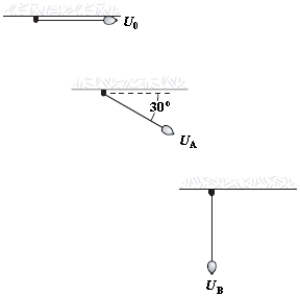
(Multiple Choice)
5.0/5 (73)
(73) A 2.0-kg block sliding on a rough horizontal surface is attached to one end of a horizontal spring (k = 250 N/m)which has its other end fixed.The block passes through the equilibrium position with a speed of 2.6 m/s and first comes to rest at a displacement of 0.20 m from equilibrium.What is the coefficient of kinetic friction between the block and the horizontal surface?
(Multiple Choice)
4.8/5 (83)
(83) A spring with spring constant k = 800 N/m is compressed 12 cm from its equilibrium position.A spring with spring constant k = 400 N/m has the same elastic potential energy as the first spring when its extension is
(Multiple Choice)
4.9/5 (92)
(92) As an object moves from point A to point B only two forces act on it: one force is nonconservative and does -30 J of work,the other force is conservative and does +50 J of work.Between A and B,
(Multiple Choice)
4.9/5 (85)
(85) A 3.0-kg mass is dropped from the edge of a 50-m tall building with an initial speed of zero.The mass strikes the ground with a downward velocity of 25 m/s.Find the change in mechanical energy of the mass caused by air resistance between the point where it is dropped and the point where it strikes the ground?
(Multiple Choice)
4.8/5 (86)
(86) A 2.0-kg block slides down a plane (inclined at 40 with the horizontal)at a constant speed of 5.0 m/s.At what rate is the gravitational force on the block doing work?
(Multiple Choice)
4.8/5 (77)
(77) Two equal masses are raised at constant velocity by ropes that run over pulleys,as shown below.Mass B is raised twice as fast as mass A.The magnitudes of the forces are FA and FB,while the power supplied is respectively PA and PB.Which statement is correct? 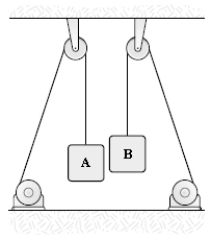
(Multiple Choice)
4.8/5 (67)
(67) Objects A and B,of mass M and 2M respectively,are each pushed a distance d straight up an inclined plane by a force F parallel to the plane.The coefficient of kinetic friction between each mass and the plane has the same value k.At the highest point,
(Multiple Choice)
4.8/5 (77)
(77) An astronaut tosses a ball out in space where gravitational forces may be neglected.What will happen to the ball?
(Multiple Choice)
4.8/5 (70)
(70) The equation below describes a physical situation: Which description best fits the equation?
(Multiple Choice)
4.9/5 (76)
(76) A 1.2-kg mass is projected from ground level with a velocity of 30 m/s at some unknown angle above the horizontal.A short time after being projected,the mass barely clears a 16-m tall fence.Disregard air resistance and assume the ground is level.What is the kinetic energy of the mass as it clears the fence?
(Multiple Choice)
4.9/5 (79)
(79) A large spring is used to stop the cars after they come down the last hill of a roller coaster.The cars start at rest at the top of the hill and are caught by a mechanism at the instant their velocities at the bottom are zero.Compare the compression of the spring,xA,for a fully loaded car with that,xB,for a lightly loaded car when mA = 2mB. 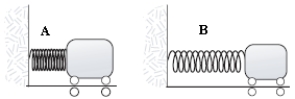
(Multiple Choice)
4.9/5 (88)
(88) A 1.2-kg mass is projected up a rough circular track (radius = 0.80 m)as shown.The speed of the mass at point A is 8.4 m/s,and at point B,it is 5.6 m/s.What is the change in mechanical energy between A and B caused by the force of friction? 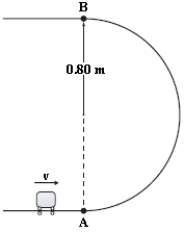
(Multiple Choice)
4.9/5 (81)
(81) The equation below is the solution to a physics problem: . The most likely physical situation it describes is
(Multiple Choice)
4.9/5 (90)
(90) A certain pendulum consists of a 1.5-kg mass swinging at the end of a string (length = 2.0 m).At the lowest point in the swing the tension in the string is equal to 20 N.To what maximum height above this lowest point will the mass rise during its oscillation?
(Multiple Choice)
4.8/5 (87)
(87) A 2.0-kg mass swings at the end of a light string (length = 3.0 m).Its speed at the lowest point on its circular path is 6.0 m/s.What is its kinetic energy at an instant when the string makes an angle of 50 with the vertical?
(Multiple Choice)
4.9/5 (69)
(69) Identical masses m are attached to identical springs of spring constant k suspended from the ceiling.With both masses hanging in their equilibrium positions,mass A is pulled down 10 cm and released while mass B is pushed up 10 cm and released.Which statement is correct?
(Multiple Choice)
4.9/5 (96)
(96) 
Filters
- Essay(0)
- Multiple Choice(0)
- Short Answer(0)
- True False(0)
- Matching(0)