



 Chat with AI
Exam 15: Transfer Pricing


An appropriate transfer price between two divisions of The Fathom Company can be determined from the following data: (CIA adapted)
Fabricating Division Market price of \ 50 subassembly \ 20 Variable cost of subassembly 1,000 Excess capacity (in units) Assembling Division 900 Number of units needed \ What is the natural bargaining range for the two divisions?

 (87)
 Verified
A
Chattanooga Inc. ,has two divisions for its metal fabrication business.The Stamp Division stamps the objects and then transfers them to the Finish Division,which finishes and sells them.Last year,the Stamp Division had administrative expenses of $40,000.The Finish Division incurred additional production costs of $120,000 (exclusive of amounts paid to the Stamp Division for the stamped steel)to process 120,000 units.The Finish Division sold the finished goods for $500,000 and incurred $80,000 in variable selling and administrative expenses.Required:
a.Prepare income statements for each division.Use a transfer price of the Stamp Division's total cost plus 5%.Assume Cost of Goods Sold for the Finish Division is $351,000.b.Repeat (a),using a transfer price of $2.00 per unit;this is also the market price.c.Repeat (a),using a negotiated transfer price of $1.90 per unit.d.Which transfer price results in higher income to Chattanooga Inc.?
(72) Verified d.In terms of total company income,transfer prices have no impact;i.e. ,the total profit is $80,000 regardless of how it is allocated between the two divisions.However,different pricing systems can provide managers with different incentives,which may have an impact on profits.
a.The Stamp Division = The Finish Division COGS $351,000 - $120,000 added costs = $231,000;$231,000 = 105% of the Stamp Division costs;The Stamp Division cost = $231,000/105% = $220,000;$220,000 - $40,000 other costs = $180,000 Stamp Division COGS.
Pomme Corporation has a Motor Division that does work for other Divisions in the company as well as for outside customers.The company's Equipment Division has asked the Motor Division to provide it with 2,000 special motors each year.The special motors would require $17.00 per unit in variable production costs.The Equipment Division has a bid from an outside supplier for the special motors at $28.00 per unit.In order to have time and space to produce the special motor,the Motor Division would have to cut back production of another motor - the J789 that it presently is producing.The J789 sells for $34.00 per unit,and requires $22.00 per unit in variable production costs.Packaging and shipping costs of the J789 are $4.00 per unit.Packaging and shipping costs for the new special motor would be only $0.50 per unit.The Motor Division is now producing and selling 10,000 units of the J789 each year.Production and sales of the J789 would drop by 10% if the new special motor is produced for the Equipment Division.Required:
a.What is the range of transfer prices within which both the Divisions' profits would increase as a result of agreeing to the transfer of 2,000 special motors per year from the Motor Division to the Equipment Division?
b.Is it in the best interests of Pomme Corporation for this transfer to take place? Explain.
(78) Verified(Note: Due to limitations in fonts and word processing software,> and < signs must be used in this solution rather than "greater than or equal to" and "less than or equal to" signs. )
a.From the perspective of the Motors Division,profits would increase as a result of the transfer if,and only if:
Transfer price > Variable cost + Opportunity cost.
The opportunity cost is the contribution margin on the lost sales,divided by the number of units transferred:
Opportunity cost = [($34.00 per unit - $22.00 per unit - $4.00 per unit)× 1,000 units*]/2,000 units = $4.00 per unit.
*10% × 10,000 units = 1,000 units.
Therefore,Transfer price > ($17.00 per unit + $0.50 per unit)+ $4.00 per unit = $21.50 per unit.
From the viewpoint of the Equipment Division,the transfer price must be less than the cost of buying the units from the outside supplier.Therefore,Transfer price < $28.00.
Combining the two requirements,we get the following range of transfer prices: $21.50 < Transfer price < $28.00.
b.Yes,the transfer should take place.From the viewpoint of the entire company,the cost of transferring the units within the company is $21.50,but the cost of purchasing the special parts from the outside supplier is $28.00.Therefore,the company's profits increase on average by $6.50 for each of the special motors that is transferred within the company,even though this would cut into production and sales of another product.
Division N has asked Division M of the same company to supply it with 10,000 units of part P782 this year to use in one of its products.Division N has received a bid from an outside supplier for the parts at a price of $25.00 per unit.Division M has the capacity to produce 50,000 units of part P782 per year.Division M expects to sell 46,000 units of part P782 to outside customers this year at a price of $26.00 per unit.To fill the order from Division N,Division M would have to cut back its sales to outside customers.Division M produces part P782 at a variable cost of $17.00 per unit.The cost of packing and shipping the parts for outside customers is $1.00 per unit.These packing and shipping costs would not have to be incurred on sales of the parts to Division N.Required:
a.What is the range of transfer prices within which both the Divisions' profits would increase as a result of agreeing to the transfer of 10,000 parts this year from Division N to Division M?
b.Is it in the best interests of the overall company for this transfer to take place? Explain.(Note: Due to limitations in fonts and word processing software,> and < signs must be used in this solution rather than "greater than or equal to" and "less than or equal to" signs. )
(78) Macon Motor Works has just acquired a new Battery Division.The Battery Division produces a standard 12-volt battery that it sells to retail outlets at a competitive price of $20.The retail outlets purchase about 800,000 batteries a year.Since the Battery Division has a capacity of 1,000,000 batteries a year,top management is thinking that it might be wise for the company's Automotive Division to start purchasing batteries from the newly acquired Battery Division.The Automotive Division now purchases 300,000 batteries a year from an outside supplier,at a price of $18 per battery.The discount from the competitive $20 price is a result of the large quantity purchased.The Battery Division's cost per battery is shown below: Direct materials \ 8 Direct labor 4 Variable overhead 2 Fixed overhead Total cost \ 16
Fixed costs are based on 1,000,000 batteries.Both divisions are to be treated as investment centers,and their performance is to be evaluated by the ROI formula.Required:
a.What transfer price would you recommend and why?
b.What transfer price would you recommend if the Battery Division is now selling 1,000,000 batteries a year to retail outlets?
c.Suppose the manager of the Battery Division can increase its capacity to 1,500,000 units for $1,200,000.She then has the option of (a)cutting the retail price to $17.50 with the certainty that sales will increase to 1,500,000 batteries,or (b)maintaining the outside price of $20.00 for the 800,000 batteries and transferring the 300,000 batteries to the Automotive Division at some price that would produce the same income for the Battery Division as option (a).What is the minimum transfer price you would recommend in this situation?
(84) Briefly discuss transfer prices in relation to external segment reporting under GAAP.
(86) The Gear Division makes a part with the following characteristics:
Production capacity 25,000 units Selling price to outside customers \ 18 Variable cost per unit \ 11 Fixed cost, total \ 100,000 Motor Division of the same company would like to purchase 10,000 units each period from the Gear Division.The Motor Division now purchases the part from an outside supplier at a price of $17 each.Suppose that the Gear Division is operating at capacity and can sell all of its output to outside customers.If the Gear Division sells the parts to Motor Division at $17 per unit,the company as a whole will be:
(80) A company has two divisions,Softwoods and Hardwoods,each operating as a profit center.The Softwood Division charges the Hardwood Division $35 per unit (for each unit transferred to the Hardwood Division).Other data for the Softwood Division are as follows:
Variable Cost per unit \ 30 Fixed Costs \ 10,000 Annual Sales to the Hardwood Division 5,000 units Annual Sales to Outsiders 50,000 units The Softwood Division is planning to raise its transfer price to $50 per unit.The Hardwood Division can purchase units at $40 per unit from outsiders,but doing so would idle the Softwood Division's facilities (now committed to producing units for the Hardwood Division).The Softwood Division cannot increase its sales to outsiders.From the perspective of the company as a whole,from who should the Hardwood Division acquire the units,assuming the Hardwood Division's market is unaffected?
(84) An organization that has significant foreign operations must disclose how its transfer prices are established between domestic and foreign divisions.
(92) Altoona Corporation has two divisions,Hinges and Doors,which are both organized as profit centers;the Hinge Division produces and sells hinges to the Door Division and to outside customers.The Hinge Division has total costs of $35,$20 of which are variable.The Hinge Division is operating significantly below capacity and sells the hinges for $50.The Door Division has received an offer from an outsider vendor to supply all the hinges it needs (20,000 hinges)at a cost of $45.The manager of the Door Division is considering the offer but wants to approach the Hinge Division first.What is the maximum transfer price from the Hinge Division to the Door Division?
(82) The Raisin Division of Trail Mix Foods,Inc.had the following operating results last year:
Sales (150,000 pounds of raisins) \ 60,000 Variable expenses 37,500 Contribution margin 22,500 Fixed expenses Profit \ 10,500 Raisin expects identical operating results this year.The Raisin Division has the ability to produce and sell 200,000 pounds of raisins annually.Assume that the Raisin Division is currently operating at its capacity of 200,000 pounds of raisins.Also assume again that the Peanut Division wants to purchase an additional 20,000 pounds of raisins from the Raisin Division.Under these conditions,what amount per pound of raisins would the Raisin Division have to charge Peanut in order to maintain its current profit?
(71) The Stake Division of the Outdoor Lumination Company produces stakes which can be sold to outside customers or transferred to the Solar Light Division of the Outdoor Lumination Company.Last year,the Solar Light Division bought 50,000 stakes from the Stake Division at $2.50 each.The following data are available for last year's activities in the Stake Division: 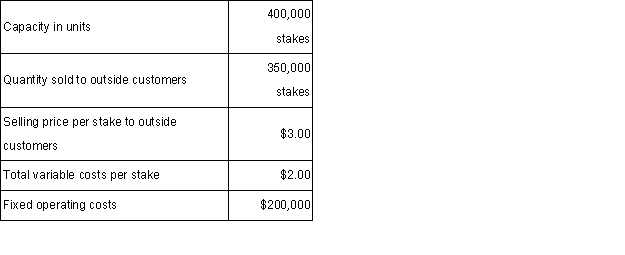 In order to sell 50,000 stakes to the Solar Light Division,the Stake Division must give up sales of 30,000 stakes to outside customers.That is,the Stake Division could sell 380,000 stakes each year to outside customers (rather than only 350,000 stakes as shown above)if it were not making sales to the Solar Light Division.Suppose that last year an outside supplier would have been willing to provide the Solar Light Division with the basic stakes at $2.10 each.If the Solar Light Division had chosen to buy all of its stakes from the outside supplier instead of the Stake Division,the change in net operating income for the company as a whole would have been:
(78) Martin Company currently manufactures all component parts used in the manufacture of various hand tools.The Extruding Division produces a steel handle used in three different tools.The budget for these handles is 120,000 units with the following unit cost. Direct material \ .60 Direct labor .40 Variable overhead .10 Fixed overhead Total unit cost \ 1.30 Polishing Division purchases 20,000 handles from the Extruding Division and completes the hand tools.An outside supplier,Venture Steel,has offered to supply 20,000 units of the handle to Polishing Division for $1.25 per unit.The Extruding Division currently has idle capacity that cannot be used.What is the cost impact to Martin as a whole of purchasing from Venture Steel? (CMA adapted)
(84) Dockside Enterprises Inc. ,operates two divisions: (1)a management division that owns and manages bulk carriers on the Great Lakes and (2)a repair division that operates a dry dock in Tampa,Florida.The repair division works on company ships,as well as other large-hull ships.The repair division has an estimated variable cost of $37 per labor-hour.The repair division has a backlog of work for outside ships.They charge $70.00 per hour for labor,which is standard for this type of work.The management division complained that it could hire its own repair workers for $45.00 per hour,including leasing an adequate work area.What is the maximum transfer price per hour that the management division should pay?
(66) Ms.Clarke,one of the marketing managers,has come to the meeting with a number of reports about one of her products.The Vice President of Marketing sees her agitation and asks her what the problem is."Well,the product made by the East Coast Division is losing sales even after the price had been lowered drastically.The manager of the division is threatening to close because of the reduced demand."
The Vice President of Marketing asks why the lowered prices are a problem and Ms.Clarke says that,according to the manager,the price used to transfer the goods to Southern Division are based on market price and,with the lowered market price,the unit-level costs are no longer being covered and he is losing money on every transfer as well as every third-party sale.Required:
Explain further to the Vice President of Marketing the issues involved in transfer pricing when there are distressed market prices.
(83) Lock Division of Morgantown Corp.sells 80,000 units of part Z-25 to the outside market.Part Z-25 sells for $40,has a variable cost of $22,and a fixed cost per unit of $10.The Lock Division has a capacity to produce 100,000 units per period.The Cabinet Division currently purchases 10,000 units of part Z-25 from the Lock Division for $40.The Cabinet Division has been approached by an outside supplier willing to supply the parts for $36.What is the effect on Morgantown's overall profit if the Lock Division refuses the outside price and the Cabinet Division decides to buy outside?
(69) The Hinges Division of Altoona Corp.sells 80,000 units of part Z-25 to the outside market.Part Z-25 sells for $40,has a variable cost of $22,and a fixed cost per unit of $10.The Hinges Division has a capacity to produce 100,000 units per period.The Door Division currently purchases 10,000 units of part Z-25 from the Hinges Division for $40.The Door Division has been approached by an outside supplier willing to supply the parts for $36.If Altoona uses a negotiated transfer pricing system,what is the minimum transfer price that should be charged for this transaction?
(77) 
Filters
- Essay(0)
- Multiple Choice(0)
- Short Answer(0)
- True False(0)
- Matching(0)