



 Chat with AI
Exam 13: A: Definite Integrals - Techniques

Exam 1: Linear Equations and Functions245 Questions
Exam 2: Quadratic and Other Special Functions120 Questions
Exam 3: Matrices230 Questions
Exam 4: Inequalities and Linear Programming119 Questions
Exam 5: Exponential and Logarithmic Functions109 Questions
Exam 6: Mathematics of Finance131 Questions
Exam 7: Introduction to Probability180 Questions
Exam 8: Further Topics in Probability and Data Description114 Questions
Exam 9: Derivatives249 Questions
Exam 10: Derivatives172 Questions
Exam 11: Derivatives Continued139 Questions
Exam 12: Indefinite Integrals120 Questions
Exam 13: Definite Integrals - Techniques370 Questions
Exam 13: A: Definite Integrals - Techniques370 Questions
Exam 14: Functions of Two or More Variables122 Questions
Exam 15: Algebraic Concepts 240 Questions
Exam 15: Algebraic Concepts 374 Questions
Exam 15: Algebraic Concepts 496 Questions
Exam 15: Algebraic Concepts 599 Questions
Select questions type


The United States' spending for military (in billions of dollars per year) can be modeled by  , where
 represents 1993. Estimate the total spending for the United States military between 2000 and 2005 by using 10 equal subdivisions and right-hand endpoints to approximate the area under the graph of M(t) between
 and
 . Round to three decimal places.
, where represents 1993. Estimate the total spending for the United States military between 2000 and 2005 by using 10 equal subdivisions and right-hand endpoints to approximate the area under the graph of M(t) between and . Round to three decimal places. (Multiple Choice)
4.9/5  (74)
(74) Use the Trapezoidal Rule to approximate  with n = 6. Round your answer to two decimal places.
 (Multiple Choice)
4.9/5 (72)
(72) Find the area between the curve  and the x-axis from
 to
 .
and the x-axis from to . (Multiple Choice)
4.9/5 (78)
(78) 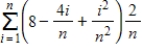 by using the sum formulas.
With data for 1990 to 2002, the total receipts for world tourism (in billions of dollars per year) can be modeled by the function  where
 represents 1985. Find the predicted total receipts for world tourism for the decade from 2003 to 2013. Round your answer to one decimal place.
where represents 1985. Find the predicted total receipts for world tourism for the decade from 2003 to 2013. Round your answer to one decimal place. (Multiple Choice)
5.0/5 (84)
(84) Suppose the income from an Internet access business is a continuous income stream with annual rate of flow given by 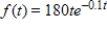 in thousands of dollars per year. Find the total income over the next 20 years.
 (Multiple Choice)
4.7/5 (82)
(82) 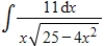 .
 over

 .
The United States' spending for military (in billions of dollars per year) can be modeled by  , where
 represents 1993. Estimate the total spending for the United States military between 2000 and 2005 by using 10 equal subdivisions and right-hand endpoints to approximate the area under the graph of M(t) between
 and
 . Round to three decimal places.
, where represents 1993. Estimate the total spending for the United States military between 2000 and 2005 by using 10 equal subdivisions and right-hand endpoints to approximate the area under the graph of M(t) between and . Round to three decimal places. (Multiple Choice)
4.9/5 (81)
(81)  .
Equations are given whose graphs enclose a region. Find the area of the region.  ,
 ,
 and

, , and (Multiple Choice)
4.8/5 (77)
(77) Use rectangles to find the area between  and the x-axis from
 to

and the x-axis from to (Multiple Choice)
4.9/5 (77)
(77)  .
Use the figure to decide which of  is larger, or if they are equal.

is larger, or if they are equal. (Multiple Choice)
4.7/5 (86)
(86) Use the figure to decide which of 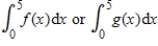 is larger, or if they are equal.
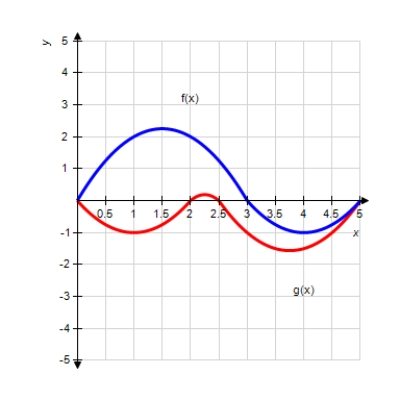
is larger, or if they are equal. (Multiple Choice)
4.8/5 (76)
(76) Suppose that the profit from a machine's production can be considered as a continuous income stream with annual rate of flow at time t given by  (dollars per year). If money is worth 14%, compounded continuously, find the present value of this stream over the next 5 years. Round your answer to the nearest dollar.
 (Multiple Choice)
4.8/5 (84)
(84) Use the sum formulas to find the value of the sum that follows. 
(Multiple Choice)
4.7/5 (78)
(78) The cost of producing x units of a certain item is  Find the average value of the cost function C(x) over the interval from 0 to 1,000. Round answer to nearest penny.
 (Multiple Choice)
4.9/5 (87)
(87) 
Filters
- Essay(0)
- Multiple Choice(0)
- Short Answer(0)
- True False(0)
- Matching(0)