



 Chat with AI
Exam 2: Quadratic and Other Special Functions

Exam 1: Linear Equations and Functions245 Questions
Exam 2: Quadratic and Other Special Functions120 Questions
Exam 3: Matrices230 Questions
Exam 4: Inequalities and Linear Programming119 Questions
Exam 5: Exponential and Logarithmic Functions109 Questions
Exam 6: Mathematics of Finance131 Questions
Exam 7: Introduction to Probability180 Questions
Exam 8: Further Topics in Probability and Data Description114 Questions
Exam 9: Derivatives249 Questions
Exam 10: Derivatives172 Questions
Exam 11: Derivatives Continued139 Questions
Exam 12: Indefinite Integrals120 Questions
Exam 13: Definite Integrals - Techniques370 Questions
Exam 13: A: Definite Integrals - Techniques370 Questions
Exam 14: Functions of Two or More Variables122 Questions
Exam 15: Algebraic Concepts 240 Questions
Exam 15: Algebraic Concepts 374 Questions
Exam 15: Algebraic Concepts 496 Questions
Exam 15: Algebraic Concepts 599 Questions
Select questions type


Find the x-intercepts, if any exist. Round your answers to two decimal places. 
(Multiple Choice)
4.8/5  (81)
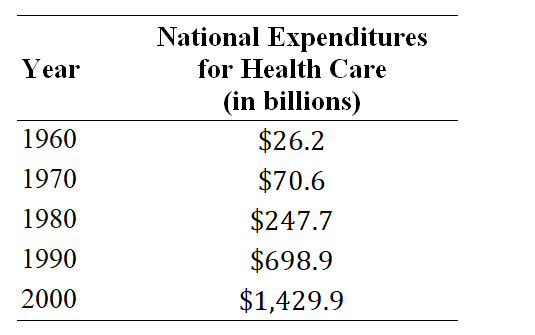
(81) The table below shows the national expenditures for health care in a certain country for selected years. Find a power model and a linear model for the data where x is the number of years after 1950. Which of the models seems to be the best to use if you are interested in finding the health care costs near the year 1990? Round numerical values in your answers to three decimal places.
(Multiple Choice)
4.9/5 (70)
(70) Find the exact real solutions to the equation, if they exist. 
(Multiple Choice)
4.7/5 (83)
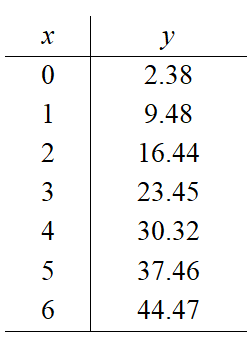
(83) Determine what type of function best models the data given below, and find the equation that is the best fit for the data. Round your final values to four decimal places.
(Multiple Choice)
4.9/5 (95)
(95) 
 .
If  , find
 and
 . Round your answers to two decimal places.
, find and . Round your answers to two decimal places. (Multiple Choice)
4.8/5 (72)
(72) The daily profit from the sale of a product is given by  dollars. What is the maximum possible profit? Round intermediate calculations and final answer to the nearest dollar.
 (Multiple Choice)
4.9/5 (74)
(74) Determine what value of x gives the optimal value of the function, and determine the optimal (maximum or minimum) value. Round your answers to two decimal places. 
(Multiple Choice)
4.9/5 (69)
(69) Find the maximum revenue for the revenue function  . Round your answer to the nearest cent.
 (Multiple Choice)
5.0/5 (82)
(82) Determine whether the given graph is the graph of a polynomial function, a rational function (but not a polynomial), or a piecewise defined function. Use the graph to estimate the turning points. Round your answers to two decimal places. 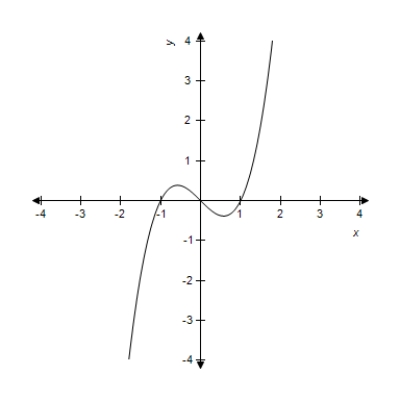
(Multiple Choice)
4.9/5 (93)
(93) If the profit from the sale of x units of a product is  , what level(s) of production will yield a profit of $1,000?
 (Multiple Choice)
4.9/5 (69)
(69) If the supply function for a commodity is  and the demand function is
 , find the equilibrium quantity and equilibrium price. Round your final answer to two decimal places.
and the demand function is , find the equilibrium quantity and equilibrium price. Round your final answer to two decimal places. (Multiple Choice)
4.7/5 (77)
(77) If a firm has the following cost and revenue functions, find the break-even points. 
(Multiple Choice)
4.9/5 (79)
(79) The amount of money invested in a certain mutual funds, measured in millions of dollars, for the years 1995 to 1999 was found to be modeled by 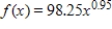 million dollars, where x is the number of years past 1990. Will the graph of this function bend upward or will it bend downward? How much money is predicted to be in the fund in the year 2009? Round your answer to two decimal places.
 (Multiple Choice)
4.9/5 (77)
(77) A ball thrown vertically into the air has its height above ground given by  , where t is in seconds and s is in feet. Find the maximum height of the ball.
 (Multiple Choice)
4.9/5 (79)
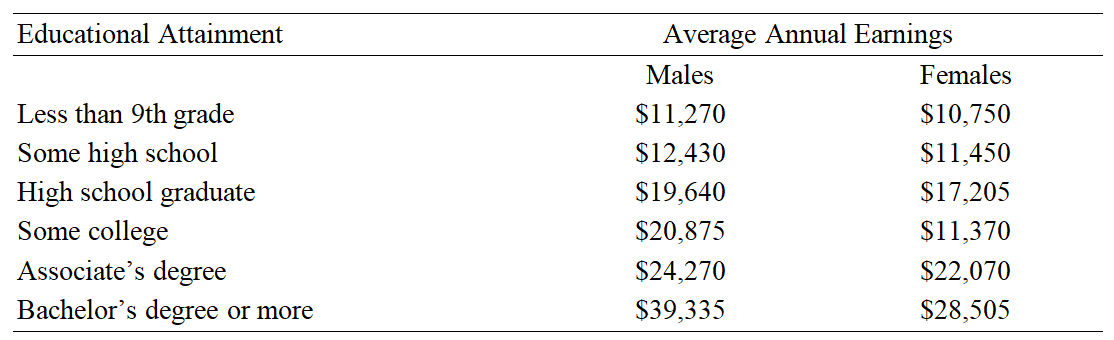
(79) The table shows the average earnings of year-round, full-time workers by gender and educational attainment in a certain country. Let x represent earnings for males and y represent earnings for females, and find a linear model that expresses women's annual earnings as a function of men's. Interpret the slope of the linear model. Round your final values to three decimal places.
(Multiple Choice)
4.8/5 (84)
(84)  .
 in general form.
Form the profit function for the cost and revenue functions, where the total costs and total revenues are given by  and
 .
and . (Multiple Choice)
4.9/5 (78)
(78) 
Filters
- Essay(0)
- Multiple Choice(0)
- Short Answer(0)
- True False(0)
- Matching(0)