



 Chat with AI
Exam 20: Process Cost Systems

Exam 1: Introduction to Accounting and Business190 Questions
Exam 2: Analyzing Transactions224 Questions
Exam 3: The Adjusting Process179 Questions
Exam 4: Completing the Accounting Cycle194 Questions
Exam 5: Accounting Systems160 Questions
Exam 6: Accounting for Merchandising Businesses215 Questions
Exam 7: Inventories165 Questions
Exam 8: Sarbanes-Oxley, Internal Control, and Cash176 Questions
Exam 9: Receivables140 Questions
Exam 10: Fixed Assets and Intangible Assets170 Questions
Exam 11: Current Liabilities and Payroll169 Questions
Exam 12: Accounting for Partnerships and Limited Liability Companies190 Questions
Exam 13: Corporations: Organization, Stock Transactions, and Dividends165 Questions
Exam 14: Long-Term Liabilities: Bonds and Notes185 Questions
Exam 15: Investments and Fair Value Accounting133 Questions
Exam 16: Statement of Cash Flows160 Questions
Exam 17: Financial Statement Analysis185 Questions
Exam 18: Managerial Accounting Concepts and Principles173 Questions
Exam 19: Job Order Costing173 Questions
Exam 20: Process Cost Systems177 Questions
Exam 21: Cost Behavior and Cost-Volume-Profit Analysis215 Questions
Exam 22: Budgeting188 Questions
Exam 23: Performance Evaluation Using Variances From Standard Costs161 Questions
Exam 24: Performance Evaluation for Decentralized Operations200 Questions
Exam 25: Differential Analysis and Product Pricing162 Questions
Exam 26: Capital Investment Analysis179 Questions
Select questions type


If the products of a manufacturing process are produced to customer specifications, a process cost system is more appropriate than a job order cost system.
(True/False)
4.9/5  (88)
(88) Department E had 4,000 units in Work in Process that were 40% completed at the beginning of the period at a cost of $12,500. Of the $12,500, $8,000 was for material and $4,500 was for conversion costs. 14,000 units of direct materials were added during the period at a cost of $28,700. 15,000 units were completed during the period, and 3,000 units were 75% completed at the end of the period. All materials are added at the beginning of the process. Direct labor was $32,450 and factory overhead was $18,710. If the average cost method is used the conversion cost per unit (to the nearest cent) would be:
(Multiple Choice)
4.7/5 (73)
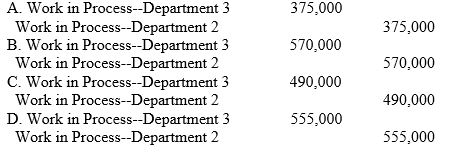
(73) Mocha Company manufactures a single product by a continuous process, involving three production departments. The records indicate that direct materials, direct labor, and applied factory overhead for Department 1 were $100,000, $125,000, and $150,000, respectively. The records further indicate that direct materials, direct labor, and applied factory overhead for Department 2 were $50,000, $60,000, and $70,000, respectively. Department 2 has transferred-in costs of $390,000 for the current period. In addition, work in process at the beginning of the period for Department 2 totaled $75,000, and work in process at the end of the period totaled $90,000. The journal entry to record the flow of costs into Department 3 during the period is:
(Short Answer)
4.9/5 (86)
(86) Department G had 3,600 units, 25% completed at the beginning of the period, 11,000 units were completed during the period, 3,000 units were one-fifth completed at the end of the period, and the following manufacturing costs were debited to the departmental work in process account during the period:  Assuming that all direct materials are placed in process at the beginning of production and that the first-in, first-out method of inventory costing is used, what is the total cost of 3,600 units of beginning inventory which were completed during the period (round unit cost calculations to four decimal places)?
 (Multiple Choice)
4.9/5 (83)
(83) Zang Co. manufacturers its products in a continuous process involving two departments, Machining and Assembly. Present entries to record the following selected transactions related to production during June:

(Essay)
4.9/5 (96)
(96) If 10,000 units which were 40% completed are in process at November 1, 80,000 units were completed during November, and 12,000 were 20% completed at November 30, the number of equivalent units of production for November was 75,600. (Assume no loss of units in production and that inventories are costed by the first-in, first-out method.)
(True/False)
4.9/5 (79)
(79) Carmelita Inc., has the following information available:  At the beginning of the period, there were 500 units in process that were 60 percent complete as to conversion costs and 100 percent complete as to direct materials costs. During the period 4,500 units were started and completed. Ending inventory contained 340 units that were 30 percent complete as to conversion costs and 100 percent complete as to materials costs. (Assume that the company uses the FIFO process cost method. Round cost per unit figures to two cents, i.e. $2.22 when calculating total costs.)
The total costs that will be transferred into Finished Goods for units started and completed were
At the beginning of the period, there were 500 units in process that were 60 percent complete as to conversion costs and 100 percent complete as to direct materials costs. During the period 4,500 units were started and completed. Ending inventory contained 340 units that were 30 percent complete as to conversion costs and 100 percent complete as to materials costs. (Assume that the company uses the FIFO process cost method. Round cost per unit figures to two cents, i.e. $2.22 when calculating total costs.)
The total costs that will be transferred into Finished Goods for units started and completed were (Multiple Choice)
4.9/5 (74)
(74) Which of the following is not characteristic of a process cost system?
(Multiple Choice)
4.8/5 (59)
(59) Department G had 3,600 units, 25% completed at the beginning of the period, 11,000 units were completed during the period, 3,000 units were one-fifth completed at the end of the period, and the following manufacturing costs were debited to the departmental work in process account during the period:  Assuming that all direct materials are placed in process at the beginning of production and that the first-in, first-out method of inventory costing is used, what is the total cost of the departmental work in process inventory at the end of the period (round unit cost calculations to four decimal places)?
 (Multiple Choice)
4.9/5 (70)
(70) The cost of production report reports the cost charged to production and the costs allocated to finished goods and work in process.
(True/False)
4.7/5 (79)
(79) The cost of production report reports the cost of the goods sold.
(True/False)
4.9/5 (79)
(79) Penny, Inc. employs a process costing system. Direct materials are added at the beginning of the process. Here is information about July's activities: 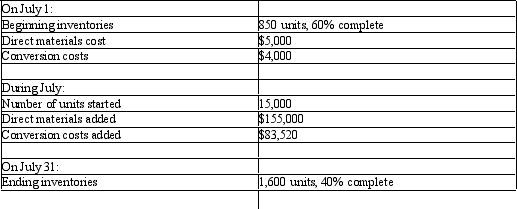 Using the FIFO method, the number of equivalent units of conversion costs was
 (Multiple Choice)
4.8/5 (92)
(92) Mocha Company manufactures a single product by a continuous process, involving three production departments. The records indicate that direct materials, direct labor, and applied factory overhead for Department 1 were $100,000, $125,000, and $150,000, respectively. The records further indicate that direct materials, direct labor, and applied factory overhead for Department 2 were $55,000, $65,000, and $80,000, respectively. In addition, work in process at the beginning of the period for Department 1 totaled $75,000, and work in process at the end of the period totaled $60,000. The journal entry to record the flow of costs into Department 2 during the period for direct labor is:

(Short Answer)
4.7/5 (82)
(82) The cost per equivalent units of direct materials and conversion in the Bottling Department of Beverages on Jolt Company is $.47 and $.15, respectively. The equivalent units to be assigned costs are as follows.
 The beginning work in process inventory had a cost of $3,500. Determine the cost of completed and transferred out production, and the ending work in process inventory.
 (Essay)
5.0/5 (84)
(84) Amos Company's molding department opened on October 1, 2012. During October, 35,000 units were completed and transferred out to the next department. On October 31, 2012, the 9,000 units which remained in inventory were 40% complete with respect to conversion costs and 100% complete with respect to materials.
Required:
How many equivalent units of work did the molding department complete during October for materials and conversion costs?
(Essay)
4.7/5 (80)
(80) Gilbert Corporation had 25,000 finished units and 8,000 units were 35% complete. The equivalent units totaled 30,200.
(True/False)
5.0/5 (75)
(75) All costs of the processes in a process costing system ultimately pass through the Cost of Goods Sold account.
(True/False)
5.0/5 (81)
(81) The three categories of manufacturing costs comprising the cost of work in process are direct labor, direct materials, and:
(Multiple Choice)
4.8/5 (90)
(90) Explain the concept of equivalent units. Give an example to validate your explanation.
(Essay)
4.8/5 (88)
(88) The cost per equivalent units of direct materials and conversion in the Bottling Department of Mountain Springs Water Company is $.45 and $.12, respectively. The equivalent units to be assigned costs are as follows.
 The beginning work in process inventory had a cost of $2,200. Determine the cost of completed and transferred out production, and the ending work in process inventory.
 (Essay)
4.9/5 (82)
(82) 
Filters
- Essay(0)
- Multiple Choice(0)
- Short Answer(0)
- True False(0)
- Matching(0)