



 Chat with AI
Exam 23: Performance Evaluation Using Variances From Standard Costs

Exam 1: Introduction to Accounting and Business190 Questions
Exam 2: Analyzing Transactions224 Questions
Exam 3: The Adjusting Process179 Questions
Exam 4: Completing the Accounting Cycle194 Questions
Exam 5: Accounting Systems160 Questions
Exam 6: Accounting for Merchandising Businesses215 Questions
Exam 7: Inventories165 Questions
Exam 8: Sarbanes-Oxley, Internal Control, and Cash176 Questions
Exam 9: Receivables140 Questions
Exam 10: Fixed Assets and Intangible Assets170 Questions
Exam 11: Current Liabilities and Payroll169 Questions
Exam 12: Accounting for Partnerships and Limited Liability Companies190 Questions
Exam 13: Corporations: Organization, Stock Transactions, and Dividends165 Questions
Exam 14: Long-Term Liabilities: Bonds and Notes185 Questions
Exam 15: Investments and Fair Value Accounting133 Questions
Exam 16: Statement of Cash Flows160 Questions
Exam 17: Financial Statement Analysis185 Questions
Exam 18: Managerial Accounting Concepts and Principles173 Questions
Exam 19: Job Order Costing173 Questions
Exam 20: Process Cost Systems177 Questions
Exam 21: Cost Behavior and Cost-Volume-Profit Analysis215 Questions
Exam 22: Budgeting188 Questions
Exam 23: Performance Evaluation Using Variances From Standard Costs161 Questions
Exam 24: Performance Evaluation for Decentralized Operations200 Questions
Exam 25: Differential Analysis and Product Pricing162 Questions
Exam 26: Capital Investment Analysis179 Questions
Select questions type


The following information is for the standard and actual costs for the Happy Corporation.
Standard Costs:
Budgeted units of production - 16,000 (80% of capacity)
Standard labor hours per unit - 4
Standard labor rate - $26 per hour
Standard material per unit - 8 lbs.
Standard material cost - $ 12 per pound
Standard variable overhead rate - $15 per labor hour
Budgeted fixed overhead - $640,000
Fixed overhead rate is based on budgeted labor hours at 80% capacity.
Actual Cost:
Actual production - 16,500 units
Actual material purchased and used - 130,000 pounds
Actual total material cost - $1,600,000
Actual labor - 65,000 hours
Actual total labor costs - $1,700,000
Actual variable overhead - $1,000,000
Actual fixed overhead - $640,000
Actual variable overhead - $1,000,000
Determine: (a) the quantity variance, price variance, and total direct materials cost variance; (b) the time variance, rate variance, and total direct labor cost variance; and (c) the volume variance, controllable variance, and total factory overhead cost variance.
(Essay)
4.8/5  (78)
(78) Cost systems using detailed estimates of each element of manufacturing cost entering into the finished product are called budgeted cost systems.
(True/False)
4.9/5 (83)
(83) Standards are performance goals used to evaluate and control operations.
(True/False)
5.0/5 (70)
(70) Standard costs are divided into which of the following components?
(Multiple Choice)
4.8/5 (76)
(76) Which of the following conditions normally would not indicate that standard costs should be revised?
(Multiple Choice)
4.8/5 (61)
(61) A negative fixed overhead volume variance can be caused due to the following except:
(Multiple Choice)
4.7/5 (67)
(67) The Flapjack Corporation had 8,200 actual direct labor hours at an actual rate of $12.40 per hour. Original production had been budgeted for 1,100 units, but only 1,000 units were actually produced. Labor standards were 7.6 hours per completed unit at a standard rate of $13.00 per hour. Compute the labor time variance.
(Multiple Choice)
4.8/5 (78)
(78) The following data is given for the Bahia Company: 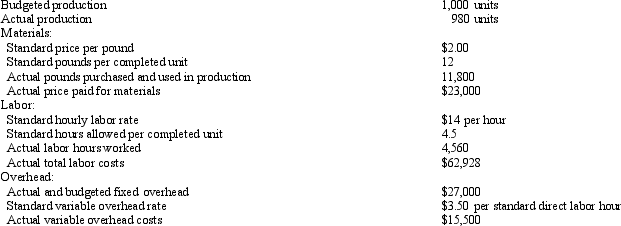 Overhead is applied on standard labor hours.
The factory overhead controllable variance is:
Overhead is applied on standard labor hours.
The factory overhead controllable variance is: (Multiple Choice)
4.8/5 (74)
(74) The following data is given for the Stringer Company: 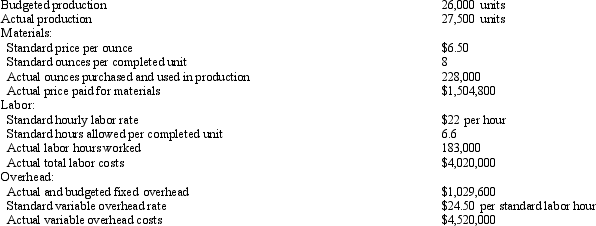 Overhead is applied on standard labor hours.
The direct material quantity variance is:
Overhead is applied on standard labor hours.
The direct material quantity variance is: (Multiple Choice)
4.9/5 (74)
(74) Compute the standard cost for one hat, based on the following standards for each hat:

(Essay)
4.9/5 (79)
(79) If the standard to produce a given amount of product is 1,000 units of direct materials at $11 and the actual was 800 units at $12, the direct materials quantity variance was $1,000 unfavorable.
(True/False)
4.9/5 (87)
(87) A favorable cost variance occurs when actual cost is less than budgeted cost at actual volumes.
(True/False)
5.0/5 (76)
(76) The formula to compute direct labor time variance is to calculate the difference between
(Multiple Choice)
4.9/5 (96)
(96) The St. Augustine Corporation originally budgeted for $360,000 of fixed overhead at 100% production capacity. Production was budgeted to be 12,000 units. The standard hours for production were 5 hours per unit. The variable overhead rate was $3 per hour. Actual fixed overhead was $360,000 and actual variable overhead was $170,000. Actual production was 11,700 units. Compute the factory overhead controllable variance.
(Multiple Choice)
4.9/5 (82)
(82) The following data is given for the Taylor Company:
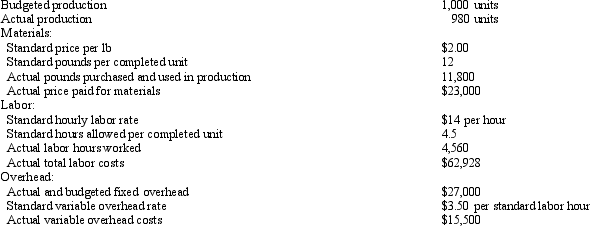 Overhead is applied on standard labor hours.
Compute the direct labor rate and time variances for Taylor Company.
Overhead is applied on standard labor hours.
Compute the direct labor rate and time variances for Taylor Company. (Essay)
4.9/5 (83)
(83) Financial reporting systems that are guided by the principle of exceptions concept focus attention on variances from standard costs.
(True/False)
4.7/5 (82)
(82) 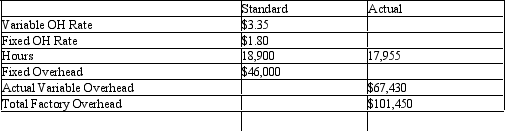 Calculate the variable factory overhead controllable variance using the above information:
 (Multiple Choice)
4.9/5 (90)
(90) The following data relate to direct labor costs for February:  What is the direct labor rate variance?
 (Multiple Choice)
4.9/5 (74)
(74) The St. Augustine Corporation originally budgeted for $360,000 of fixed overhead at 100% production capacity. Production was budgeted to be 12,000 units. The standard hours for production were 5 hours per unit. The variable overhead rate was $3 per hour. Actual fixed overhead was $360,000 and actual variable overhead was $170,000. Actual production was 11,700 units. Compute the factory overhead volume variance.
(Multiple Choice)
4.8/5 (71)
(71) The standard cost is how much a product should cost to manufacture.
(True/False)
4.9/5 (81)
(81) 
Filters
- Essay(0)
- Multiple Choice(0)
- Short Answer(0)
- True False(0)
- Matching(0)