



 Chat with AI
Exam 9: Receivables

Exam 1: Introduction to Accounting and Business190 Questions
Exam 2: Analyzing Transactions224 Questions
Exam 3: The Adjusting Process179 Questions
Exam 4: Completing the Accounting Cycle194 Questions
Exam 5: Accounting Systems160 Questions
Exam 6: Accounting for Merchandising Businesses215 Questions
Exam 7: Inventories165 Questions
Exam 8: Sarbanes-Oxley, Internal Control, and Cash176 Questions
Exam 9: Receivables140 Questions
Exam 10: Fixed Assets and Intangible Assets170 Questions
Exam 11: Current Liabilities and Payroll169 Questions
Exam 12: Accounting for Partnerships and Limited Liability Companies190 Questions
Exam 13: Corporations: Organization, Stock Transactions, and Dividends165 Questions
Exam 14: Long-Term Liabilities: Bonds and Notes185 Questions
Exam 15: Investments and Fair Value Accounting133 Questions
Exam 16: Statement of Cash Flows160 Questions
Exam 17: Financial Statement Analysis185 Questions
Exam 18: Managerial Accounting Concepts and Principles173 Questions
Exam 19: Job Order Costing173 Questions
Exam 20: Process Cost Systems177 Questions
Exam 21: Cost Behavior and Cost-Volume-Profit Analysis215 Questions
Exam 22: Budgeting188 Questions
Exam 23: Performance Evaluation Using Variances From Standard Costs161 Questions
Exam 24: Performance Evaluation for Decentralized Operations200 Questions
Exam 25: Differential Analysis and Product Pricing162 Questions
Exam 26: Capital Investment Analysis179 Questions
Select questions type


Determine the amount to be added to Allowance for Doubtful Accounts in each of the following cases and indicate the ending balance in each case.

(Essay)
4.9/5  (85)
(85) Allowance for Doubtful Accounts has a credit balance of $800 at the end of the year (before adjustment), and an analysis of accounts in the customer ledger indicates the estimated amount of uncollectible accounts should be $16,000. Based on the estimate above, which of the following adjusting entries should be made?
(Multiple Choice)
4.9/5 (91)
(91) Based on the following data and using a 365-day year, compute (a) the accounts receivable turnover and (b) the number of days' sales in receivables. The industry average is a collection period of once every 20 days, and the number of days' sales in receivables averages 25. (c) Comment on this situation.

(Essay)
4.9/5 (90)
(90) The difference between the balance in Accounts Receivable and the balance in the Allowance for Doubtful Accounts is called the net realizable value.
(True/False)
4.7/5 (67)
(67) When using the direct write-off method off accounting for uncollectible receivables, the account Allowance for Doubtful Accounts is debited when a specific account is determined to be uncollectible.
(True/False)
4.9/5 (72)
(72) The direct write-off method records Bad Debt Expense in the year the specific account receivable is determined to be uncollectible.
(True/False)
4.8/5 (74)
(74) Determine the due date and the amount of interest due at maturity on the following notes:

(Essay)
4.8/5 (70)
(70) The following journal entries would be used in one of the two methods of accounting for uncollectible receivables. Identify each.
(a)
 (b)

(b)
(Essay)
4.9/5 (87)
(87) Allowance for Doubtful Accounts has a debit balance of $1,100 at the end of the year (before adjustment), and an analysis of customers' accounts indicates uncollectible receivables of $12,900. Which of the following entries records the proper adjustment for Bad Debt Expense?
(Multiple Choice)
4.9/5 (76)
(76) If the direct write-off method of accounting for uncollectible receivables is used, what general ledger account is debited to write off a customer's account as uncollectible?
(Multiple Choice)
4.8/5 (77)
(77) The equation for computing interest on an interest-bearing note is as follows: interest equals maturity value times interest rate times time.
(True/False)
4.9/5 (80)
(80) If the allowance method of accounting for uncollectible receivables is used, what general ledger account is debited to write off a customer's account as uncollectible?
(Multiple Choice)
4.9/5 (65)
(65) Under the allowance method, when a year-end adjustment is made for estimated uncollectible accounts
(Multiple Choice)
4.9/5 (87)
(87) Allowance for Doubtful Accounts has a credit balance of $500 at the end of the year (before adjustment), and bad debt expense is estimated at 3% of net credit sales. If net credit sales are $300,000, the amount of the adjusting entry to record the estimated uncollectible accounts receivables is
(Multiple Choice)
4.9/5 (65)
(65) Abbott Company uses the allowance method of accounting for uncollectible accounts. Abbott estimates that 3% of net credit sales will be uncollectible. On January 1, 2010, the Allowance for Doubtful Accounts had a credit balance of $2,400. During 2010, Abbott wrote-off accounts receivable totaling $1,800 and made credit sales of $100,000. There were no Sales Returns or Sales Discounts during the year. After the adjusting entry, the December 31, 2010, balance in the Bad Debt Expense would be
(Multiple Choice)
4.8/5 (89)
(89) a) The aging of Torme Designs shown below. Calculate the amount of each periodicity range that is deemed to be uncollectible.
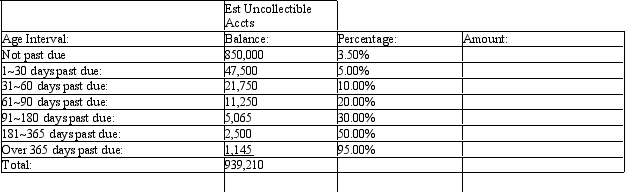 b) If the Allowance for Doubtful Accounts has a credit balance of $1,135.00, record the adjusting entry for the bad debt expense for the year.
 (Essay)
4.8/5 (78)
(78) When companies sell their receivables to other companies, the transaction is called factoring.
(True/False)
4.8/5 (77)
(77) A primary difference between the direct write-off and allowance method is whether or not bad debts is based on a percentage of sales.
(True/False)
5.0/5 (74)
(74) 
Filters
- Essay(0)
- Multiple Choice(0)
- Short Answer(0)
- True False(0)
- Matching(0)