



 Chat with AI
Exam 3: The Balance Sheet and Financial Disclosures

Exam 1: Environment and Theoretical Structure of Financial Accounting181 Questions
Exam 2: Review of the Accounting Process 139 Questions
Exam 3: The Balance Sheet and Financial Disclosures168 Questions
Exam 4: The Income Statement, Comprehensive Income, and the Statement of Cash Flows178 Questions
Exam 5: Revenue Recognition316 Questions
Exam 6: Time Value of Money Concepts126 Questions
Exam 7: Cash and Receivables187 Questions
Exam 8: Inventories: Measurement182 Questions
Exam 9: Inventories: Additional Issues153 Questions
Exam 10: Property, Plant, and Equipment and Intangible Assets: Acquisition149 Questions
Exam 11: Property, Plant, and Equipment and Intangible Assets: Utilization and Disposition223 Questions
Exam 12: Investments183 Questions
Exam 13: Current Liabilities and Contingencies155 Questions
Exam 14: Bonds and Long-Term Notes256 Questions
Exam 15: Leases262 Questions
Exam 16: Accounting for Income Taxes176 Questions
Exam 17: Pensions and Other Postretirement Benefits246 Questions
Exam 18: Shareholders Equity179 Questions
Exam 19: Share-Based Compensation and Earnings Per Share231 Questions
Exam 20: Accounting Changes and Error Corrections152 Questions
Exam 21: The Statement of Cash Flows Revisited192 Questions
Select questions type


Indicate whether each of the actions listed below will immediately increase (I), decrease (D), or have no effect (N) on the ratios shown. Assume each ratio is greater than 1.0 before the action is taken.
-
(Essay)
4.8/5  (70)
(70) Listed below are five terms followed by a list of phrases that describe or characterize each of the terms. Match each phrase with the correct term.
-Paid-in capital
(Multiple Choice)
4.8/5 (76)
(76) The usual difference between accounts payable and notes payable is:
(Multiple Choice)
4.8/5 (87)
(87) Listed below are five terms followed by a list of phrases that describe or characterize each of the terms. Match each phrase with the correct term.
-Current ratio
(Multiple Choice)
5.0/5 (75)
(75) Segment reporting requires disclosure of each customer that accounts for more than 5% of total enterprise revenue.
(True/False)
4.9/5 (86)
(86) Which of the following would be disclosed in the summary of significant accounting policies disclosure note? 
(Multiple Choice)
4.8/5 (79)
(79) Listed below are five terms followed by a list of phrases that describe or characterize each of the terms. Match each phrase with the correct term.
-Liquidity
(Multiple Choice)
4.8/5 (94)
(94) An omission in the notes to the financial statements that is so serious that even a qualified opinion is not justified would result in:
(Multiple Choice)
4.9/5 (66)
(66) Which of the following is not a required segment reporting disclosure according to U.S. GAAP?
(Multiple Choice)
4.8/5 (66)
(66) Listed below are five terms followed by a list of phrases that describe or characterize each of the terms. Match each phrase with the correct term.
-Property, plant, and equipment
(Multiple Choice)
4.7/5 (79)
(79) Briefly explain what is meant by a subsequent event. Give two examples of subsequent events.
(Essay)
4.9/5 (71)
(71) Listed below are five terms followed by a list of phrases that describe or characterize each of the terms. Match each phrase with the correct term.
-Long-term solvency
(Multiple Choice)
4.7/5 (83)
(83) Prepaid expenses are classified as current assets if the services purchased are expected to expire within 12 months or the operating cycle, whichever is longer.
(True/False)
4.8/5 (74)
(74) The criteria for determining which items comprise cash equivalents often is disclosed in the summary of significant accounting policies.
(True/False)
4.8/5 (84)
(84) All current assets are either cash or assets that will be converted into cash or consumed within 12 months or the operating cycle, whichever is longer.
(True/False)
4.9/5 (82)
(82) The balance sheet for Altoid Co. is shown below.
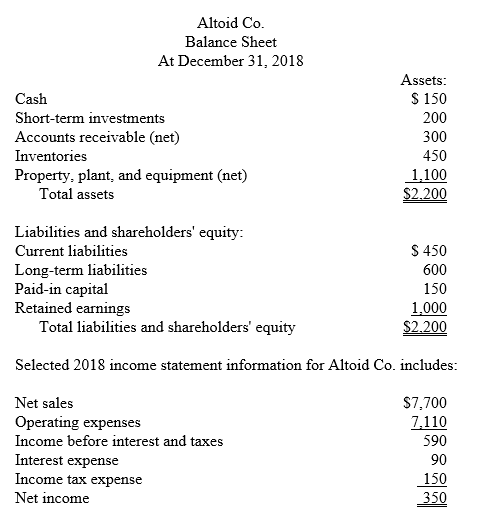 Required: Compute the following financial statement ratios for 2018:
-Altoid Co.'s current ratio. Round your answer to two decimal places.
Required: Compute the following financial statement ratios for 2018:
-Altoid Co.'s current ratio. Round your answer to two decimal places. (Essay)
4.8/5 (79)
(79) 
Filters
- Essay(0)
- Multiple Choice(0)
- Short Answer(0)
- True False(0)
- Matching(0)