



 Chat with AI
Exam 15: Financial Statement Analysis

Exam 1: Introduction to Accounting and Business194 Questions
Exam 2: Analyzing Transactions222 Questions
Exam 3: The Adjusting Process179 Questions
Exam 4: Completing the Accounting Cycle196 Questions
Exam 5: Accounting for Merchandising Businesses221 Questions
Exam 6: Inventories167 Questions
Exam 7: Sarbanes-Oxley, Internal Control, and Cash174 Questions
Exam 8: Receivables147 Questions
Exam 9: Fixed Assets and Intangible Assets175 Questions
Exam 10: Current Liabilities and Payroll172 Questions
Exam 11: Corporations: Organization, Stock Transactions, and Dividends168 Questions
Exam 12: Long-Term Liabilities: Bonds and Notes181 Questions
Exam 13: Investments and Fair Value Accounting137 Questions
Exam 14: Statement of Cash Flows162 Questions
Exam 15: Financial Statement Analysis184 Questions
Select questions type


The ratio of the market price per share of common stock on a specific date to the annual earnings per share is referred to as the price-earnings ratio.
(True/False)
4.8/5  (82)
(82) 

\ 30,000 Accounts payable 65,000 Accounts receivable 7,000 Acculud liabilities 20,000 Cash 40,000 Intangible assets 72,000 Inventory 100,000 Long-term investments 75,000 Long-term liabilities 36,000 Marketable securities 20,000 Notes payable (short-term) 625,000 Property, plant, and equipment 2,000 Prepaid expenses Based on the above data, what is the amount of working capital?
(Multiple Choice)
4.9/5 (74)
(74) The percentage analysis of increases and decreases in corresponding items in comparative financial statements is referred to as horizontal analysis.
(True/False)
4.9/5 (87)
(87) Interpreting financial analysis should be considered in light of conditions peculiar to the industry and the general economic conditions.
(True/False)
4.8/5 (82)
(82) The following items were taken from the financial statements of Stanton, Inc., over a three-year period:
 Compute the following for each of the above time periods.

Compute the following for each of the above time periods.
(Essay)
4.8/5 (57)
(57) The denominator of the rate of return on total assets ratio is the average total assets.
(True/False)
4.7/5 (85)
(85) The following information is available for Dorman Company:  Which of the following statements is correct?
 (Multiple Choice)
4.8/5 (85)
(85) Horizontal analysis of comparative financial statements includes the
(Multiple Choice)
4.7/5 (91)
(91) Ratios and various other analytical measures are a substitute for sound judgment, nor do they provide definitive guides for action.
(True/False)
4.8/5 (96)
(96) A company reports the following:
 Determine the (a) accounts receivable turnover, and (b) number of days' sales in receivables. Round your answer to one decimal place.
 (Essay)
4.8/5 (80)
(80) Solvency analysis focuses on the ability of a business to pay its current and noncurrent liabilities.
(True/False)
4.9/5 (72)
(72) Those unusual items reported as deductions from income from continuing operations should be listed net of the related income tax.
(True/False)
4.9/5 (80)
(80) In a common-sized income statement, each item is expressed as a percentage of net income.
(True/False)
4.9/5 (77)
(77) Hsu Company reported the following on its income statement: \ 420,000 Income before income taxes 120,000 Income tax expense \ 300,000 Net income An analysis of the income statement revealed that interest expense was $80,000. Hsu Company's times interest earned was
(Multiple Choice)
4.9/5 (71)
(71) The number of times interest expense is earned is computed as
(Multiple Choice)
4.7/5 (68)
(68) A company can use comparisons of its financial data to the data of other companies and industry values to evaluate its position.
(True/False)
4.7/5 (78)
(78) The numerator used to calculate accounts receivable turnover is
(Multiple Choice)
4.9/5 (84)
(84) If a company has issued only one class of stock, the earnings per share are determined by dividing net income plus interest expense by the number of shares outstanding.
(True/False)
4.8/5 (72)
(72) The following data were extracted from the income statement of Maine Solutions, Inc.
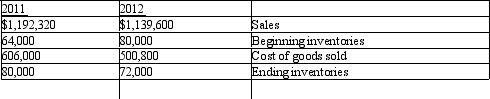 Required:

Required:
(Essay)
4.8/5 (84)
(84) 
Filters
- Essay(0)
- Multiple Choice(0)
- Short Answer(0)
- True False(0)
- Matching(0)