



 Chat with AI
Exam 10: Accounting Systems for Manufacturing Businesses

Exam 1: The Role of Accounting in Business96 Questions
Exam 2: Basic Accounting Concepts89 Questions
Exam 3: Accrual Accounting Concepts111 Questions
Exam 4: Accounting for Merchandising Businesses138 Questions
Exam 5: Sarbanes-Oxley, Internal Control, and Cash110 Questions
Exam 6: Receivables and Inventories102 Questions
Exam 7: Fixed Assets and Intangible Assets86 Questions
Exam 8: Liabilities and Stockholders Equity131 Questions
Exam 9: Financial Statement Analysis83 Questions
Exam 10: Accounting Systems for Manufacturing Businesses120 Questions
Exam 11: Cost Behavior and Cost-Volume-Profit Analysis140 Questions
Exam 12: Differential Analysis and Product Pricing99 Questions
Exam 13: Budgeting and Standard Cost Systems168 Questions
Exam 14: Performance Evaluation for Decentralized Operations137 Questions
Exam 15: Capital Investment Analysis103 Questions
Select questions type


A manufacturing business converts materials into finished products through the use of machinery and labor.
(True/False)
4.9/5  (80)
(80) Which of the following is a characteristic of the just-in-time philosophy?
(Multiple Choice)
4.8/5 (82)
(82) In response to materials requisition, materials are transferred from the storeroom to the factory.
(True/False)
4.9/5 (75)
(75) If the cost of direct materials is not a significant portion of the total product cost, it may be classified as:
(Multiple Choice)
4.9/5 (86)
(86) For Peterson Company, total overhead applied was $35,000,000 at the end of the year. Actual overhead was $35,800,000. Closing over/under applied overhead into cost of goods sold would cause net income to:
(Multiple Choice)
4.8/5 (76)
(76) A summary of the materials requisitions completed during a period serves as the basis for transferring the cost of the materials from the Materials account to:
(Multiple Choice)
4.9/5 (84)
(84) The following information is available for the first month of operations of Deer Inc., a manufacturer of sports apparel:
\ 1,500,000 Sales 410,000 Gross profit 125,000 Indirect labor 30,000 Indirect materials 415,000 Other factory overhead 700,000 Materials purchased 1,600,000 Total manufacturing costs for the period 35,000 Materials inventory, end of period Using the given information, determine the following:
a. Cost of goods sold
b. Direct materials cost
c. Direct labor cost
(Essay)
4.9/5 (74)
(74) Conversion cost is the combination of direct labor cost and factory overhead cost.
(True/False)
4.9/5 (73)
(73) Which of the following techniques is used by just-in-time manufacturing?
(Multiple Choice)
4.7/5 (87)
(87) The cost of a manufactured product generally consists of direct materials cost, direct labor cost, and factory overhead cost.
(True/False)
4.7/5 (78)
(78) The summary of the time tickets at the end of each month is the basis for recording the direct and indirect labor costs incurred in production.
(True/False)
4.8/5 (88)
(88) In a job order cost system, materials and supply costs for a service business are normally included as part of overhead cost.
(True/False)
4.9/5 (83)
(83) For a construction contractor, the wages of carpenters would be classified as direct labor cost.
(True/False)
4.9/5 (74)
(74) An activity-based costing system allocates factory overhead rates to products or services using:
(Multiple Choice)
4.8/5 (72)
(72) Which of the following would be a period costs for a textbooks printing company?
(Multiple Choice)
5.0/5 (87)
(87) The cost of wages paid to employees directly involved in the manufacturing process of converting materials into finished product is classified as:
(Multiple Choice)
4.8/5 (82)
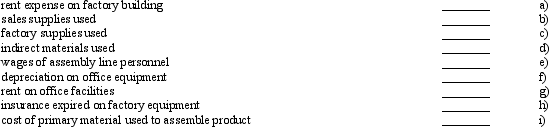
(82) Use the correct number to designate each item below:
1) direct materials
2) selling and administrative expenses
3) factory overhead
4) direct labor
(Essay)
4.9/5 (83)
(83) If the cost of employee wages is not a significant portion of the total product cost, the wages are classified as factory overhead cost.
(True/False)
5.0/5 (77)
(77) 
Filters
- Essay(0)
- Multiple Choice(0)
- Short Answer(0)
- True False(0)
- Matching(0)