



 Chat with AI
Exam 6: Section 2: Rational Expressions

Exam 1: Section 1: Real Numbers and Their Properties29 Questions
Exam 1: Section 2: Real Numbers and Their Properties29 Questions
Exam 2: Section 1: Linear Equations and Inequalities in One Variable26 Questions
Exam 2: Section 2: Linear Equations and Inequalities in One Variable26 Questions
Exam 3: Section 1: Linear Equations and Inequalities in Two Variables26 Questions
Exam 3: Section 2: Linear Equations and Inequalities in Two Variables25 Questions
Exam 4: Section 1: Exponents and Polynomials28 Questions
Exam 4: Section 2: Exponents and Polynomials28 Questions
Exam 5: Section 1: Factoring25 Questions
Exam 5: Section 2: Factoring25 Questions
Exam 6: Section 1: Rational Expressions25 Questions
Exam 6: Section 2: Rational Expressions25 Questions
Exam 7: Section 1: Systems of Linear Equations17 Questions
Exam 7: Section 2: Systems of Linear Equations15 Questions
Exam 8: Section 1: More on Inequalities23 Questions
Exam 8: Section 2: More on Inequalities22 Questions
Exam 9: Section 1: Radicals and Rational Exponents25 Questions
Exam 9: Section 2: Radicals and Rational Exponents25 Questions
Exam 10: Section 1: Quadratic Equations and Inequalities25 Questions
Exam 10: Section 2: Quadratic Equations and Inequalities25 Questions
Exam 11: Section 1: Functions26 Questions
Exam 11: Section 2: Functions25 Questions
Exam 12: Section 1: Exponential and Logarithmic Functions25 Questions
Exam 12: Section 2: Exponential and Logarithmic Functions25 Questions
Exam 13: Section 1: Nonlinear Systems and the Conic Sections25 Questions
Exam 13: Section 2: Nonlinear Systems and the Conic Sections24 Questions
Exam 14: Section 1: Sequences and Series Available Online at Www.mhhe.com/dugopolski21 Questions
Exam 14: Section 2: Sequences and Series Available Online at Www.mhhe.com/dugopolski21 Questions
Exam 15: Mathematical Problem Set27 Questions
Exam 16: Algebraic Equations and Problem Solving27 Questions
Exam 17: Algebra and Math Problems50 Questions
Exam 18: Algebraic Equation Practice50 Questions
Select questions type


For the given ratio, find and equivalent ratio of integers in lowest terms. 

Free
(Essay)
4.7/5  (91)
(91) Correct Answer: Verified
Reduce the given expression to lowest terms. 
Free
(Short Answer)
4.8/5 (94)
(94) Correct Answer:Verified
Verifiedw - 1
Perform the indicated operations and write your result in lowest terms. 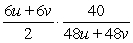
Free
(Essay)
4.8/5 (80)
(80) Correct Answer:Verified
Verified
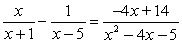

Among 100 college students, 40 said they study 11 or more hours per week while the rest said they did not. What is the ratio of those students who study at least 11 hours per week to those that do not?
(Short Answer)
4.7/5 (91)
(91) A large pump can fill a 78,000 gallon reservoir in 8 hours. Working together, the large pump and a smaller one can fill the reservoir in 6 hours. How long would it take the smaller pump to fill the reservoir by itself?
(Short Answer)
4.8/5 (77)
(77) Cora can paddle her canoe 8 miles in the same time that Susan's motorboat covers 28 miles. If Susan's boat travels 10 mph faster than Cora's canoe, then how fast is Susan's boat?
(Short Answer)
4.9/5 (80)
(80) 
Build the rational expression into an equivalent rational expression with the indicated denominator. 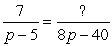
(Essay)
4.9/5 (80)
(80) 

Chris prepares a 10-pound mixture of cashews and peanuts. He paid $18 for the cashews and $14 for the peanuts. If cashews cost three times more than peanuts, then how many pounds of cashews did he use?
(Short Answer)
4.8/5 (71)
(71) Perform the indicated operations and write your result in lowest terms. 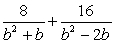
(Essay)
4.8/5 (72)
(72) 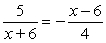

Perform the indicated operations and write your result in lowest terms. 
(Essay)
4.8/5 (81)
(81) Find the LCD for the given rational expressions, and convert each rational expression into an equivalent rational expression with the LCD as the denominator. 
(Essay)
4.7/5 (79)
(79) David hires a septic system contractor to dig trenches for his new septic tank. The cost to hire the contractor is a fixed cost of $250 plus an additional $80 per hour. Write an expression which describes the average cost of an x-hour job.
(Essay)
4.7/5 (78)
(78) Hugo empties his piggy bank onto his kitchen table. After the coins come to rest, one-fourth of the nickels are heads up, two-thirds of the dimes are heads up, and one-half of the quarters are heads up. The figure below shows the composition of the coins that were in the piggy bank. Use the figure and the given information to determine the percentage of coins that are heads up. 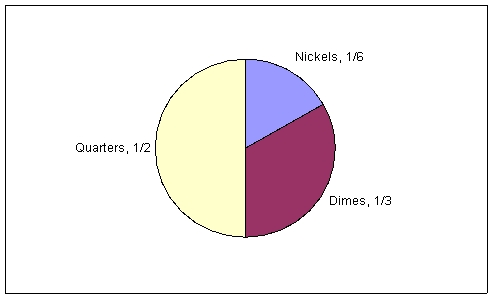
(Short Answer)
4.9/5 (92)
(92) 
Filters
- Essay(0)
- Multiple Choice(0)
- Short Answer(0)
- True False(0)
- Matching(0)