



 Chat with AI
Exam 13: Allocating Costs to Responsibility Centers

Exam 1: Fundamental Concepts114 Questions
Exam 2: Measuring Product Costs125 Questions
Exam 3: Activity-Based Management139 Questions
Exam 4: Strategic Management of Costs,quality,and Time146 Questions
Exam 5: Cost Drivers and Cost Behavior114 Questions
Exam 6: Financial Modeling for Short-Term Decision Making120 Questions
Exam 7: Differential Cost Analysis for Operating Decisions186 Questions
Exam 8: Capital Expenditure Decisions126 Questions
Exam 9: Profit Planning and Budgeting126 Questions
Exam 10: Profit and Cost Center Performance Evaluation100 Questions
Exam 11: Investment Center Performance Evaluation126 Questions
Exam 12: Incentive Issues123 Questions
Exam 13: Allocating Costs to Responsibility Centers93 Questions
Select questions type


Which of the following statements best describes cost allocation?
(Multiple Choice)
4.8/5  (86)
(86) Useful Tool Company
Useful Tool Company has two service departments (General Factory and Repair)and two operating departments (Fabrication and Assembly).Management has decided to allocate repair costs on the basis of the area (square feet)in each department and to allocate General Factory on the basis of labor hours worked by the employees in each of their respective departments.
The following data appear in the company records for the current period:
 The company allocates the costs from the General Factory Department first.
Refer to the Useful Tool Company.Using the step method,what is the total amount of costs allocated to (a)the Fabrication Department and (b)the Assembly Department?
The company allocates the costs from the General Factory Department first.
Refer to the Useful Tool Company.Using the step method,what is the total amount of costs allocated to (a)the Fabrication Department and (b)the Assembly Department? (Essay)
4.8/5 (72)
(72) Stephanie Company
Stephanie Company has two production departments: D and J.Stephanie also has 3 service departments: Personnel,Administration,and Shipping.Shipping costs are allocated on the basis of number of packages,while Personnel and Administration costs are allocated using number of employees.Assume that the ranking of the benefits provided is in the order listed below.
 Refer to Stephanie Company.Using the direct method,what amount of personnel costs is allocated to Department J (rounded to the nearest $)?
 (Multiple Choice)
4.9/5 (73)
(73) Which of the following is a reason for using activity-based costing to allocate service department costs?
(Multiple Choice)
5.0/5 (85)
(85) Which of the following is the method of allocating joint costs based on a physical measure of volume,weight,or any other common measure of physical characteristics?
(Multiple Choice)
4.8/5 (68)
(68) Applying the techniques of activity-based costing typically results in identifying which of the following?
(Multiple Choice)
4.9/5 (91)
(91) Garfield Company has two production departments and a maintenance department.In addition,the company keeps other costs for the general plant in a separate account.The estimated cost data for Year 1 follow:
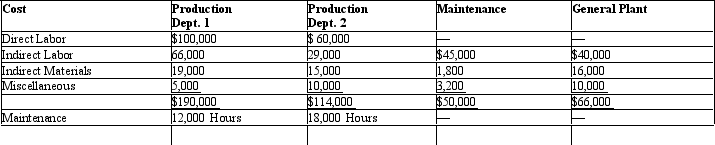 The general plant services the three departments in the following proportions: 50 percent (Department 1);30 percent (Department 2);20 percent (Maintenance).
Required:
Allocate maintenance costs based on maintenance hours.Allocate maintenance department and general plant costs to the production departments.Use the step method,starting with general plant costs.
The general plant services the three departments in the following proportions: 50 percent (Department 1);30 percent (Department 2);20 percent (Maintenance).
Required:
Allocate maintenance costs based on maintenance hours.Allocate maintenance department and general plant costs to the production departments.Use the step method,starting with general plant costs. (Essay)
4.7/5 (83)
(83) What is the third,or final,step in allocating service department costs to production departments?
(Multiple Choice)
4.9/5 (90)
(90) Stephanie Company
Stephanie Company has two production departments: D and J.Stephanie also has 3 service departments: Personnel,Administration,and Shipping.Shipping costs are allocated on the basis of number of packages,while Personnel and Administration costs are allocated using number of employees.Assume that the ranking of the benefits provided is in the order listed below.
 Refer to Stephanie Company.Using the step method,what amount of Personnel costs is allocated to Department J (rounded to the nearest $)?
 (Multiple Choice)
4.9/5 (66)
(66) Which of the following is a reason for using activity-based costing to allocate service department costs?
(Multiple Choice)
4.9/5 (85)
(85) The method of allocating joint costs used when output product prices are highly volatile or when significant processing occurs between the splitoff point and the first point of marketability is called the
(Multiple Choice)
4.9/5 (71)
(71) 
Filters
- Essay(0)
- Multiple Choice(0)
- Short Answer(0)
- True False(0)
- Matching(0)