



 Chat with AI
Exam 6: Accounting for Merchandising Businesses

Exam 1: Introduction to Accounting and Business191 Questions
Exam 2: Analyzing Transactions226 Questions
Exam 3: The Adjusting Process180 Questions
Exam 4: Completing the Accounting Cycle195 Questions
Exam 5: Accounting Systems160 Questions
Exam 6: Accounting for Merchandising Businesses218 Questions
Exam 7: Inventories169 Questions
Exam 8: Sarbanes-Oxley, Internal Control, and Cash177 Questions
Exam 9: Receivables151 Questions
Exam 10: Fixed Assets and Intangible Assets172 Questions
Exam 11: Current Liabilities and Payroll171 Questions
Exam 12: Accounting for Partnerships and Limited Liability Companies192 Questions
Exam 13: Corporations: Organization, Stock Transactions, and Dividends171 Questions
Exam 14: Long-Term Liabilities: Bonds and Notes188 Questions
Exam 15: Investments and Fair Value Accounting133 Questions
Exam 16: Statement of Cash Flows165 Questions
Exam 17: Financial Statement Analysis186 Questions
Select questions type


For each of the following, calculate the cost of inventory reported on the balance sheet.

(Essay)
4.8/5  (85)
(85) As we compare a merchandise business to a service business, the financial statement that changes the most is the Balance Sheet.
(True/False)
4.8/5 (83)
(83) Describe the major differences in preparing the financial statements for a service business and a merchandising business.

(Essay)
4.8/5 (85)
(85) Details of a purchase invoice and related credit memo are summarized as follows:
 Assume that the credit memo was received prior to payment and that the invoice is paid within the discount period. Determine the following:

Assume that the credit memo was received prior to payment and that the invoice is paid within the discount period. Determine the following:
(Essay)
4.8/5 (75)
(75) Who pays the freight costs when the terms are FOB shipping point?
(Multiple Choice)
4.8/5 (72)
(72) Match each of the following definitions with its term.
Correct Answer: Verified
Premises:
Responses:
(Matching)
4.9/5 (81)
(81) A company using the periodic inventory system has the following account balances: Merchandise Inventory at the beginning of the year, $3,600; Freight-In, $650; Purchases, $10,700; Purchases Returns and Allowances, $1,950; Purchases Discounts, $330. The cost of merchandise purchased is equal to
(Multiple Choice)
4.9/5 (82)
(82) Who pays the freight cost when the terms are FOB destination?
(Multiple Choice)
4.8/5 (84)
(84) What is the major difference between a periodic and perpetual inventory system?
(Multiple Choice)
5.0/5 (84)
(84) If the ownership of merchandise passes to the buyer when the seller delivers the merchandise for shipment, the terms are stated as FOB destination.
(True/False)
4.8/5 (73)
(73) Computerized systems can be used to capture accounting information such as accounts receivable, inventory items, accounts payable, and sales.
(True/False)
4.9/5 (84)
(84) Match each of the following terms with the appropriate definition below.
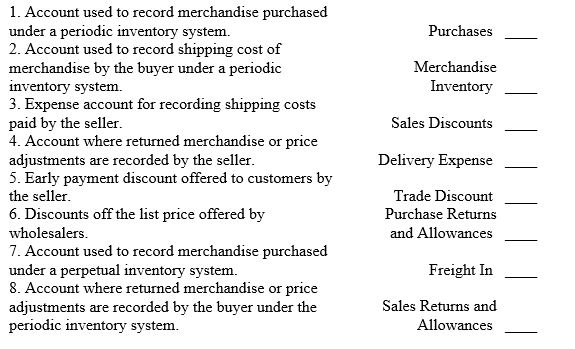
(Essay)
4.8/5 (81)
(81) In a periodic inventory system, the cost of merchandise purchased includes the cost of freight-in.
(True/False)
4.8/5 (76)
(76) Using a perpetual inventory system, the entry to record the return of merchandise purchased on account includes a
(Multiple Choice)
4.9/5 (85)
(85) A business using the perpetual inventory system, with its detailed subsidiary records, does need to take a physical inventory.
(True/False)
4.8/5 (81)
(81) In a perpetual inventory system, merchandise returned to vendors reduces the merchandise inventory account.
(True/False)
4.9/5 (88)
(88) Office salaries, depreciation of office equipment, and office supplies are examples of what type of expense?
(Multiple Choice)
4.8/5 (86)
(86) 
Filters
- Essay(0)
- Multiple Choice(0)
- Short Answer(0)
- True False(0)
- Matching(0)