



 Chat with AI
Exam 6: Thermochemistry: Energy Flow and Chemical Change

Exam 1: Keys to the Study of Chemistry79 Questions
Exam 2: The Components of Matter105 Questions
Exam 3: Stoichiometry of Formulas and Equations87 Questions
Exam 4: The Major Classes of Chemical Reactions124 Questions
Exam 5: Gases and the Kinetic-Molecular Theory115 Questions
Exam 6: Thermochemistry: Energy Flow and Chemical Change85 Questions
Exam 7: Quantum Theory and Atomic Structure83 Questions
Exam 8: Electron Configuration and Chemical Periodicity85 Questions
Exam 9: Models of Chemical Bonding74 Questions
Exam 10: The Shapes of Molecules109 Questions
Exam 11: Theories of Covalent Bonding58 Questions
Exam 12: Intermolecular Forces: Liquids, Solids, and Phase Changes111 Questions
Exam 13: The Properties of Mixtures: Solutions and Colloids105 Questions
Exam 14: Periodic Patterns in the Main Group Elements: Bonding, Structure, and Reactivity118 Questions
Exam 15: Organic Compounds and the Atomic Properties of Carbon118 Questions
Exam 16: Kinetics: Rates and Mechanisms of Chemical Reactions88 Questions
Exam 17: Equilibrium: the Extent of Chemical Reactions104 Questions
Exam 18: Acid-Base Equilibria103 Questions
Exam 19: Ionic Equilibria in Aqueous Systems119 Questions
Exam 20: Thermodynamics: Entropy, Free Energy, and the Direction of Chemical Reactions94 Questions
Exam 21: Electrochemistry: Chemical Change and Electrical Work102 Questions
Exam 22: The Elements in Nature and Industry57 Questions
Exam 23: The Transition Elements and Their Coordination Compounds92 Questions
Exam 24: Nuclear Reactions and Their Applications94 Questions
Select questions type


Given the following data: 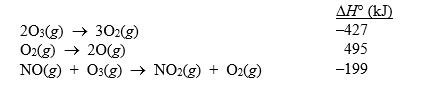 calculate H° for the reaction
NO(g) + O(g) NO2(g)
calculate H° for the reaction
NO(g) + O(g) NO2(g) (Short Answer)
4.8/5  (70)
(70) A system delivers 1275 J of heat while the surroundings perform 855 J of work on it. Calculate E in J.
(Multiple Choice)
4.9/5 (77)
(77) Calculate the enthalpy change for the reaction NO(g) + O(g) NO2(g)
From the following data:
NO(g) + O3(g) NO2(g) + O2(g) H = -198.9 kJ
O3(g) 1.5O2(g) H = -142.3 kJ
O2(g) 2O(g) H = 495.0 kJ
(Multiple Choice)
4.9/5 (89)
(89) Although internal energy (E) is more fundamental and conceptually easier than enthalpy (H), in most chemical applications H is more relevant and useful than E. Why?
(Essay)
4.8/5 (84)
(84) If, as a pioneer, you wished to warm your room by taking an object heated on top of a pot-bellied stove to it, which of the following 15-pound objects, each heated to 100°C, would be the best choice? The specific heat capacity (in J/(g·K)) for each substance is given in parentheses. Iron (0.450), copper (0.387), granite (0.79), gold (0.129), water (4.18).
(Multiple Choice)
4.8/5 (84)
(84) 
Filters
- Essay(0)
- Multiple Choice(0)
- Short Answer(0)
- True False(0)
- Matching(0)