



 Chat with AI
Exam 24: Nuclear Reactions and Their Applications

Exam 1: Keys to the Study of Chemistry79 Questions
Exam 2: The Components of Matter105 Questions
Exam 3: Stoichiometry of Formulas and Equations87 Questions
Exam 4: The Major Classes of Chemical Reactions124 Questions
Exam 5: Gases and the Kinetic-Molecular Theory115 Questions
Exam 6: Thermochemistry: Energy Flow and Chemical Change85 Questions
Exam 7: Quantum Theory and Atomic Structure83 Questions
Exam 8: Electron Configuration and Chemical Periodicity85 Questions
Exam 9: Models of Chemical Bonding74 Questions
Exam 10: The Shapes of Molecules109 Questions
Exam 11: Theories of Covalent Bonding58 Questions
Exam 12: Intermolecular Forces: Liquids, Solids, and Phase Changes111 Questions
Exam 13: The Properties of Mixtures: Solutions and Colloids105 Questions
Exam 14: Periodic Patterns in the Main Group Elements: Bonding, Structure, and Reactivity118 Questions
Exam 15: Organic Compounds and the Atomic Properties of Carbon118 Questions
Exam 16: Kinetics: Rates and Mechanisms of Chemical Reactions88 Questions
Exam 17: Equilibrium: the Extent of Chemical Reactions104 Questions
Exam 18: Acid-Base Equilibria103 Questions
Exam 19: Ionic Equilibria in Aqueous Systems119 Questions
Exam 20: Thermodynamics: Entropy, Free Energy, and the Direction of Chemical Reactions94 Questions
Exam 21: Electrochemistry: Chemical Change and Electrical Work102 Questions
Exam 22: The Elements in Nature and Industry57 Questions
Exam 23: The Transition Elements and Their Coordination Compounds92 Questions
Exam 24: Nuclear Reactions and Their Applications94 Questions
Select questions type


Write a complete, balanced equation to represent the electron capture decay of argon-37.
(Essay)
4.9/5  (77)
(77) Explain how the number of protons and neutrons in a radioactive nucleus can be used to predict its probable mode of decay. Illustrate your answer with a schematic graph, properly labeled, showing stable nuclides (nuclei) in relation to number of protons and neutrons.
(Essay)
4.9/5 (71)
(71) Positron decay and electron capture have the same net effect on the Z and N values of a nucleus.
(True/False)
4.9/5 (92)
(92) After 4 half-lives, the fraction of a radioactive isotope which still remains is approximately one-eighth.
(True/False)
5.0/5 (76)
(76) A 55-kg person exposed to thorium-234 receives 7.5 × 10⁴ particles, each with an energy of 1.6 × 10⁻¹⁴ J. How many rads does the person receive?
(Multiple Choice)
4.7/5 (77)
(77) Which one of the following equations correctly represents electron capture by the  nucleus?
 (Multiple Choice)
4.9/5 (74)
(74) No alpha decay is observed for isotopes of elements with Z < 83.
(True/False)
4.8/5 (89)
(89) The isotopes  and
 are all stable, while
 is radioactive. The mode of decay for
 is most likely to be
and are all stable, while is radioactive. The mode of decay for is most likely to be (Multiple Choice)
4.9/5 (76)
(76) The isotopes of promethium,  and
 are unstable, and lie on opposite sides of the "line of stability". Which of the following combinations is most likely to represent the type of decay for these isotopes?
and are unstable, and lie on opposite sides of the "line of stability". Which of the following combinations is most likely to represent the type of decay for these isotopes? (Multiple Choice)
4.9/5 (65)
(65) The isotopes  are all stable, while
 is radioactive. The mode of decay for
 is most likely to be
are all stable, while is radioactive. The mode of decay for is most likely to be (Multiple Choice)
4.8/5 (80)
(80) Which one of the following nuclei has a magic number of neutrons and/or protons?
(Multiple Choice)
5.0/5 (85)
(85) The s-process involves a slow succession of neutron absorption and beta decay processes during the normal life of a star.
(True/False)
4.8/5 (67)
(67) Cesium-134 is a emitter with a half-life of 2.0 years. How much of a 2.50-g sample of cesium-134 will remain after 10 years?
(Multiple Choice)
4.9/5 (76)
(76) Fill in missing sub- and superscripts for all particles to complete the following equation for beta decay. 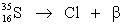
(Essay)
4.8/5 (72)
(72) Select the nuclide that completes the following nuclear reaction. 
(Multiple Choice)
4.8/5 (87)
(87) 
Filters
- Essay(0)
- Multiple Choice(0)
- Short Answer(0)
- True False(0)
- Matching(0)