



 Chat with AI
Exam 9: Models of Chemical Bonding

Exam 1: Keys to the Study of Chemistry79 Questions
Exam 2: The Components of Matter105 Questions
Exam 3: Stoichiometry of Formulas and Equations87 Questions
Exam 4: The Major Classes of Chemical Reactions124 Questions
Exam 5: Gases and the Kinetic-Molecular Theory115 Questions
Exam 6: Thermochemistry: Energy Flow and Chemical Change85 Questions
Exam 7: Quantum Theory and Atomic Structure83 Questions
Exam 8: Electron Configuration and Chemical Periodicity85 Questions
Exam 9: Models of Chemical Bonding74 Questions
Exam 10: The Shapes of Molecules109 Questions
Exam 11: Theories of Covalent Bonding58 Questions
Exam 12: Intermolecular Forces: Liquids, Solids, and Phase Changes111 Questions
Exam 13: The Properties of Mixtures: Solutions and Colloids105 Questions
Exam 14: Periodic Patterns in the Main Group Elements: Bonding, Structure, and Reactivity118 Questions
Exam 15: Organic Compounds and the Atomic Properties of Carbon118 Questions
Exam 16: Kinetics: Rates and Mechanisms of Chemical Reactions88 Questions
Exam 17: Equilibrium: the Extent of Chemical Reactions104 Questions
Exam 18: Acid-Base Equilibria103 Questions
Exam 19: Ionic Equilibria in Aqueous Systems119 Questions
Exam 20: Thermodynamics: Entropy, Free Energy, and the Direction of Chemical Reactions94 Questions
Exam 21: Electrochemistry: Chemical Change and Electrical Work102 Questions
Exam 22: The Elements in Nature and Industry57 Questions
Exam 23: The Transition Elements and Their Coordination Compounds92 Questions
Exam 24: Nuclear Reactions and Their Applications94 Questions
Select questions type


Arrange aluminum, nitrogen, phosphorus, and indium in order of increasing electronegativity.
(Multiple Choice)
5.0/5  (69)
(69) In which of these substances are the atoms held together by polar covalent bonding?
(Multiple Choice)
4.9/5 (88)
(88) Arrange the following bonds in order of increasing bond strength.
(Multiple Choice)
4.9/5 (88)
(88) In which of these substances are the atoms held together by metallic bonding?
(Multiple Choice)
4.8/5 (79)
(79) Select the correct formula for a compound formed from barium and nitrogen.
(Multiple Choice)
4.7/5 (77)
(77) Arrange calcium, rubidium, sulfur, and arsenic in order of decreasing electronegativity.
(Multiple Choice)
4.8/5 (84)
(84) Using the bond energies provided below, calculate H° for the reaction CH4(g) + 4Cl2(g) CCl4(g) + 4HCl(g)
Bond energies: C-H = 413 kJ/mol, Cl-Cl = 243 kJ/mol, C-Cl = 339 kJ/mol, H-Cl = 427 kJ/mol
(Multiple Choice)
4.9/5 (78)
(78) The diameter of a chloride ion is 362 pm, and the diameter of a potassium ion is 276 pm. What is the distance between the nuclei of adjacent chloride and potassium ions in solid potassium chloride?
(Multiple Choice)
4.9/5 (77)
(77) The lattice energy of rubidium chloride is the energy change accompanying the process
Rb+(g) + Cl-(g) RbCl(s)
Calculate the lattice energy of RbCl using the following data: 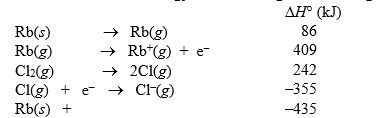
 Cl2(g) RbCl(s)
 (Short Answer)
4.8/5 (88)
(88) The majority of elements are good electrical conductors when in solid form.
(True/False)
4.7/5 (69)
(69) The lattice energy of CaF2 is the energy change for which one, if any, of the following processes?
(Multiple Choice)
4.9/5 (70)
(70) Analysis of an unknown substance showed that it has a high boiling point and is brittle. It is an insulator as a solid but conducts electricity when melted. Which of the following substances would have those characteristics?
(Multiple Choice)
4.7/5 (79)
(79) The electrostatic energy of two charged particles is inversely proportional to the square of the distance between them.
(True/False)
4.9/5 (69)
(69) Combustion of a fat will release more energy than combustion of an equal mass of carbohydrate because
(Multiple Choice)
4.9/5 (90)
(90) Bond energy increases as bond order increases, for bonding between a given pair of atoms.
(True/False)
4.8/5 (82)
(82) For which of the following elements (in their normal, stable, forms) would it be correct to describe the bonding as involving "electron pooling"?
(Multiple Choice)
4.8/5 (72)
(72) Covalently bonded substances do not necessarily exist as separate molecules.
(True/False)
4.9/5 (89)
(89) Calculate the lattice energy of magnesium sulfide from the data given below.
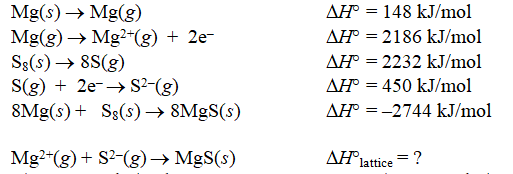 A) -3406 kJ/mol
B) -2720. kJ/mol
C) 2720. kJ/mol
D)3406 kJ/mol
E)none of the above
A) -3406 kJ/mol
B) -2720. kJ/mol
C) 2720. kJ/mol
D)3406 kJ/mol
E)none of the above (Not Answered)
This question doesn't have any answer yet

Filters
- Essay(0)
- Multiple Choice(0)
- Short Answer(0)
- True False(0)
- Matching(0)