



 Chat with AI
Exam 17: Costing Systems: Process Costing

Exam 1: Uses of Accounting Information and the Financial Statements178 Questions
Exam 2: Measurement Concepts: Recording Business Transactions139 Questions
Exam 3: Measuring Business Income: Adjusting the Accounts168 Questions
Exam 4: Foundations of Financial Reporting and the Classified Balance Sheet130 Questions
Exam 5: Accounting for Merchandising Operations177 Questions
Exam 6: Inventories162 Questions
Exam 7: Cash and Internal Control141 Questions
Exam 8: Receivables111 Questions
Exam 9: Long-Term Assets227 Questions
Exam 10: Current Liabilities and Fair Value Accounting179 Questions
Exam 11: Long-Term Liabilities200 Questions
Exam 12: Stockholders Equity196 Questions
Exam 13: The Statement of Cash Flows147 Questions
Exam 14: Financial Statement Analysis164 Questions
Exam 15: Managerial Accounting and Cost Concepts199 Questions
Exam 16: Costing Systems: Job Order Costing121 Questions
Exam 17: Costing Systems: Process Costing139 Questions
Exam 18: Value-Based Systems: Activity-Based Costing and Lean Accounting146 Questions
Exam 19: Cost-Volume-Profit Analysis167 Questions
Exam 20: The Budgeting Process113 Questions
Exam 21: Flexible Budgets and Performance Analysis116 Questions
Exam 22: Standard Costing and Variance Analysis118 Questions
Exam 23: Short-Run Decision Analysis128 Questions
Exam 24: Capital Investment Analysis106 Questions
Exam 25: Pricing Decisions, including Target Costing and Transfer Pricing139 Questions
Exam 26: Quality Management and Measurement101 Questions
Exam 27: Accounting for Unincorporated Businesses106 Questions
Exam 28: Accounting for Investments112 Questions
Select questions type


The basis used in computing equivalent unit cost under process costing system is made up of certain specific jobs worked on during the fiscal year.
(True/False)
4.8/5  (85)
(85) Stephen Company uses the FIFO method in its process costing system.Beginning inventory in the mixing department consisted of 5,000 units that were 65 percent complete with respect to conversion costs.Ending work in process inventory consisted of 5,000 units that were 70 percent complete with respect to conversion costs.If 12,000 units were transferred to the next processing department during the period,the equivalent units for conversion costs would be
(Multiple Choice)
4.9/5 (76)
(76) Under the FIFO costing method,separate unit cost analyses are not used for each accounting period because costs of different periods are averaged.
(True/False)
4.8/5 (86)
(86) In a process cost report,accounting for physical units excludes the physical units in beginning inventory to arrive at "units to be accounted for."
(True/False)
4.9/5 (78)
(78) In a process costing system,some of the increases to Department C's Work in Process Inventory account would come from Department B's
(Multiple Choice)
4.9/5 (86)
(86) The following unit data were assembled for the heating process of Morgan Processing Inc.for the month of August.Direct materials are added at the beginning of the process.Conversion costs are added uniformly over the production process.The company uses the FIFO process costing method.  -The number of equivalent units produced by Morgan Processing with respect to conversion costs is
 (Multiple Choice)
4.8/5 (74)
(74) Use the following data of Daylight Incorporation,a company using a process costing system,to answer the questions below. 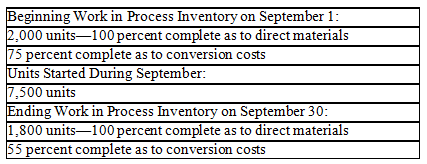 -The company uses average process costing method.
Equivalent units for conversion costs of Daylight during the month totaled
-The company uses average process costing method.
Equivalent units for conversion costs of Daylight during the month totaled (Multiple Choice)
4.8/5 (66)
(66) Information for the current month for the Polishing Department is shown below.  Direct materials are added at the beginning of the process.Beginning work in process is 30 percent complete as to conversion costs;ending work in process inventory is 80 percent complete.Determine the cost of ending work in process inventory.
 (Multiple Choice)
4.8/5 (77)
(77) Blackwell Corporation uses a process costing system and has just completed production for the month of December 2014.The following production data were obtained from the accounting records:
a.Units in beginning inventory totaled 9,000 and were 80 percent complete as of December 1 (all direct materials were added to these products in the preceding month).
b.During the period,216,000 units were started.
c.17,400 units were partially completed as of December 31,2014.
d.Ending work in process inventory was 100 percent complete with respect to direct materials and 70 percent complete with respect to conversion costs at month end.
Using the information provided,compute the equivalent units of production for direct materials and conversion costs for the month ended December 31,2014,assuming a FIFO costing flow.
(Essay)
4.8/5 (89)
(89) Several Work in Process Inventory accounts are used in a process costing system.
(True/False)
4.9/5 (78)
(78) During October,Department A of Answer Inc.started 320,000 units of product in a particular manufacturing process.The beginning work in process inventory was 50,000 units,and the ending inventory was 30,000 units.Direct materials are introduced at the start of processing,and beginning and ending inventories are considered to be 50 percent complete with respect to conversion costs.Department A uses the FIFO costing method.
-The number of units started and completed by department A of Answer during October was
(Multiple Choice)
4.8/5 (74)
(74) Which of the following cost flow assumptions most closely follows the logical product flow in a process costing environment?
(Multiple Choice)
4.8/5 (73)
(73) In a process costing system,the average costing method assumes that cost flows mirror the logical physical flow of production.
(True/False)
4.7/5 (85)
(85) How are costs recognized,matched,and measured in a process costing system?
(Essay)
4.9/5 (70)
(70) Trunkey Products Inc.uses a process costing system and has just completed production for the month of November 2014.The following production data were obtained from the accounting records:
a.Units in beginning inventory totaled 6,800 and were 30 percent complete as of November 1 (all direct materials were added to these products in the preceding month).
b.During the period,156,200 units were started.
c.19,200 units were partially completed as of November 30,2014.
d.Ending work in process inventory was 40 percent complete at month end.
From the data given,compute the equivalent units of production for direct materials and conversion costs for the month ended November 30,2014,assuming the company follows average costing method.
(Essay)
4.9/5 (83)
(83) One reason for preparing a process cost report for a particular department is to determine the amount of costs to transfer to the next department or to the Finished Goods Inventory account at the end of the period.
(True/False)
4.7/5 (77)
(77) Once the products are completed,packaged,and ready for sale,their costs are transferred
to the Finished Goods Inventory account.
(True/False)
4.9/5 (81)
(81) Total conversion costs for the period include direct materials,direct labor,and overhead.
(True/False)
4.7/5 (87)
(87) Use the following information to perform the calculations requested below,assuming that the FIFO costing approach to a process costing system is being used.
Beginning work in process inventory: 6,000 units,100 percent complete as to direct materials,75 percent complete as to conversion costs
Ending work in process inventory: 18,000 units,100 percent complete as to direct materials,65 percent complete as to conversion costs
Units started during the month: 44,000
a.Calculate units started and completed during the month.
b.Calculate units to be accounted for during the month.
c.Calculate equivalent units for conversion costs.
d.Calculate equivalent units for direct materials.

(Essay)
5.0/5 (81)
(81) Which of the following is not a characteristic of a process costing system?
(Multiple Choice)
4.7/5 (73)
(73) 
Filters
- Essay(0)
- Multiple Choice(0)
- Short Answer(0)
- True False(0)
- Matching(0)