



 Chat with AI
Exam 5: Accounting for Merchandising Operations

Exam 1: Uses of Accounting Information and the Financial Statements178 Questions
Exam 2: Measurement Concepts: Recording Business Transactions139 Questions
Exam 3: Measuring Business Income: Adjusting the Accounts168 Questions
Exam 4: Foundations of Financial Reporting and the Classified Balance Sheet130 Questions
Exam 5: Accounting for Merchandising Operations177 Questions
Exam 6: Inventories162 Questions
Exam 7: Cash and Internal Control141 Questions
Exam 8: Receivables111 Questions
Exam 9: Long-Term Assets227 Questions
Exam 10: Current Liabilities and Fair Value Accounting179 Questions
Exam 11: Long-Term Liabilities200 Questions
Exam 12: Stockholders Equity196 Questions
Exam 13: The Statement of Cash Flows147 Questions
Exam 14: Financial Statement Analysis164 Questions
Exam 15: Managerial Accounting and Cost Concepts199 Questions
Exam 16: Costing Systems: Job Order Costing121 Questions
Exam 17: Costing Systems: Process Costing139 Questions
Exam 18: Value-Based Systems: Activity-Based Costing and Lean Accounting146 Questions
Exam 19: Cost-Volume-Profit Analysis167 Questions
Exam 20: The Budgeting Process113 Questions
Exam 21: Flexible Budgets and Performance Analysis116 Questions
Exam 22: Standard Costing and Variance Analysis118 Questions
Exam 23: Short-Run Decision Analysis128 Questions
Exam 24: Capital Investment Analysis106 Questions
Exam 25: Pricing Decisions, including Target Costing and Transfer Pricing139 Questions
Exam 26: Quality Management and Measurement101 Questions
Exam 27: Accounting for Unincorporated Businesses106 Questions
Exam 28: Accounting for Investments112 Questions
Select questions type


The following items represent a classification scheme for a multistep income statement. write the letter for each account to indicate to which category it belongs.
Correct Answer: Verified
Premises:
Responses:
(Matching)
4.8/5  (63)
(63) The calculation of cost of goods available for sale during the year is not affected by the previous year's ending merchandise inventory.
(True/False)
4.8/5 (71)
(71) On the income statement,freight-out is included as part of cost of goods sold.
(True/False)
4.7/5 (63)
(63) Companies that sell goods that have a high unit value tend to use the perpetual inventory system.
(True/False)
4.9/5 (84)
(84) Given the following information,prepare in good form the cost of goods sold section of an income statement for 20x5.

(Essay)
4.9/5 (80)
(80) Under the perpetual inventory system,the purchase of merchandise is recorded with a debit to Purchases.
(True/False)
4.9/5 (91)
(91) When the buyer bears the transportation charge,it is called freight-out.
(True/False)
4.8/5 (72)
(72) Using the following information,calculate for 20x5 (a)net sales, (b)cost of goods sold, (c)gross margin,and (d)net income.
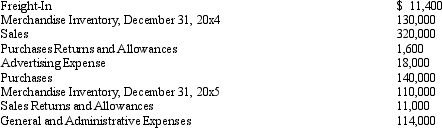
(Essay)
4.8/5 (74)
(74) Adding together the ending merchandise inventory and cost of goods sold gives the cost of goods available for sale.
(True/False)
4.8/5 (72)
(72) The collection of a $2,000 account beyond the 2 percent discount period would result in a(n)
(Multiple Choice)
4.9/5 (90)
(90) Wolf Equipment uses a perpetual inventory method.Discuss how Wolf Equipment accounts for freight-in and freight-out.
(Essay)
4.8/5 (83)
(83) Under the periodic inventory system,the amount for inventory on hand is accurate only on the balance sheet date.
(True/False)
4.9/5 (86)
(86) Distinguish between the cost of goods available for sale and the cost of goods sold.
(Essay)
5.0/5 (73)
(73) Cost of Goods Sold would not be found on a single-step income statement.
(True/False)
5.0/5 (87)
(87) Upon making a credit card sale,a business should record the sale as an accounts receivable until the customer pays his or her credit card bill.
(True/False)
4.9/5 (82)
(82) A purchase on account with an invoice price of $1,500 has been made.The entry to record the payment after the 2 percent discount period would include a(n)
(Multiple Choice)
4.9/5 (77)
(77) 
Filters
- Essay(0)
- Multiple Choice(0)
- Short Answer(0)
- True False(0)
- Matching(0)