



 Chat with AI
Exam 5: Birth, Death and Movement

Exam 1: Ecology and How to Do It50 Questions
Exam 2: Ecology’s Evolutionary Backdrop50 Questions
Exam 3: Physical Conditions and the Availability of Resources50 Questions
Exam 4: Climate and the World’s Biomes50 Questions
Exam 5: Birth, Death and Movement50 Questions
Exam 6: Interspecific Competition50 Questions
Exam 7: Predation, Grazing and Disease50 Questions
Exam 8: Molecular and Evolutionary Ecology50 Questions
Exam 9: From Populations to Communities50 Questions
Exam 10: Patterns in Species Richness50 Questions
Exam 11: The Flux of Energy and Matter Through Ecosystems50 Questions
Exam 12: Global Biogeochemical Cycles and Their Alteration by Humans50 Questions
Exam 13: Conservation Ecology51 Questions
Exam 14: The Ecology of Human Population Growth, Disease, and Food Supply51 Questions
Select questions type


Using Table 5.2,what is one potential explanation as to why mx (proportion of female young produced per surviving individual in each class)decreases from age class 8 to 15? 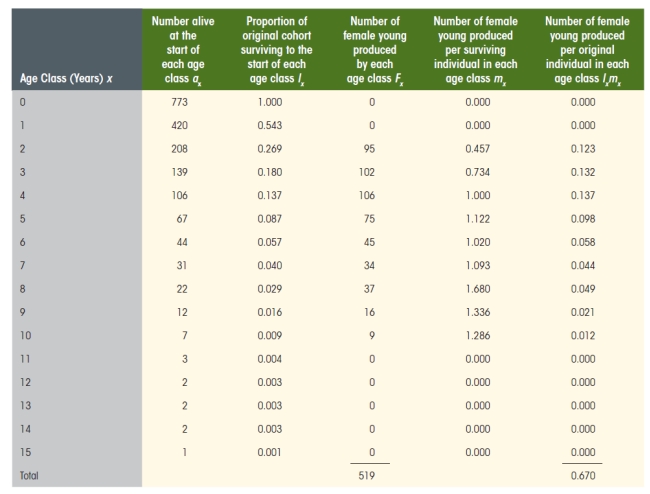
(Multiple Choice)
4.8/5  (84)
(84) In Figure 5.11a,how many years pass for a cohort before greater than 50 percent of the cohort is lost? 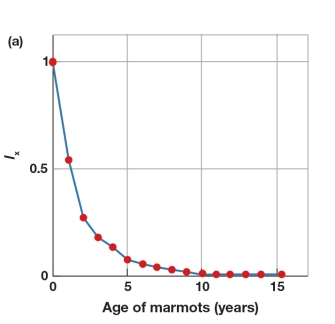
(Multiple Choice)
4.8/5 (92)
(92) If you were studying the life history of a population of howler monkeys in Costa Rica,the survivorship curve would look most like Type _______.
(Multiple Choice)
5.0/5 (76)
(76) __________ denotes a populations intrinsic rate of natural increase.
(Multiple Choice)
4.9/5 (72)
(72) In a mark and recapture study you initially collect 50 frogs.You mark and release those 50 and plan to collect again in another week.The following week you collect 50 frogs and 10 of them are from your previous mark and recapture.How large would you estimate the population to be?
(Multiple Choice)
4.8/5 (79)
(79) This multicellular outgrowth is the product of a modular organism.It will proceed through its own life cycle,and its development will be indeterminate.This growth is known as which of the following terms?
(Multiple Choice)
4.8/5 (95)
(95) An organism that has indeterminate development and grows by the repeated production of modules is defined as which type of organism?
(Multiple Choice)
4.9/5 (78)
(78) You are studying salamanders to test if offspring fitness is affected by the number of eggs a female oviposits.What you learn is that females that lay more eggs produce smaller offspring.This is an example of ________ and means that there is __________ to high reproductive output for these salamanders.
(Multiple Choice)
4.7/5 (85)
(85) Using Table 5.2,how would you describe the trend in l (proportion of original cohort surviving to the start of each age class)as a function of age class? 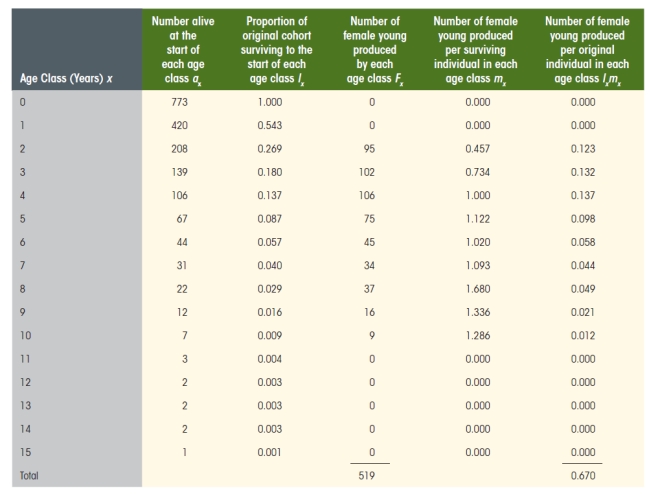
(Multiple Choice)
4.9/5 (82)
(82) Which organism completes its entire life cycle in a single year?
(Multiple Choice)
4.7/5 (82)
(82) If R0 were calculated as 0.88 for a population of desert mice,what would this imply?
(Multiple Choice)
4.9/5 (84)
(84) Which of the following choices best describes an iteroparous organism?
(Multiple Choice)
4.8/5 (67)
(67) A perennial plant (Sparaxus grandiflora)must invest resources differently when it starts to enter a reproductive stage.Which of the following choices explains how a perennial plant may deal with this?
(Multiple Choice)
5.0/5 (80)
(80) Based on Figure 5.11,at what age group do marmots appear to experience the lowest risk of mortality? 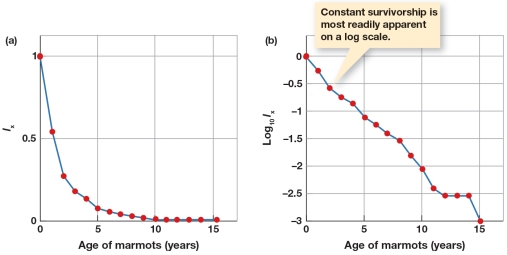
(Multiple Choice)
4.9/5 (81)
(81) According to Figure 5.5,which of the following statements is accurate about the perennial Sparaxis grandiflora found in South Africa? 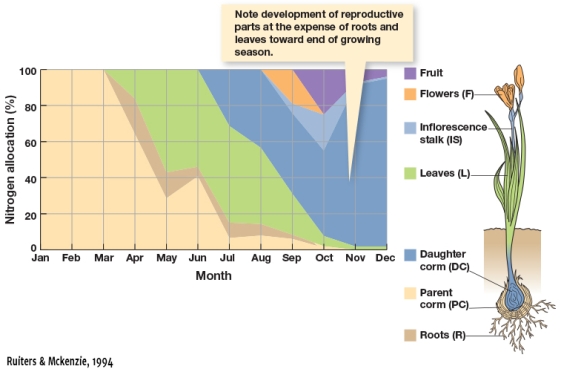
(Multiple Choice)
4.7/5 (68)
(68) You have been researching species of bacteria found in the rocky intertidal zone.These bacteria are likely __________ because they live in a disturbed habitat,reproduce quickly,and invest little energy in growth or development.
(Multiple Choice)
4.8/5 (103)
(103) 
Filters
- Essay(0)
- Multiple Choice(0)
- Short Answer(0)
- True False(0)
- Matching(0)