



 Chat with AI
Exam 4: Activity-Based Costing

Exam 1: Introduction to Cost Management157 Questions
Exam 2: Basic Cost Management Concepts201 Questions
Exam 3: Cost Behavior200 Questions
Exam 4: Activity-Based Costing201 Questions
Exam 5: Product and Service Costing: Job-Order System150 Questions
Exam 6: Process Costing188 Questions
Exam 7: Allocating Costs of Support Departments and Joint Products173 Questions
Exam 8: Budgeting for Planning and Control Key200 Questions
Exam 9: Standard Costing: a Functional-Based Control Approach123 Questions
Exam 10: Decentralization: Responsibility Accounting, Performance Evaluation, and Transfer Pricing139 Questions
Exam 11: Strategic Cost Management151 Questions
Exam 12: Activity-Based Management146 Questions
Exam 13: The Balanced Scorecard: Strategic-Based Control124 Questions
Exam 14: Quality and Environmental Cost Management202 Questions
Exam 15: Lean Accounting and Productivity Measurement172 Questions
Exam 16: Cost-Volume-Profit Analysis138 Questions
Exam 17: Activity Resource Usage Model and Tactical Decision Making128 Questions
Exam 18: Pricing and Profitability Analysis164 Questions
Exam 19: Capital Investment126 Questions
Exam 20: Inventory Management: Economic Order Quantity, Jit, and the Theory of Constraints127 Questions
Select questions type


Non-unit-based drivers are factors that measure the demands that cost objects place on activities.
(True/False)
4.9/5  (67)
(67) Figure 4-22 The Wellness Clinic is considering a time-driven activity based costing system. Given the following data:
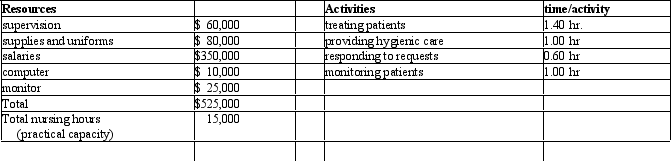 Refer to Figure 4-22. What is the activity rate for responding to requests?
 (Multiple Choice)
5.0/5 (92)
(92) Figure 4-5 The Brookstone Company produces 9 volt batteries and AAA batteries. The Brookstone Company uses a plantwide rate to apply overhead based on direct labor hours. The following data is given:
 Refer to Figure 4-5. How much overhead is applied to each 9 volt batteries and AAA batteries respectively? (round to 2 decimal places)
 (Multiple Choice)
4.7/5 (81)
(81) In a time-driven ABC system, once the managers determine the cost of per time unit of supplying resources to activities, the next step would be
(Multiple Choice)
4.8/5 (87)
(87) Figure 4-21 Appleby Manufacturing uses an activity-based costing system. The company produces Model F and Model G. Information relating to the two products is as follows:  The following overhead costs are reported for the following activities of the production process:
 Jones manufacturing has used activity based costing to assign costs to Models F and G as given in the table below:
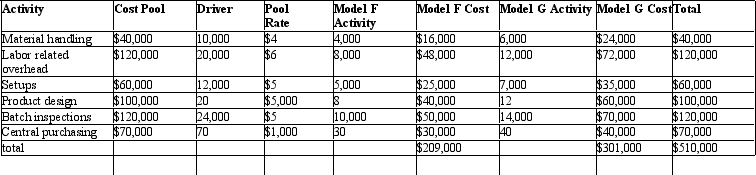 Appleby Manufacturing wants to implement an approximately relevant ABC system by using the two most expensive activities for cost assignment.
Refer to Figure 4-21. Under the equally accurate reduced ABC system, using consumption ratios for labor related and batch inspections, the overhead assigned to labor related activities would be? (round to 5 decimal places)
The following overhead costs are reported for the following activities of the production process:
Jones manufacturing has used activity based costing to assign costs to Models F and G as given in the table below:
Appleby Manufacturing wants to implement an approximately relevant ABC system by using the two most expensive activities for cost assignment.
Refer to Figure 4-21. Under the equally accurate reduced ABC system, using consumption ratios for labor related and batch inspections, the overhead assigned to labor related activities would be? (round to 5 decimal places) (Multiple Choice)
4.9/5 (91)
(91) Figure 4-5 The Brookstone Company produces 9 volt batteries and AAA batteries. The Brookstone Company uses a plantwide rate to apply overhead based on direct labor hours. The following data is given:
 Refer to Figure 4-5. How much was overhead over/underapplied?
 (Multiple Choice)
4.7/5 (76)
(76) In the __________ ABC systems, managers directly estimate the resource demands imposed by each product.
or
(Short Answer)
5.0/5 (84)
(84) The proportion of an overhead activity consumed by a product is the __________ ratio.
(Short Answer)
4.9/5 (72)
(72) The activity that aids management in achieving objectives such as product or customer costing, continuous improvement and environmental management is called:
(Multiple Choice)
4.9/5 (66)
(66) Figure 4-18 Marion Manufacturing uses an activity-based costing system. The company produces Model X and Model Y. Information relating to the two products is as follows:
 The following costs are reported:
 Refer to Figure 4-18. Setups would be classified as a
The following costs are reported:
Refer to Figure 4-18. Setups would be classified as a (Multiple Choice)
4.8/5 (84)
(84) The following information is provided for the year:  If normal costing is used, the amount of overhead applied for the year is
 (Multiple Choice)
4.8/5 (78)
(78) If activity-based costing is used, electricity usage would be an example of a
(Multiple Choice)
4.9/5 (87)
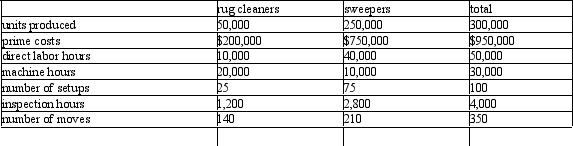
(87) Figure 4-10 The Manoli Company has collected the following data for use in calculating product costs:
Activity Data: (expected and actual)
 Departmental Data: (expected and actual)
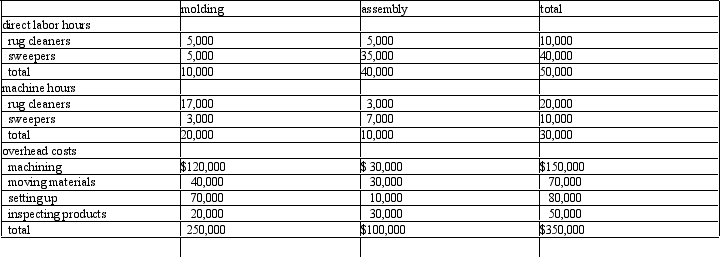 Refer to Figure 4-10. What is the unit product cost for rug cleaners using activity based costing?
Departmental Data: (expected and actual)
Refer to Figure 4-10. What is the unit product cost for rug cleaners using activity based costing? (Multiple Choice)
4.8/5 (86)
(86) Which is NOT a characteristic of a unit-based costing system?
(Multiple Choice)
4.8/5 (86)
(86) A department that is capital-intensive most likely would use a predetermined departmental overhead rate based on which of the following activity bases?
(Multiple Choice)
4.9/5 (78)
(78) Figure 4-20 Quasi-Tech Corporation produces specially machined parts. The parts are produced in batches in one continuous manufacturing process. Each part is custom produced and requires special engineering design activity (based on customer specifications). Once the design is completed, the equipment can be set up for batch production. Once the batch is completed, a sample is taken and inspected to see if the parts are within the tolerances allowed. Thus, the manufacturing process has four activities: engineering, setups, machining, and inspecting. Costs have been assigned to each activity using direct tracing and resource drivers:
 Owens produces two models: Model X and Model Y. The following table shows how the two products consume activity.
 Refer to Figure 4-20. How much overhead is assigned to Model D using the 4 activity drivers?
Owens produces two models: Model X and Model Y. The following table shows how the two products consume activity.
Refer to Figure 4-20. How much overhead is assigned to Model D using the 4 activity drivers? (Multiple Choice)
4.9/5 (80)
(80) Figure 4-8 Tandem Company manufactures two products (D and F). The overhead costs ($84,000) have been divided into three cost pools that use the following activity drivers:
 Refer to Figure 4-8. What is the allocation rate per setup using activity-based costing?
 (Multiple Choice)
4.8/5 (88)
(88) Figure 4-4 Mannitou Company made the following predictions for 2014:
 Job A2 (which was started and completed in June) used 3,000 direct labor hours, 2,000 machine hours, and $57,000 of prime costs.
Refer to Figure 4-4. If factory overhead is applied based on direct labor hours, the cost of Job A2 for the Mannitou Company is
Job A2 (which was started and completed in June) used 3,000 direct labor hours, 2,000 machine hours, and $57,000 of prime costs.
Refer to Figure 4-4. If factory overhead is applied based on direct labor hours, the cost of Job A2 for the Mannitou Company is (Multiple Choice)
4.8/5 (78)
(78) Figure 4-11 Longview Manufacturing Company manufactures two products (I and II). The overhead costs ($58,000) have been divided into three cost pools that use the following activity drivers:
 Refer to Figure 4-11. Using functional-based costing, what is the amount of overhead cost to be assigned to Product II using labor hours as the allocation base?
 (Multiple Choice)
4.8/5 (79)
(79) 
Filters
- Essay(0)
- Multiple Choice(0)
- Short Answer(0)
- True False(0)
- Matching(0)